Skip to content
You can now search across every topic, entity and event.What's new
US Midterms 2026
7SEP

DeSantis Times Map to SCOTUS Ruling

2 min read
13:32UTC

Florida's redistricting session opens Monday, timed so that a Supreme Court ruling narrowing the Voting Rights Act could clear the legal path before maps are finalised.

PoliticsDeveloping
Key takeaway

Florida's redistricting session is timed to exploit a potential SCOTUS ruling weakening the Voting Rights Act.

Florida's redistricting special session opens Monday 20 April and runs through Friday 24 April. Republicans hold 20 of 28 congressional seats and are targeting three to five more. The session date aligns with the state's candidate filing deadline, creating an extremely tight operational window: any new map must be enacted before filings close on 24 April.

MultiState reported on 6 April that Governor Ron DeSantis is deliberately awaiting the Supreme Court's ruling in Louisiana v. Callais before finalising the map 1. Callais tests whether Section 2 of the Voting Rights Act still requires majority-minority congressional districts. A ruling narrowing Section 2 would remove the primary legal constraint on the Florida gerrymander.

DeSantis scheduled the session in a window where the Callais ruling could arrive. If it does, the map has a cleaner path through both state and federal courts. Florida's Supreme Court is DeSantis-aligned, reducing near-term state court challenge prospects. Federal Fair Districts litigation is expected but operates on a slower timeline. The asymmetry persists: Republican redistricting is proceeding faster than Democratic equivalents.

Deep Analysis

In plain English

Redistricting is the process of drawing the boundaries of congressional districts, which determines how many seats each party is likely to win. This normally happens once every 10 years after the census. Florida's Republicans are attempting a mid-decade redraw , outside the normal cycle , to gain more seats. Governor Ron DeSantis called a special legislative session for 20-24 April to draw new maps. He is deliberately waiting to see how the Supreme Court rules in a case called Louisiana v. Callais, which will decide whether the Voting Rights Act still requires states to create some congressional districts where Black or Hispanic voters form a majority. If the court weakens that requirement, Florida can draw maps that reduce minority representation, which would likely produce more Republican-leaning seats. The state's filing deadline for candidates is also 24 April , the same day the session ends. Any new map must be drawn before that deadline for it to apply to the November 2026 election.

Deep Analysis
Root Causes

Florida's redistricting acceleration exploits two structural asymmetries.

First, the VRA Section 2 legal uncertainty created by the Callais case: the existing constraint on 'packing and cracking' majority-minority districts has been the primary obstacle to maximising Republican map advantages in Florida. Waiting for Callais before finalising the map is rational risk management , enacting a map under ambiguous law rather than waiting for clarity is the risk of the sequence reversed.

Second, Florida's court alignment: the state Supreme Court, with DeSantis-appointed justices forming the majority, has already indicated its orientation on redistricting in prior cases. Federal challenge is the only realistic legal path, and federal Fair Districts litigation operates on a timeline (18-36 months) that will not resolve before November 2026 regardless of when the map is enacted.

What could happen next?
  • Consequence

    If the Callais ruling narrows VRA Section 2 before 24 April, Florida can enact a map targeting 3-5 additional Republican seats with reduced legal exposure , a net swing of 3-5 in the Republican column that partially offsets the Democratic gains being projected from the broader wave environment.

  • Risk

    A map enacted before Callais arrives carries higher federal court exposure and may require a third redistricting cycle if the SCOTUS decision creates new standards the pre-Callais map violates.

First Reported In

Update #2 · First votes exceed every forecast

MultiState· 12 Apr 2026
Read original
Causes and effects
Different Perspectives
New Hampshire student voters
Students who hold no accepted photo ID under HB 323 cannot vote in the 8 September primary after Judge Laplante declined to block the law on timing grounds. Whether the same rule applies on 3 November is still open.
Alaska Democratic Party
The Alaska Democratic Party moved $884,835 in coordinated spending to Mary Peltola between 17 and 30 July, more than the DCCC spent nationally in the same fortnight.
National Republican Senatorial Committee
The NRSC, which sued to remove coordinated-spending caps in NRSC v. FEC, put $2,230,472 behind candidates in the first complete month after winning that case, more than double the total for the prior six months combined.
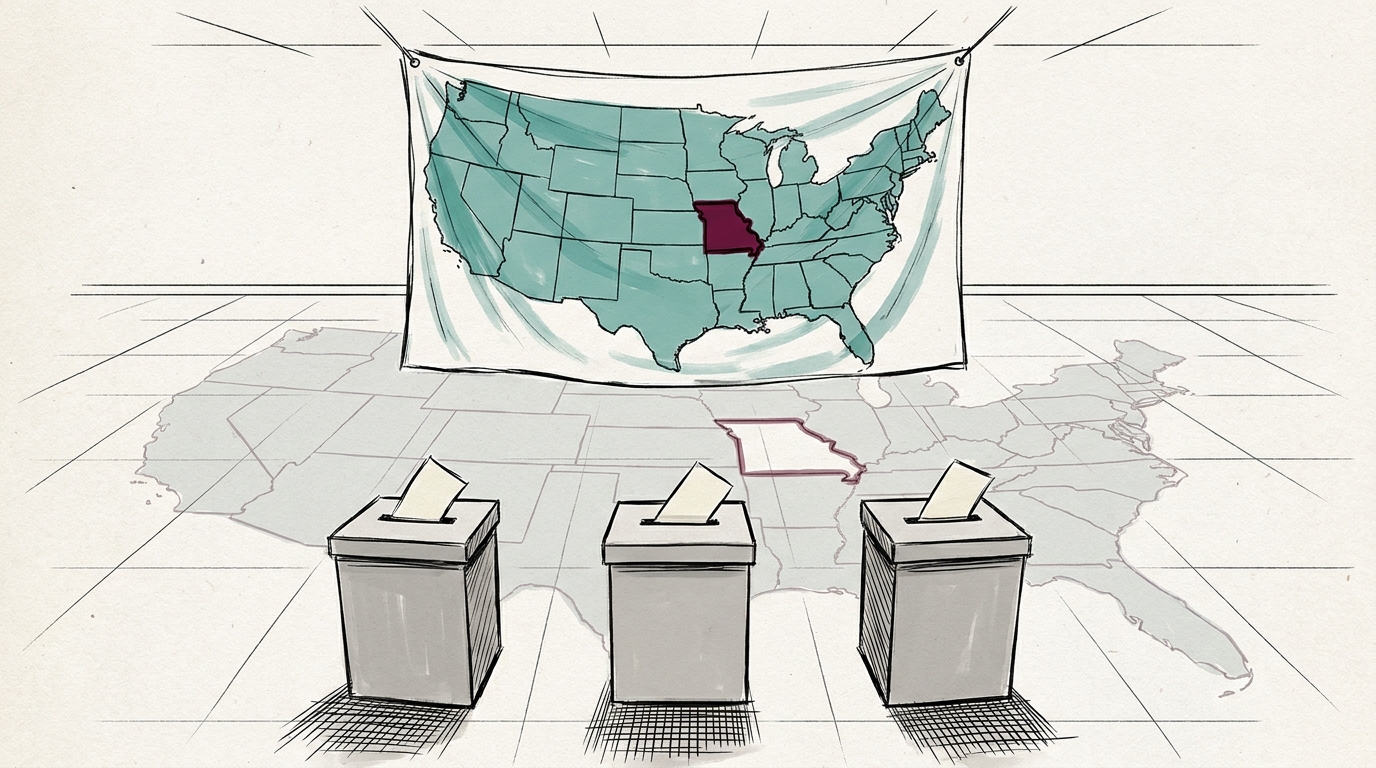
Supreme Court of Missouri
The unanimous court held that Article III, section 49 carries no redistricting exception, so a referendum petition against a congressional map is as valid as against any other law. It ordered the 2022 map to govern unless voters approve HB 1 on 3 November.
Denny Hoskins, Missouri Secretary of State
Hoskins told the Supreme Court that changing the congressional map after 1.2 million primary votes and ahead of the 19 September overseas-ballot deadline violates Purcell and the Elections Clause. He wants HB 1 reinstated before ballots print for November.
Senate Republican leadership
Floor time is finite at 51-47 with a bipartisan funding negotiation running, and a contested procedural fight over grant conditions is not the best use of it this month. Nothing has been abandoned; the resolution keeps its place on the calendar.
