Skip to content
You can now search across every topic, entity and event.What's new
US Midterms 2026
7SEP

Court lifts caps on party spending

3 min read
13:32UTC

The Supreme Court removed the federal limit on party coordinated spending 6-3 on 30 June, freeing party committees to bankroll their own candidates' ad campaigns without a ceiling for the rest of the 2026 cycle.

PoliticsDeveloping
Key takeaway

Party committees can now spend without limit beside their candidates, and Republicans hold the bigger war chest.

The Supreme Court removed the federal limit on how much a political party may spend in direct coordination with its own candidates on Tuesday 30 June, ruling 6-3 that the caps violate the First Amendment. The decision in NRSC v. FEC takes effect at once and runs for the four months of campaign that remain in the 2026 cycle 1. Justice Brett Kavanaugh wrote for the majority; Justices Kagan, Sotomayor and Jackson dissented. We had flagged the case as the term's likeliest rewrite of campaign-finance rules when the Court agreed to hear it .

The caps had held party coordinated spending with a named candidate to between $65,300 and $130,600 in a House race, and up to $4m in a Senate race, this cycle. They formed one wall of the Federal Election Campaign Act (FECA), the post-Watergate framework Congress built in the 1970s to curb the flow of money into campaigns. The ruling tears that wall down at once.

Tim Scott, who chairs the Republican Senate committee, called the decision 'a decisive First Amendment victory'; the Democratic chairs Kirsten Gillibrand and Ken Martin called it 'a win for billionaire donors' 2. The case turned on speech doctrine that would have split this way in any term, so reading partisan intent into the vote overstates it. Freed from the caps, party committees can now pour unlimited coordinated money into their candidates' races, and Republicans hold more cash to spend at every committee tier. Democratic lawyers had fought the caps even while their committees posted record fundraising this spring , yet Democrats meet the new rules from the weaker cash position.

The deregulation follows a five-decade line the Court has drawn through campaign-finance law, from Buckley v. Valeo in 1976 to Citizens United in 2010. Where Citizens United freed outside groups to spend, NRSC v. FEC frees the parties themselves to spend hand-in-hand with their candidates, pulling money back toward the committees at the centre of each campaign.

Deep Analysis

In plain English

Political parties like the Republican Party's Senate campaign committee used to face a strict cap on how much they could spend working directly with their own candidates, up to about $4m per Senate race. Anything beyond that had to be spent 'independently', with no contact between the party and the campaign at all. The Supreme Court just removed that cap. Parties can now spend unlimited money coordinating directly with candidates. That matters because coordinated ads are also cheaper: television stations must offer candidates a discount rate that outside groups do not get, so the same dollar now buys more airtime than it did as independent spending.

Deep Analysis
Root Causes

Federal broadcast law requires stations to sell political advertising to candidates and parties at the 'lowest unit charge' under 47 U.S.C. § 315(b), the same discount given to a station's most-favoured commercial advertiser. Independent-expenditure groups do not qualify; only advertising authorised by, or coordinated with, a candidate does.

Until this ruling, the FECA coordination cap meant parties could only buy a limited slice of advertising at that discount before hitting the ceiling and switching to costlier independent spending. Removing the cap lets parties buy unlimited advertising at the cheap rate, which is why the NRSC shut its more expensive independent-expenditure operation within hours.

What could happen next?
  • Consequence

    Independent-expenditure groups such as the Senate Leadership Fund lose their main structural advantage over parties, since committees can now spend the same money directly at a cheaper broadcast rate.

  • Precedent

    The ruling reverses FEC v. Colorado Republican (2001) in substance without the Court naming that case, since it eliminates the coordination limit that decision upheld.

First Reported In

Update #11 · Money uncapped, ballot rules untouched

CBS News· 1 Jul 2026
Read original
Different Perspectives
New Hampshire student voters
Students who hold no accepted photo ID under HB 323 cannot vote in the 8 September primary after Judge Laplante declined to block the law on timing grounds. Whether the same rule applies on 3 November is still open.
Alaska Democratic Party
The Alaska Democratic Party moved $884,835 in coordinated spending to Mary Peltola between 17 and 30 July, more than the DCCC spent nationally in the same fortnight.
National Republican Senatorial Committee
The NRSC, which sued to remove coordinated-spending caps in NRSC v. FEC, put $2,230,472 behind candidates in the first complete month after winning that case, more than double the total for the prior six months combined.
Supreme Court of Missouri
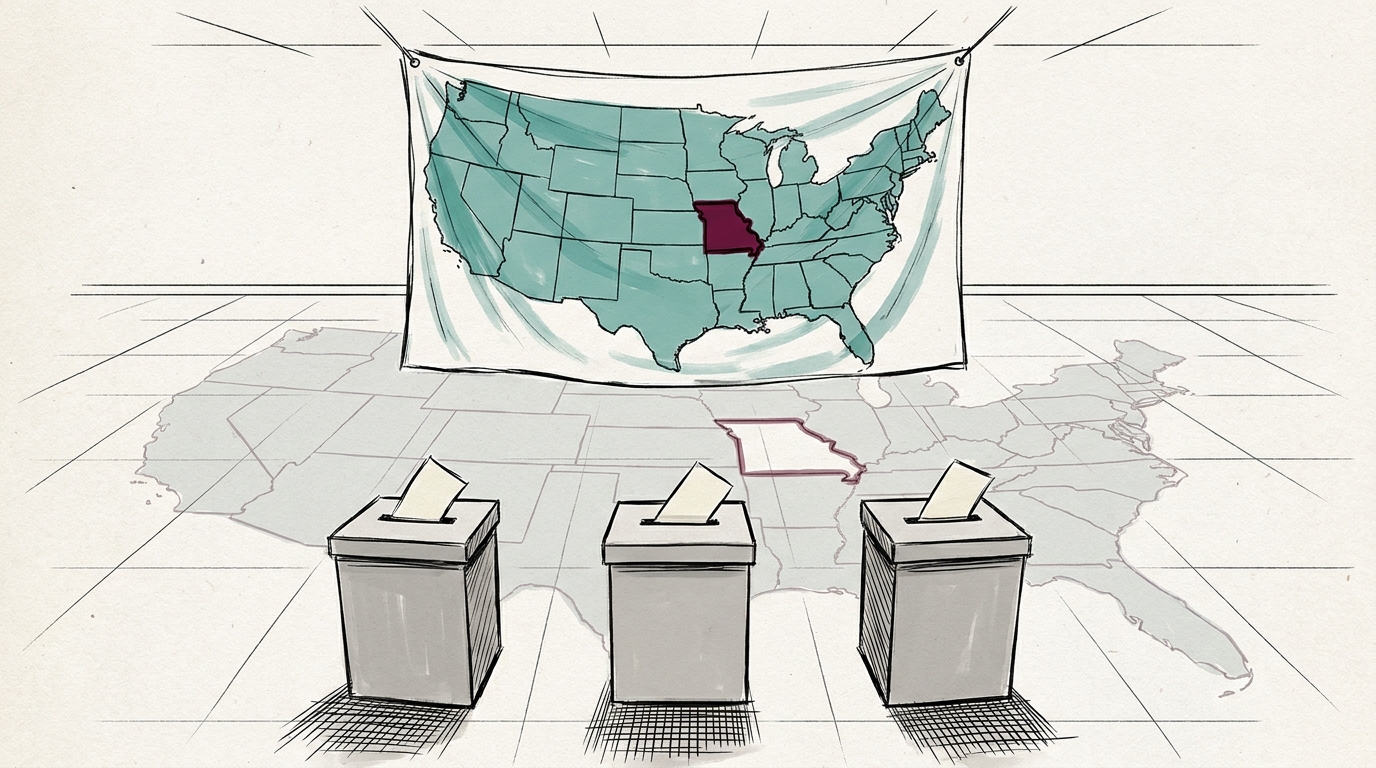
The unanimous court held that Article III, section 49 carries no redistricting exception, so a referendum petition against a congressional map is as valid as against any other law. It ordered the 2022 map to govern unless voters approve HB 1 on 3 November.
Denny Hoskins, Missouri Secretary of State
Hoskins told the Supreme Court that changing the congressional map after 1.2 million primary votes and ahead of the 19 September overseas-ballot deadline violates Purcell and the Elections Clause. He wants HB 1 reinstated before ballots print for November.
Senate Republican leadership
Floor time is finite at 51-47 with a bipartisan funding negotiation running, and a contested procedural fight over grant conditions is not the best use of it this month. Nothing has been abandoned; the resolution keeps its place on the calendar.
