Skip to content
Welcome, thoughtbot's Giant Robots listeners!Start here
US Midterms 2026
1JUL

NRSC accounts for $2.2m of July's $3.9m

3 min read
11:34UTC

FEC filings due on Thursday 20 August put coordinated party expenditure at $3,945,435 for 14 to 31 July, against $1,032,346 for the whole first half of the year. July is the first complete month since the Supreme Court struck the spending caps.

PoliticsDeveloping
Key takeaway

July is the first fully reported month of coordinated party spending; August figures arrive on 20 September.

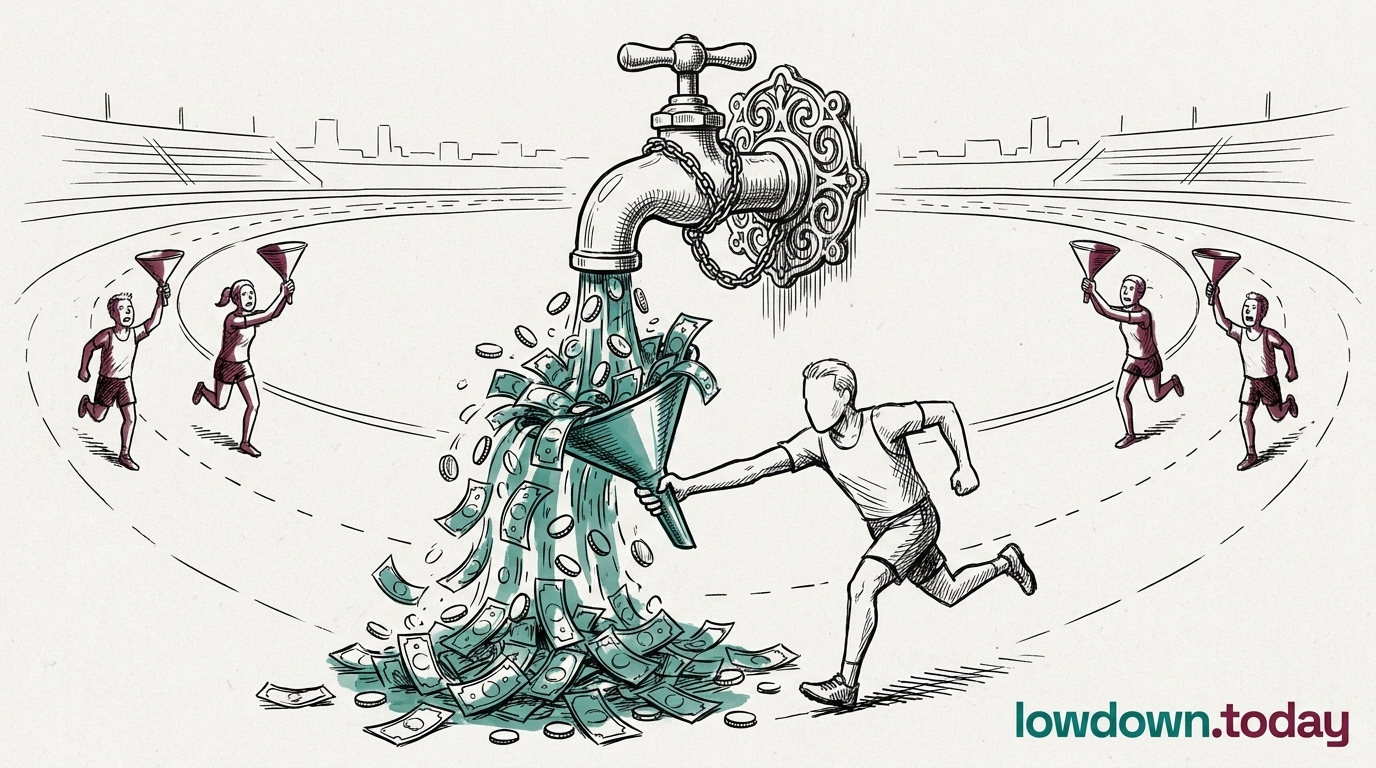
Coordinated party expenditure ran to $3,945,435 across 40 records dated 14 to 31 July 2026, against $1,032,346 across 40 records for the whole of January to June. Both figures are compiled here from the Federal Election Commission's bulk transaction file `itpas2.txt`, cycle 2026, filtered to transaction type 24C, which marks a coordinated party buy.⁠1 The National Republican Senatorial Committee (NRSC) accounts for $2,230,472 of the July total across 13 records.

The committee said on 30 June that it would shut its independent-expenditure operation and told campaigns on 1 July to fold that spending into coordinated buys. The register now shows the money moving, which is the part nobody could report at the time.

A filing calendar explains why a September briefing is reporting July money. The August Monthly report closed its books on 31 July and was due on Thursday 20 August, which falls inside the gap between the last briefing and this one.⁠2 The September Monthly, covering August, is not due until 20 September. July therefore counts as a complete, fully reported month, and the empty August rows carry no information about August spending at all.

Alaska produces the sharpest line in the file. The Alaska Democratic Party recorded $884,835 in five coordinated expenditures between 17 and 30 July, every dollar on Mary Peltola and every dollar through one direct-mail payee, against $696,884 that the Democratic Congressional Campaign Committee (DCCC) spread across eleven candidates nationwide in the same fortnight.⁠3 Dan Sullivan, the Republican incumbent Peltola is chasing, drew $136,570. Alaska spent its summer arguing over which Dan Sullivan belonged on the ballot, , and its party committee has now answered a different question about which race is worth the money.

Hold that comparison to the July window. Across every 2026-dated record in the same file the two committees sit within $4,549 of each other, the DCCC marginally ahead on $889,384, because it spent $192,500 before July while the Alaska party spent nothing.⁠4 The state party did not out-spend the national committee over the cycle; it front-loaded into fourteen days while the DCCC did not. Both figures count coordinated expenditure alone, a narrow slice of what either committee spends. One further caution on the same data: all four congressional campaign committees show zero rows in the independent-expenditure file for this cycle, and that zero is a property of the file rather than a description of anyone's behaviour.⁠5

Deep Analysis

In plain English

A Supreme Court ruling this summer removed the legal limit on how much a political party committee can spend in direct coordination with its own candidates. The first full month of spending data under the new rules became public in August, and it shows a jump: over $3.9 million in coordinated spending in the second half of July alone, against just over $1 million for the entire first six months of the year. The national Republican Senate committee spent the most of any single group, but a state-level Democratic Party in Alaska spent almost as much on one candidate as the national Democratic House committee spent on eleven candidates combined.

Deep Analysis
Root Causes

The jump from January-June to July exists because NRSC v. FEC removed FECA's coordinated-spending caps only from the ruling date forward, so the first six months of the cycle were still capped while July, the first full month after the ruling, was not.

The size of the July number is a function of the ruling's timing relative to the FEC's monthly filing calendar, not of party committees suddenly finding new donors.

What could happen next?
  • Consequence

    Individual state parties, not just the four national Hill committees, can now become decisive spenders in a single competitive race.

  • Opportunity

    Candidates who secure their state party's backing rather than the national committee's may find that route delivers comparable or greater coordinated spending.

First Reported In

Update #16 · Missouri suspends its map, and votes on it

Federal Election Commission· 7 Sept 2026
Read original →
Different Perspectives
Judge Mary Geiger Lewis, US District Court for the District of South Carolina
Lewis dismissed on standing, without prejudice, the challenge by the South Carolina NAACP and three voters with disabilities to limits on who may help voters. The limits, including a cap of five voters per assistant, stand for the 3 November Senate election.
Judge Victoria Marie Calvert, US District Court for the Northern District of Georgia
Calvert dismissed the Justice Department's suit for Georgia's unredacted voter list on 30 September, holding that the 1960 Civil Rights Act does not override state privacy law. Secretary of State Brad Raffensperger need not hand over birth dates, Social Security numbers or licence numbers.
Chad Bianco, Riverside County Sheriff
Bianco, ordered by the state supreme court on 24 September to return about 650,000 Proposition 50 ballots, called his seizure a lawful investigation. He told CalMatters he would appeal to the federal courts.
Fairshake network, through Defend American Jobs
Fairshake, the crypto-industry super PAC, has said it will spend $30 million against Sherrod Brown, and Defend American Jobs, which the Washington Times places in its network, filed $11.46 million in Ohio. The Washington Times reports that the ads do not mention cryptocurrency.
Texas PAC
Texas PAC
The super PAC reported $61.41 million of new spending on 30 September, its two largest lines opposing James Talarico and supporting Ken Paxton. Its race total of $131.53 million is the largest outside effort in any Senate contest this week, with donors undisclosed until 15 October.
Sabato's Crystal Ball
Sabato moved three Virginia seats on 29 September, putting Jen Kiggans's 2nd District at Leans Democratic and the 1st at Toss-up. It wrote that a Democratic win in the 5th, now Leans Republican, would fit a 2006-style wave.
