Skip to content
Welcome, thoughtbot's Giant Robots listeners!Start here
UK Local Elections 2026
3AUG

O'Dowd rules out a Stormont walkout

2 min read
15:31UTC

Northern Ireland's finance minister said on 11 August that Sinn Féin has "no intent, plan or otherwise" to leave the power-sharing Executive, while calling the DUP increasingly difficult to work with.

PoliticsDeveloping
Key takeaway

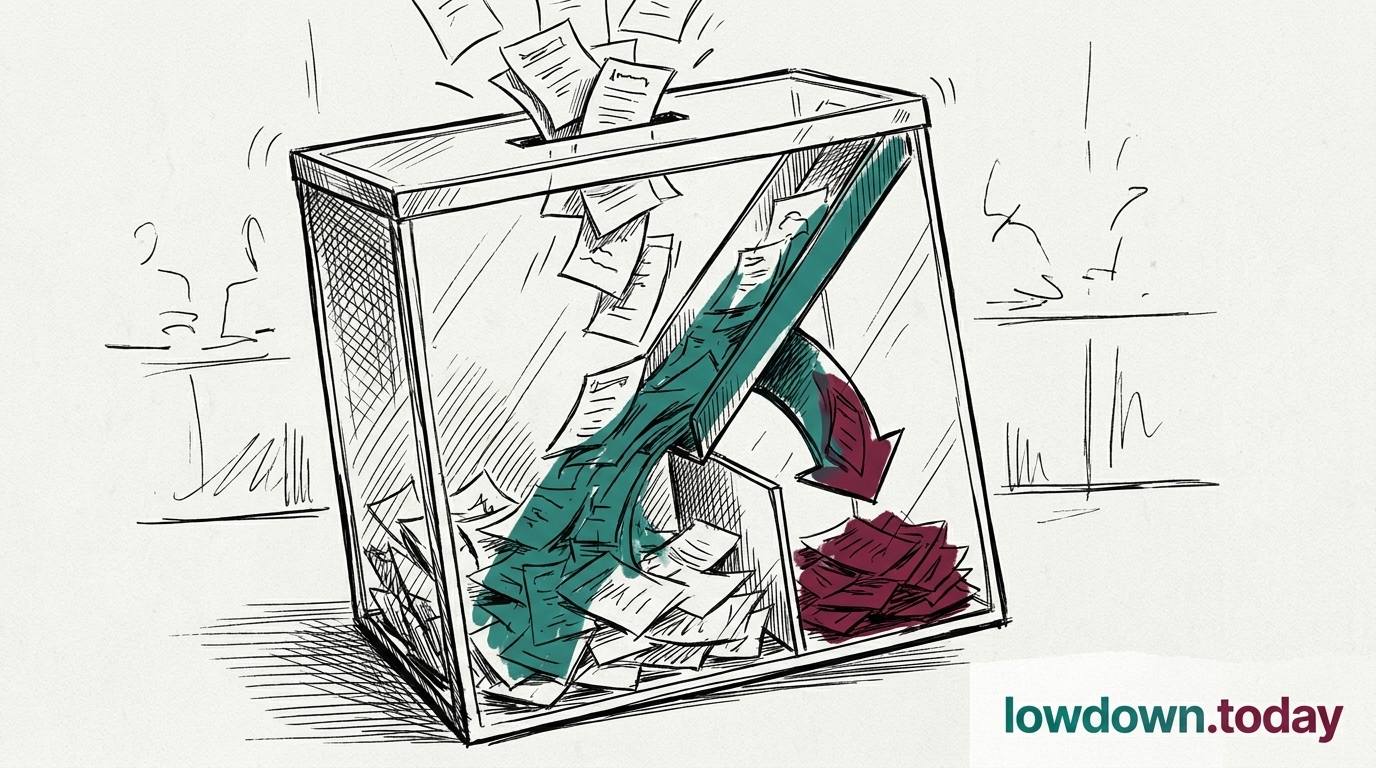
Sinn Féin's finance minister has ruled out collapsing Stormont, and given up a lever doing it.

John O'Dowd, Northern Ireland's Finance Minister, said on 11 August that Sinn Féin has "no intent, plan or otherwise" to walk away from the power-sharing Executive at Stormont, while accepting that the Democratic Unionist Party (DUP) has become increasingly difficult to work with⁠1. Stormont is the devolved government in Belfast, and its rules require the two largest designations to serve together: the First Minister and deputy First Minister hold a joint office in which neither can serve without the other.

That design is why the identity of the speaker carries the weight. A walkout can only be executed by one of the two parties in the joint office, so a denial from anyone else settles nothing. O'Dowd answers from inside the Executive, and he holds the department that has to land a difficult budget.

His remarks close a question left open a fortnight earlier, when Sinn Féin's Conor Murphy called power-sharing precarious and the DUP rejected the description. Two statements in two weeks from the party that would have to do the walking measure how loudly the question is being put to it, in Belfast and at Westminster.

Ruling out collapse costs something. Sinn Féin gives up the strongest lever it has in budget negotiations, since a threat withdrawn in public is difficult to reintroduce. It also transfers the risk: with the larger nationalist party committed to staying, any future suspension of the institutions would be attributed to unionism, which is the calculation a finance minister makes before promising to stay and take responsibility for the numbers.

Deep Analysis

In plain English

Northern Ireland's government at Stormont only works if Sinn Féin and the Democratic Unionist Party (DUP) both agree to take part; they must jointly fill the top two jobs, First Minister and deputy First Minister, and if either party pulls out, the whole executive stops functioning rather than one side simply losing a vote. John O'Dowd, Sinn Féin's Finance Minister, said on 11 August that his party has 'no intent, plan or otherwise' to walk away, while also saying the DUP has become harder to work with. His comment matters because it is a direct denial of the kind of exit that has shut down Stormont twice before, in 2017 and again in 2022.

Deep Analysis
Root Causes

Stormont's executive requires Sinn Féin and the DUP to jointly nominate the First Minister and deputy First Minister and to agree a programme for government; if either resigns collectively or a nominating party refuses to fill its post, the institutions collapse into suspension, as happened for three years from 2017 and again from 2022 to 2024.

That structural design means one party walking away is enough to stop devolved government entirely, unlike a normal majoritarian Parliament where a governing party can simply lose a vote and carry on.

O'Dowd's finance brief also gives his reassurance particular weight: as the minister managing the executive's day-to-day budget, a resignation from him would have immediate practical as well as political consequences, since Stormont's finances would lose ministerial sign-off mid-cycle.

What could happen next?
  • Meaning

    O'Dowd's denial covers only Sinn Féin's intentions; the executive's stability also depends on the DUP, which has not offered a matching guarantee.

  • Risk

    If working relations between the two parties continue to deteriorate, the executive remains vulnerable to collapse regardless of Sinn Féin's stated intent.

First Reported In

Update #15 · Reform bleeds councillors, wins by-elections

Your Thurrock· 12 Aug 2026
Read original →
Causes and effects
This Event
O'Dowd rules out a Stormont walkout
Only the party that would have to walk out can rule out a walkout, and its budget holder has now done so on the record.
Different Perspectives
Scottish Labour members
Scottish Labour's published leadership nominations show 33 MPs and MSPs backing Michael Marra against 12 for Joe Fagan, with members voting until 17 September and a result on 19 September. Elected members do not cast the ballot, so the nomination gap measures the parliamentary party rather than the membership that will decide it.
Electoral Commission
The Electoral Commission published its Q2 2026 donations register on 3 September, recording Reform UK's £5.44m as the highest of any party and Ben Delo's £4m as two cash gifts. The register records a donation's form and amount, not the origin of a donor's wealth, so a cash gift shows the same as any other.
Reform UK
Reform UK
Danny Kruger, Reform UK's MP for East Wiltshire, called the Bill "a flagrantly partisan attempt to kneecap Reform UK" during the 2 September debate, objecting to its trade-union exemption. Reform enters its Birmingham conference having topped Q2's donor register at £5.44m, £4m of it in cash from Ben Delo, a form the new ban does not reach.
Ian Davidson, Acting Returning Officer for Clacton
Davidson's office printed a 90cm ballot paper for the record 34-candidate field, with nothing in electoral law capping candidate numbers or the £500 deposit each pays. He expects the paper's size to raise printing costs and slow the count into the early hours, a strain that follows from the major parties' boycott, not from turnout.
Labour Party
Labour Party
Labour gained Penistone East from Reform on 20 August but lost Harraby South to Reform the same night, a wash that undercuts any claim of momentum. The party can point to beating Reform in a genuinely fought contest, but not to a pattern running only in its favour.
Liberal Democrats
Liberal Democrats
The Liberal Democrats took two of Reform's May wards, Almondbury on 13 August and St Neots Eynesbury on 20 August, the latter on a 29.8-point rise in their own vote share. Both results let the party claim it is the beneficiary when voters turn against Reform, not Labour or the Conservatives.