Skip to content
You can now search across every topic, entity and event.What's new
Russia-Ukraine War 2026
20MAR

Ukraine gains 400 sq km in February

3 min read
17:04UTC

Commander-in-Chief Syrskyi says Ukrainian forces reclaimed 300–400 sq km in the south during February — more than Russia gained in the same period. Independent verification is pending.

ConflictDeveloping
Key takeaway

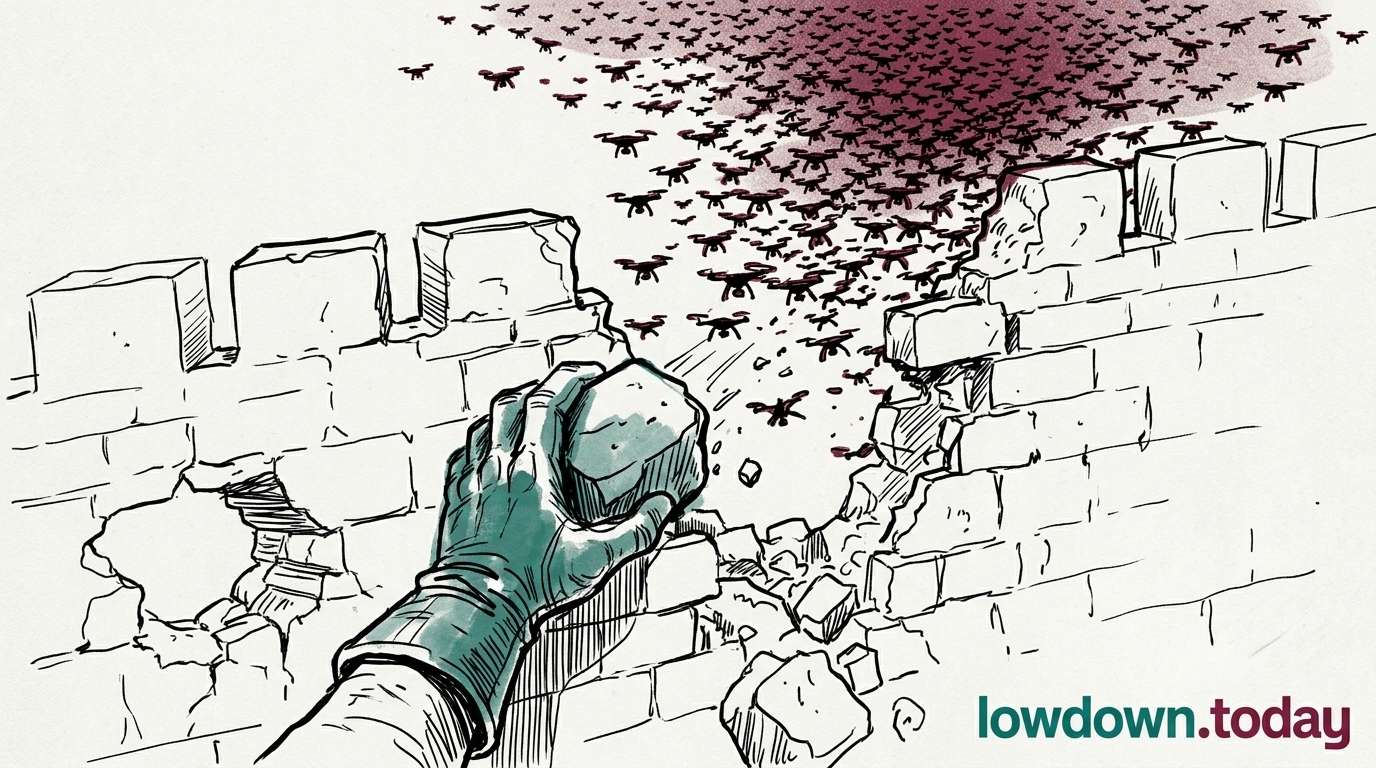
Ukraine's southern advance forces Russia to choose between Donetsk encirclement and southern flank defence.

Commander-in-Chief Oleksandr Syrskyi reported on 2 March that Ukrainian forces captured approximately 300–400 sq km in the Zaporizhzhia–Dnipropetrovsk sector during February — more territory than Russia took in the same period 1. President Zelenskyy confirmed the gains on the war's fourth anniversary. Independent satellite verification from open-source intelligence groups had not emerged at the time of reporting 2.

The claim requires context. Through 2025, Russian forces advanced at roughly 171 square miles per month across the front, built on infantry-wave tactics and glide-bomb superiority that had ground down Ukrainian defensive lines since the failure of the 2023 counter-offensive. February's reversal — Ukraine's strongest relative performance since the Kursk incursion of August 2024 — does not mean the front has shifted in Kyiv's strategic favour. It means that in one sector, Ukraine's drone-and-artillery integration temporarily outpaced Russia's adaptation cycle.

The location matters. The Zaporizhzhia–Dnipropetrovsk axis is not the Donetsk front where Russia has concentrated its forces since Pokrovsk fell in December 2025. Ukraine exploited thinner Russian lines in the south while Russian command kept its weight in the east, pressing toward Kostiantynivka with the aim of encircling Kramatorsk and Sloviansk. The gains may reflect Russian overextension across a 1,000 km front as much as Ukrainian offensive capability.

Russia has consistently responded to Ukrainian territorial gains — Kherson in November 2022, the early days of Kursk in August 2024 — with redeployment and counter-attack within weeks. If Moscow pulls forces from the Donetsk axis to contest the southern gains, it relieves pressure on Ukraine's eastern anchor cities. If it does not, Ukraine consolidates ground that becomes a bargaining chip in any resumption of the Abu Dhabi process. Either outcome gives Kyiv something it has lacked for months: the initiative to force a Russian choice.

Deep Analysis

In plain English

Picture the front line as a 1,000-kilometre rope in a tug-of-war. Most months Russia pulls more rope its way. In February, Ukraine pulled back enough to match or beat Russia's gains — the first time that's happened since the Kursk incursion in August 2024. This doesn't mean the war is turning. Russia still holds 20% of Ukraine and is pressing hard toward two major cities in the east. What it means is that Ukraine found a way to make its drones and artillery work together more effectively in the flatter southern terrain, where coordination is easier than in Donetsk's bombed-out urban battlespace. The question now is whether Russia will pull forces away from its eastern push to defend the south — a choice with real costs either way.

Deep Analysis
Synthesis

Ukraine appears to be applying a lateral-pressure strategy: advancing in the south while defending in the east to stretch Russian force allocation across incompatible simultaneous demands. This mirrors Soviet deep-battle doctrine — apply pressure at multiple points to prevent the enemy concentrating decisive mass anywhere. Whether Ukraine has the logistical depth to sustain both simultaneously is the test the coming weeks will answer.

Root Causes

The Zaporizhzhia-Dnipropetrovsk sector's open, flat terrain amplifies Ukrainian drone-artillery coordination advantages relative to Donetsk's urban battlespace, where close combat and rubble degrade targeting cycles. Russia's force density in the south has been deliberately thinned since late 2025 to sustain the primary Donetsk axis — February's Ukrainian gains partly exploit a self-created Russian gap rather than a frontline collapse.

Escalation

Russia's most probable response is intensified aerial bombardment of newly captured positions rather than major force redeployment from Donetsk. Full redeployment would sacrifice the Kramatorsk encirclement timeline, which has been Moscow's primary operational objective since late 2025. Aerial escalation is lower-cost and consistent with Russia's established doctrine of using glide bombs and drones to deny Ukrainian consolidation. Expect localised armoured counterattacks in the south alongside continued Donetsk pressure — not an either/or force shift.

What could happen next?
  • Consequence

    Russia will intensify aerial bombardment of the Zaporizhzhia sector to deny Ukrainian consolidation of newly captured positions, likely within days.

    Immediate · Assessed
  • Risk

    Ukrainian overextension — advancing beyond what mine-clearance and logistics can support — could expose newly held ground to rapid Russian armoured counterattack in March.

    Short term · Suggested
  • Opportunity

    Sustained southern pressure forces Russia into a force-allocation dilemma that could slow the Kostiantynivka advance and buy time for Kramatorsk-Sloviansk defences.

    Medium term · Suggested
  • Meaning

    Ukraine has demonstrated simultaneous offensive and defensive capability across multiple sectors, a qualitative threshold it had not clearly met since 2022.

    Short term · Assessed
First Reported In

Update #1 · Ukraine best month as Russia triples drones

Kyiv Independent· 3 Mar 2026
Read original
Different Perspectives
Turkey
Turkey
Turkey, a major buyer of Russian diesel cargoes, loses that access under Moscow's first producer-binding export ban, in force from 8 July to 31 July. Ankara hosted the same week's NATO summit pledging EUR 70bn to Ukraine, sitting on both sides of the fuel-and-alliance ledger.
NATO
NATO
NATO leaders meeting in Ankara on 7 and 8 July pledged EUR 70bn in equipment, assistance and training for Ukraine across 2026, with a 2027 sustainment commitment and a $40bn Drone Edge counter-drone initiative. European allies now fund the vast majority of that package, filling the gap left by Washington's idled crude waiver.
India
India
India's state refiners continued buying discounted Urals crude as June's price fell to $63.18 a barrel, insulating New Delhi from the OFAC waiver gap still constraining Western buyers. Indian refiners could pick up diesel-export share as Russia's producer-binding ban shuts out its former customers.
China
China
China's independent refiners kept importing discounted Urals crude through June as the price fell to $63.18 a barrel, down 26% month-on-month per CREA. Beijing has said nothing on Moscow's new diesel ban, leaving Chinese refiners a likely beneficiary if Turkish and Brazilian buyers seek replacement cargoes.
United States
United States
No successor licence has been issued since General License 134C lapsed on 17 June, leaving a 26-day gap, the longest of the war, in the Russian crude waiver. Washington's silence is tightening the channel without any stated decision, as Treasury weighs whether to let it die.
Ukraine
Ukraine
Ukraine's long-range strike campaign shifted from refineries to seaborne fuel tankers crossing the Sea of Azov, cutting tracked vessel traffic 55% between 30 June and 11 July, per Starboard Maritime Intelligence. The shift targets Russia's export revenue directly rather than just domestic supply, adding pressure alongside the collapsing Urals price.
