Skip to content
You can now search across every topic, entity and event.What's new
Russia-Ukraine War 2026
18MAR

Kramatorsk hit as fortress belt braces

3 min read
11:41UTC

A Russian airstrike killed one and damaged 40 houses in Kramatorsk on 8 March — the latest in an escalating bombardment of the four cities anchoring Ukraine's last eastern defence line.

ConflictDeveloping
Key takeaway

Escalating Kramatorsk strikes fit Russia's documented doctrine of degrading logistics nodes before ground operations.

A Russian airstrike struck Kramatorsk on 8 March, killing one person and damaging nearly 40 houses 1. Al Jazeera reported that attacks on the city were escalating, even as Ukraine consolidated the 300–400 sq km it captured during February further south in the Zaporizhzhia–Dnipropetrovsk sector 2.

The strike fits an escalation pattern that has intensified since Pokrovsk fell in December . Kramatorsk, Sloviansk, Druzhkivka, and Kostiantynivka form the fortress belt — the last major urban defence line in Donetsk Oblast. On 4 March, nine separate Russian assault actions struck positions around Kostiantynivka alone . The operational approach is systematic: degrade infrastructure through sustained bombardment to weaken defensive cohesion before committing ground forces.

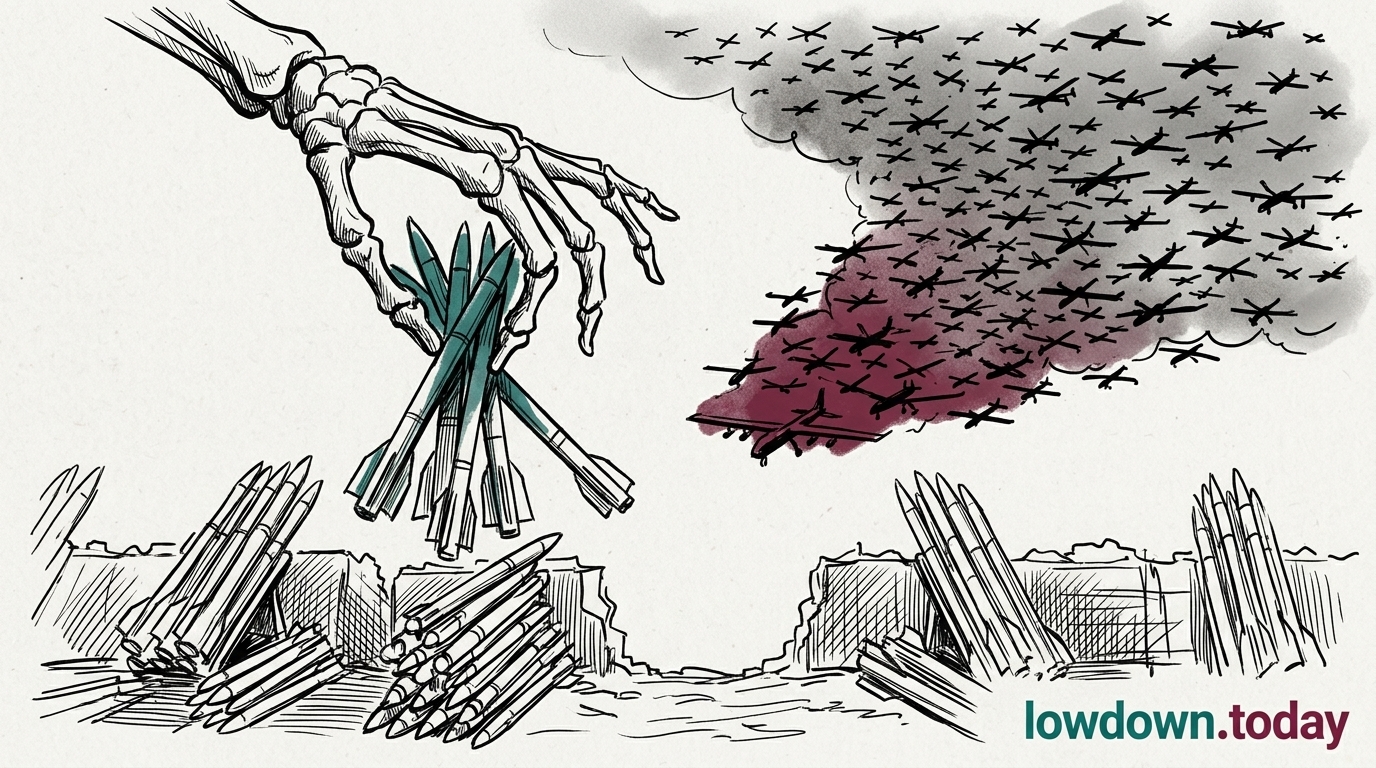
The approach carries its own constraints. Urban warfare in fortified cities favours the defender, as Russia's ten-month battle for Bakhmut in 2023 demonstrated — a grinding campaign for a city of roughly 70,000 that yielded marginal strategic gain. Kramatorsk is a larger, better-fortified position that Ukrainian engineers have had over two years to prepare. But bombardment volumes have changed since Bakhmut: the 9,837 drones, 254 guided bombs, and 33 missiles recorded on 8 March alone represent firepower Russia could not concentrate in 2023. Whether sustained bombardment at this scale can achieve what infantry could not is the open question on the Donetsk front.

Deep Analysis

In plain English

Kramatorsk is a mid-sized city in eastern Ukraine that functions as a critical military logistics hub — its rail junction moves troops and supplies across Ukraine's northern Donetsk front. Russia has intensified strikes on it since Pokrovsk fell in December 2025. The 8 March airstrike killed one person and damaged around 40 houses. Beyond the immediate toll, the pattern matters: sustained bombardment of Kramatorsk degrades both civilian life and Ukraine's capacity to resupply its eastern defences. If Russia can disrupt the rail junction enough to reduce supply flows without needing to capture the city physically, the wider defensive line weakens regardless of frontline movements.

Deep Analysis
Synthesis

The divergence between Russian escalation at Kramatorsk and Ukrainian stabilisation in the south may reflect a deliberate economy-of-force calculation rather than opportunism. Pressuring Kramatorsk's logistics hub could force Ukraine to redeploy northern Donetsk reserves to protect the city, creating thinning effects on adjacent sectors. This is force-multiplication through geographic pressure rather than weight of numbers — a rational adaptation to the attritional stalemate characterising 2025.

Root Causes

Kramatorsk's targeting logic rests on its rail junction — the primary logistics artery for Ukrainian forces across northern Donetsk Oblast. Degrading it achieves dual objectives simultaneously: disrupting military supply flows and demonstrating that no Ukrainian city in the operational rear is beyond reach. Russia's inability to generate rapid frontline breakthrough creates institutional pressure to demonstrate operational progress through infrastructure targeting rather than territorial advance.

Escalation

The body notes attacks escalating even while Ukraine holds southern territorial gains. This spatial divergence — intensifying pressure on the Kramatorsk axis while the southern front stabilises — is consistent with Russia deliberately opening a second pressure axis to force Ukrainian resource reallocation northward. Kramatorsk sits approximately 40km from current frontlines, within KAB-series guided glide bomb range, allowing Russian aircraft to strike without entering significant Ukrainian air defence coverage. This creates a low-cost, low-risk Russian option with meaningful operational payoff that is structurally difficult for Ukraine to counter with current assets.

What could happen next?
  • Meaning

    Escalating Kramatorsk strikes confirm Russia has identified the northern Donetsk logistics hub as its primary medium-term operational pressure point after Pokrovsk.

    Immediate · Assessed
  • Risk

    Rail junction damage could degrade Ukrainian resupply capacity across the entire northern Donetsk front, compounding the operational effect of the ongoing interceptor shortage.

    Short term · Assessed
  • Risk

    Systematic glide bomb use against Kramatorsk — within range without Russian aircraft entering heavy air defence coverage — represents a structurally difficult Ukrainian problem with no near-term countermeasure.

    Short term · Assessed
  • Consequence

    If Kramatorsk's logistics function is significantly degraded, Ukraine faces a choice between strategic withdrawal from the northern Donetsk axis or accepting a supply-constrained defensive posture.

    Medium term · Suggested
First Reported In

Update #3 · Iran war halts talks, drains air defences

EMPR· 9 Mar 2026
Read original
Causes and effects
This Event
Kramatorsk hit as fortress belt braces
The Kramatorsk strike is part of an intensifying Russian bombardment campaign against the four-city fortress belt anchoring Ukraine's eastern defence in Donetsk Oblast — a firepower-first approach that has replaced the costly infantry assaults that stalled through 2024–2025.
Different Perspectives
Turkey
Turkey
Turkey, a major buyer of Russian diesel cargoes, loses that access under Moscow's first producer-binding export ban, in force from 8 July to 31 July. Ankara hosted the same week's NATO summit pledging EUR 70bn to Ukraine, sitting on both sides of the fuel-and-alliance ledger.
NATO
NATO
NATO leaders meeting in Ankara on 7 and 8 July pledged EUR 70bn in equipment, assistance and training for Ukraine across 2026, with a 2027 sustainment commitment and a $40bn Drone Edge counter-drone initiative. European allies now fund the vast majority of that package, filling the gap left by Washington's idled crude waiver.
India
India
India's state refiners continued buying discounted Urals crude as June's price fell to $63.18 a barrel, insulating New Delhi from the OFAC waiver gap still constraining Western buyers. Indian refiners could pick up diesel-export share as Russia's producer-binding ban shuts out its former customers.
China
China
China's independent refiners kept importing discounted Urals crude through June as the price fell to $63.18 a barrel, down 26% month-on-month per CREA. Beijing has said nothing on Moscow's new diesel ban, leaving Chinese refiners a likely beneficiary if Turkish and Brazilian buyers seek replacement cargoes.
United States
United States
No successor licence has been issued since General License 134C lapsed on 17 June, leaving a 26-day gap, the longest of the war, in the Russian crude waiver. Washington's silence is tightening the channel without any stated decision, as Treasury weighs whether to let it die.
Ukraine
Ukraine
Ukraine's long-range strike campaign shifted from refineries to seaborne fuel tankers crossing the Sea of Azov, cutting tracked vessel traffic 55% between 30 June and 11 July, per Starboard Maritime Intelligence. The shift targets Russia's export revenue directly rather than just domestic supply, adding pressure alongside the collapsing Urals price.
