Skip to content
You can now search across every topic, entity and event.What's new
Russia-Ukraine War 2026
23JUL

Brent hits two-month low on deal bets

3 min read
20:33UTC

Brent crude traded near $87.33 on 12 June, a near-two-month low, as futures markets priced roughly an 80 per cent chance the Iran deal closes.

ConflictDeveloping
Key takeaway

Traders priced an 80 per cent chance of an unsigned deal, leaving Brent exposed to a sharp rebound.

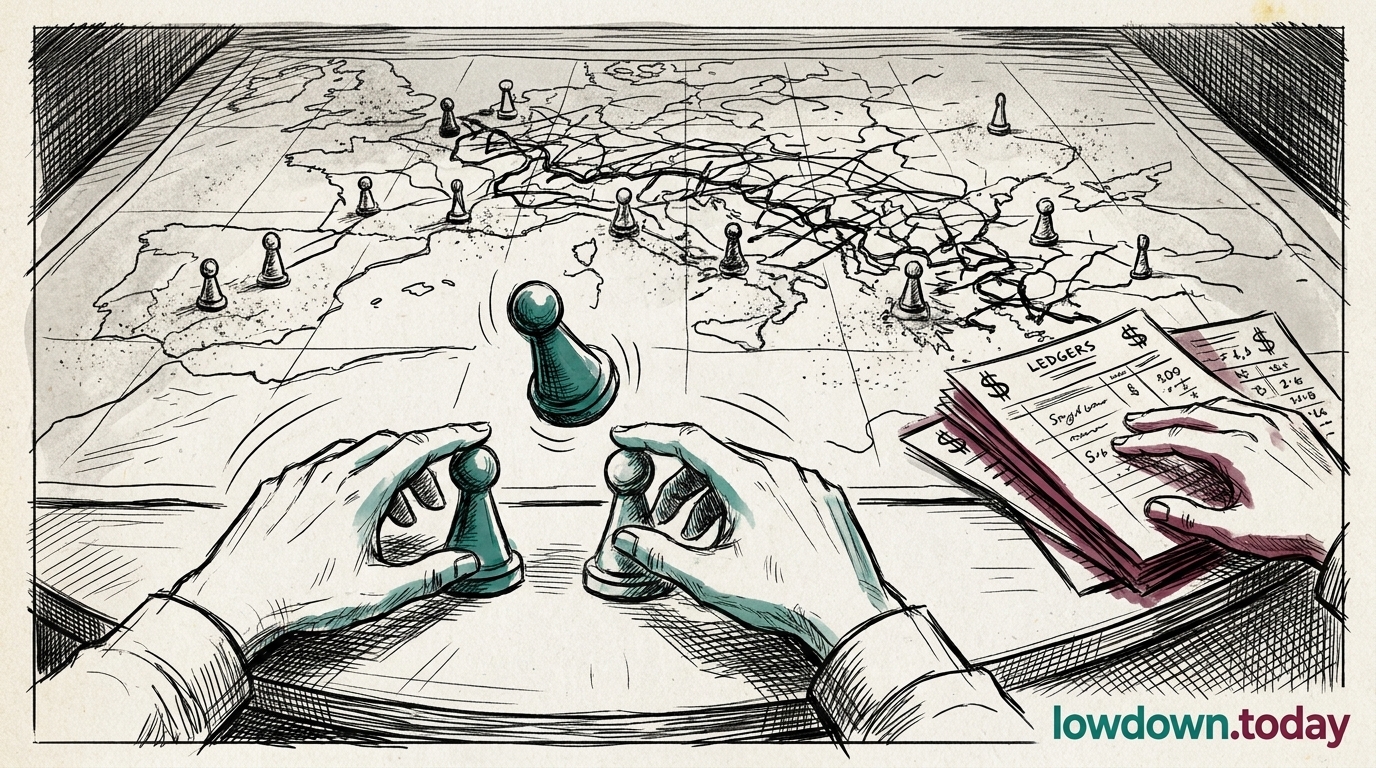
Brent Crude, the global oil benchmark, traded near $87.33 on 12 June, a near-two-month low and down about 6 per cent on the week, even as The White House register the market is betting on showed no signature. 1 Futures traders are pricing roughly an 80 per cent chance the Iran deal closes, a senior US official's figure, which means they are discounting the unsigned register almost entirely. 2

The fall was a step-down, not a slide: $96.34 on 10 June , $94.71 on 11 June , $89.25 on 12 June , now below $88. In three sessions the benchmark gave back the entire high it set on Hormuz risk. Traders, not diplomats, are the most confident actors that a deal they cannot see will close, discounting the blockade, the drone combat and the IRGC's review hedge on a bet that Hormuz reopens soon.

The confidence cuts one way. A near-two-month low feeds through to softer fuel and freight costs for importers within weeks if the move holds. But with 80 per cent already in the price, the market holds little cushion: a Vahidi re-suspension or a slipped signing would reprice Hormuz risk sharply and snap Brent back above $90, because the good news has been spent before the paper exists.


Deep Analysis

In plain English

Oil is priced on expectations as much as on actual supply. When traders think a conflict that has been disrupting Middle East oil supply is close to ending, the price falls before a single extra barrel flows. On 12 June, with news of a possible deal circulating, the price of Brent crude, the main global oil benchmark, fell to around $87.33, its lowest in nearly two months. Markets were pricing in about an 80 per cent chance the deal would close and the Strait of Hormuz would reopen. But that calculation rests on an unsigned document and unresolved disagreements: where Iran's enriched uranium goes and whether Iran's most powerful military force, the IRGC, has agreed to the deal at all. If those problems cause a delay, the price will jump back up sharply.

What could happen next?
  • Risk

    Brent near $87.33 on an unsigned deal means a single negative signal, a Vahidi re-suspension or a public IRGC contradiction, would produce a $5-$8 upward snap in one trading session.

    Immediate · Assessed
  • Opportunity

    If Hormuz fully reopens and Iran's 67 million stranded barrels clear, Brent could settle in the $80-$83 band within six to eight weeks, reducing fuel and freight inflation across oil-importing economies.

    Medium term · Suggested
  • Consequence

    Lloyd's of London has not de-listed Hormuz from its war-risk register despite the price drop; insurance premiums remain elevated and shipping diversions at 139 vessels continue regardless of futures pricing.

    Short term · Reported
First Reported In

Update #126 · The weekend signing that never reached paper

oilprice.com· 13 Jun 2026
Read original
Causes and effects
This Event
Brent hits two-month low on deal bets
Traders have priced a deal the White House register has not confirmed. With 80 per cent already in the price, the downside is asymmetric: a slipped signing snaps Brent back above $90.
Different Perspectives
IAEA (Rafael Grossi)
IAEA inspectors logged Zaporizhzhia's 22nd loss of off-site power, ten of them in the last three months, after a thunderstorm knocked out the plant's sole surviving backup line. Grossi reads the accelerating frequency, not any single outage, as the safety signal now that the plant's redundancy is exhausted.
United States (Treasury/OFAC)
Washington has let general licence 134C, its Russian crude waiver, lapse for 36 days with no successor, the longest gap of the war. Treasury has not said whether the non-renewal reflects deliberate policy or administrative delay, leaving buyers to price in compliance risk rather than wait for clarity.
Slovakia
Slovakia
Slovakia dropped its hold-out on the EU's 21st sanctions package only after winning a 2028 guarantee phasing out Russian gas, the exact pipeline dependency, roughly 80% of its crude supply, that gave it leverage. Bratislava's climbdown clears the package but leaves the same single-veto mechanism intact for the next round.
Russia (Kremlin and general staff)
General staff chief Gerasimov claimed Donetsk captures on 18 July that ISW says it cannot corroborate, extending a pattern ISW clocked at a 5:1 exaggeration ratio earlier this year. Moscow is conditioning its public for a possible autumn mobilisation after September's Duma elections rather than acknowledging the front has stalled.
Ukraine (Zelenskyy government)
Zelenskyy dismissed his commander-in-chief, defence minister and chief of general staff within eight days, replacing Syrskyi with Drapatyi and Hnatov with Skybiuk as protesters demanded Syrskyi go and Fedorov return. Kyiv frames the sweep as a bet on manoeuvre capacity ahead of a feared Russian autumn surge, not the disarray critics read into three changes in a week.
The United Kingdom
The United Kingdom
Starmer pledged £300 million in Kyiv on 16 July toward Ukraine's Gripen E squadron, adding to the PURL expansion Trump and Rutte had announced two days earlier. London is paying into a scheme built around a shortfall NATO's own published $4bn-plus pledge does not close against Zelenskyy's roughly $15bn stated need.



