Skip to content
Briefings are running a touch slower this week while we rebuild the foundations.See roadmap
Russia-Ukraine War 2026
22MAY

US strikes Kharg Island, spares the oil

4 min read
10:57UTC

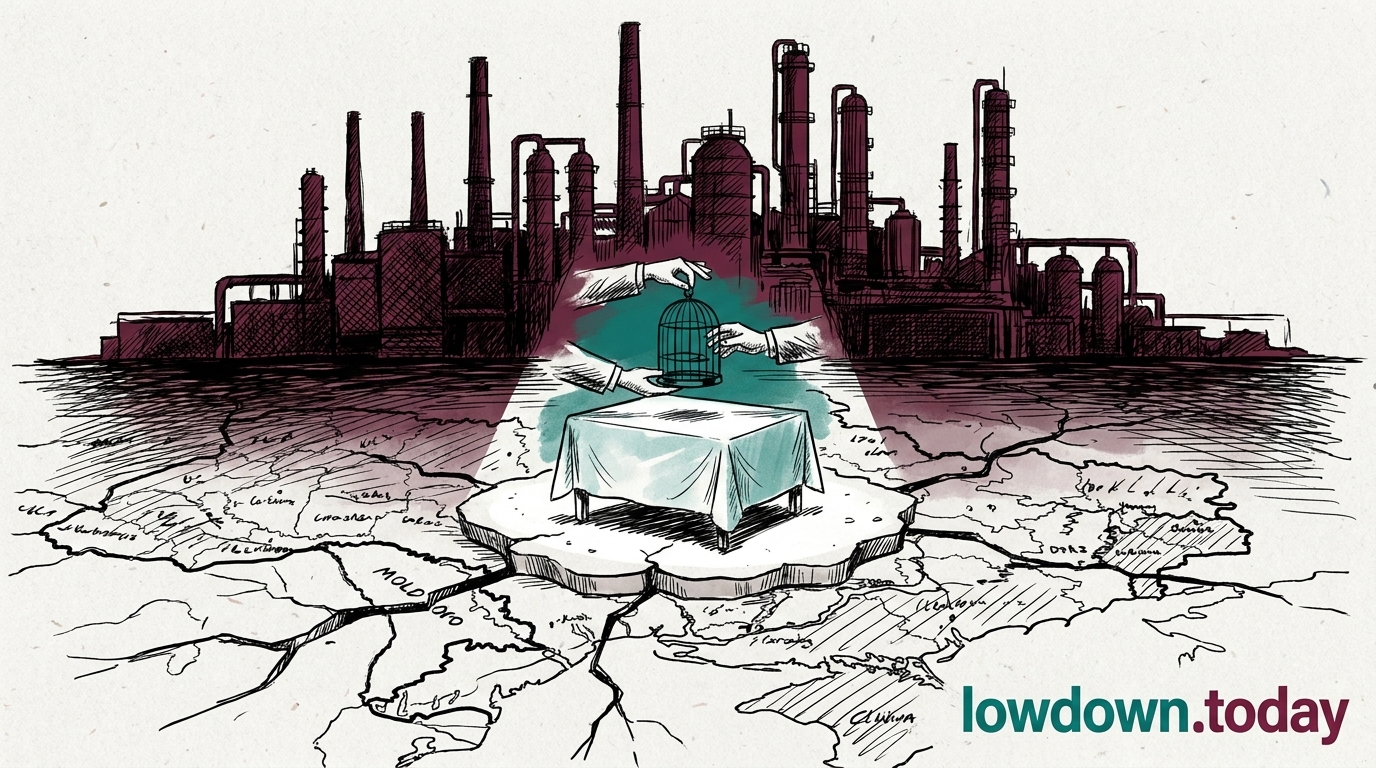
American forces hit military positions on the terminal through which 90% of Iran's crude exports flow — then left the oil infrastructure standing, converting it into a hostage.

ConflictDeveloping
Key takeaway

Striking military targets while sparing oil infrastructure converts Kharg into a hostage, not a target.

The United States struck military positions on Kharg Island on Friday — army defences, the Joshen Sea Base, an airport control tower, and a helicopter hangar, with more than 15 explosions reported. Trump stated forces had "totally obliterated every MILITARY target" on the island. Iran's government rejected the characterisation, describing the strikes as an attack on civilian economic infrastructure and sovereign territory. The distinction matters: Kharg handles roughly 90% of Iran's crude exports, and the line between military and economic infrastructure on a facility of that scale is not self-evident to the state losing it.

Kharg Island occupies a specific place in Iranian strategic memory. During the Iran-Iraq War, Iraqi aircraft attacked Kharg repeatedly between 1984 and 1988 as part of the Tanker War, attempting to cut Iran's revenue lifeline. Iran dispersed exports to Sirri and Larak islands and kept oil flowing. The island's defences have been rebuilt around the lesson that Kharg will always be a target. What is new is the scale of capability arrayed against it: the strikes that hit Tehran's Shahran refineries on Day 9 were Israeli; this was the US itself reaching Iran's economic centre of gravity.

The operational pattern is deliberate restraint as threat. By destroying military targets while leaving the terminal intact, the US demonstrated both reach and discretion — the former establishes capability, the latter creates a conditional. Iran's 11.7 million barrels of crude have continued transiting Hormuz to China since 28 February , and the shadow fleet that carries it docks at Kharg. The island is not just an export terminal; it is the physical chokepoint where Iran's remaining revenue meets the sea. Every barrel loaded there now loads under the implicit condition that the terminal's survival depends on decisions made in Tehran about Hormuz.

Iran's government has reason to contest the "exclusively military" framing. Kharg's military installations exist to defend the oil terminal. Destroying the defences while sparing the terminal does not leave the economic infrastructure untouched — it leaves it undefended. The strategic effect is to make Kharg's oil operations permanently vulnerable to a follow-up strike that requires no additional intelligence preparation or force positioning. The war's cost already exceeds $24 billion at $1.9 billion per day . The question of whether Kharg's oil terminal joins the target list is now the single most consequential economic decision of the conflict.

Deep Analysis

In plain English

Kharg Island is where nearly all of Iran's oil gets loaded onto tankers for export. The US destroyed military facilities there — a naval base, radar installations, an airport control tower — but deliberately left the oil loading equipment intact. Think of it as breaking the lock on the safe but leaving the money inside, while warning: 'Touch anything else and I return for the money.' Iran argues the distinction between military and civilian infrastructure on an active commercial export terminal is legally and practically artificial.

Deep Analysis
Synthesis

The US has executed a graduated coercive demonstration: sufficient destruction to prove capability, insufficient to trigger Iran's stated retaliation threshold. This is signalling through restraint. The strategic risk is that Iran reads the same evidence as proof of US hesitancy — that the withheld escalation will remain withheld regardless of Iranian actions.

Root Causes

Iran's 90% dependence on Kharg reflects a structural export concentration that decades of sanctions pressure did not successfully diversify. The Jask terminal, completed in 2021 specifically to bypass Hormuz, handles only a fraction of Kharg's capacity — the vulnerability was known, partially mitigated, but not resolved.

Escalation

The strike's deliberate restraint is itself escalatory in a non-linear way: it proves US precision-strike capability against Kharg while leaving the conditional threat credible. Iran cannot now dismiss the threat as bluster after witnessing the demonstration.

What could happen next?
  • Precedent

    The first direct US strike on Iranian sovereign territory in this conflict establishes a new threshold for direct military engagement, separate from proxy or proxy-adjacent operations.

    Immediate · Assessed
  • Risk

    Gulf shipping insurers may reclassify Kharg Island vicinity as an active war zone, raising underwriting costs for tankers calling at Iranian terminals even without further strikes.

    Immediate · Suggested
  • Consequence

    Iran may accelerate investment in Jask terminal capacity to reduce its strategic dependence on Kharg, diminishing US leverage over time.

    Medium term · Suggested
  • Meaning

    Selective destruction of military-only targets creates a legible signal hierarchy: the US is communicating restraint as much as capability, which structures the next escalation choice.

    Immediate · Assessed
First Reported In

Update #35 · Kharg Island struck; oil terminal spared

CNBC· 14 Mar 2026
Read original
Different Perspectives
Rafael Grossi, IAEA Director General
Grossi's Update 349 of 7 May recorded a drone strike on ZNPP's radiation monitoring laboratory on 3 May. Rosatom's 17 May public attack on the Secretariat's neutrality degrades the diplomatic ground Grossi needs for the sixth repair ceasefire at day 60 on the single backup line.
Indian Government / Embassy Moscow
The Indian Embassy in Moscow confirmed on 18 May that an Indian national was killed and three hospitalised at a refinery construction site in the 17 May barrage. India is among the largest buyers of discounted Russian crude; the fatality forces a diplomatic protest without changing the purchasing posture.
Recep Tayyip Erdogan, Turkish President
Erdogan met Zelenskyy in Ankara for nearly three hours on 15 May before the Istanbul session, recovering Turkey's 2022 mediator role and reducing Trump's leverage by hosting bilateral talks without Washington in the room. Turkey hosts the NATO Ankara summit on 7-8 July; the Istanbul format gives Erdogan standing at both tables simultaneously.
Viktor Orban / Hungarian Government
Budapest's new cabinet, formed 12 May, holds the institutional veto point on the EU tranche disbursement ahead of the first-half June window. Hungary has previously leveraged EU loan tranches to extract bilateral concessions; the combination of a fresh cabinet and a tight disbursement timeline makes Budapest the single highest-leverage actor in the EU track this fortnight.
European Council / Commission
The Commission is preparing a three-document disbursement package for the 9.1-billion euro first tranche of the EU loan to Ukraine, targeting first-half June, but delivery depends on the Magyar cabinet, which formed on 12 May, not blocking the mechanism. The 20th sanctions package remains in force against Russia.
Donald Trump / US Treasury
Treasury issued GL 134C with a 48-hour gap after GL 134B expired, confirming the waiver series functions as permanent monthly management rather than a wind-down instrument. Washington was absent from the Istanbul room; Treasury Secretary Bessent framed the Cuba carve-out as protecting 'most vulnerable nations', maintaining the fiction that the 30-day bridge has a humanitarian rationale.
