Skip to content
Briefings are running a touch slower this week while we rebuild the foundations.See roadmap
Russia-Ukraine War 2026
13MAY

948 drones — war record in one day

2 min read
20:00UTC

The largest single drone attack of the war hit 11 Ukrainian regions in rare daytime waves, killing at least eight people as the spring offensive gathered force.

ConflictDeveloping
Key takeaway

Russia launched its largest ever drone barrage precisely when US interceptor stocks were split between two wars.

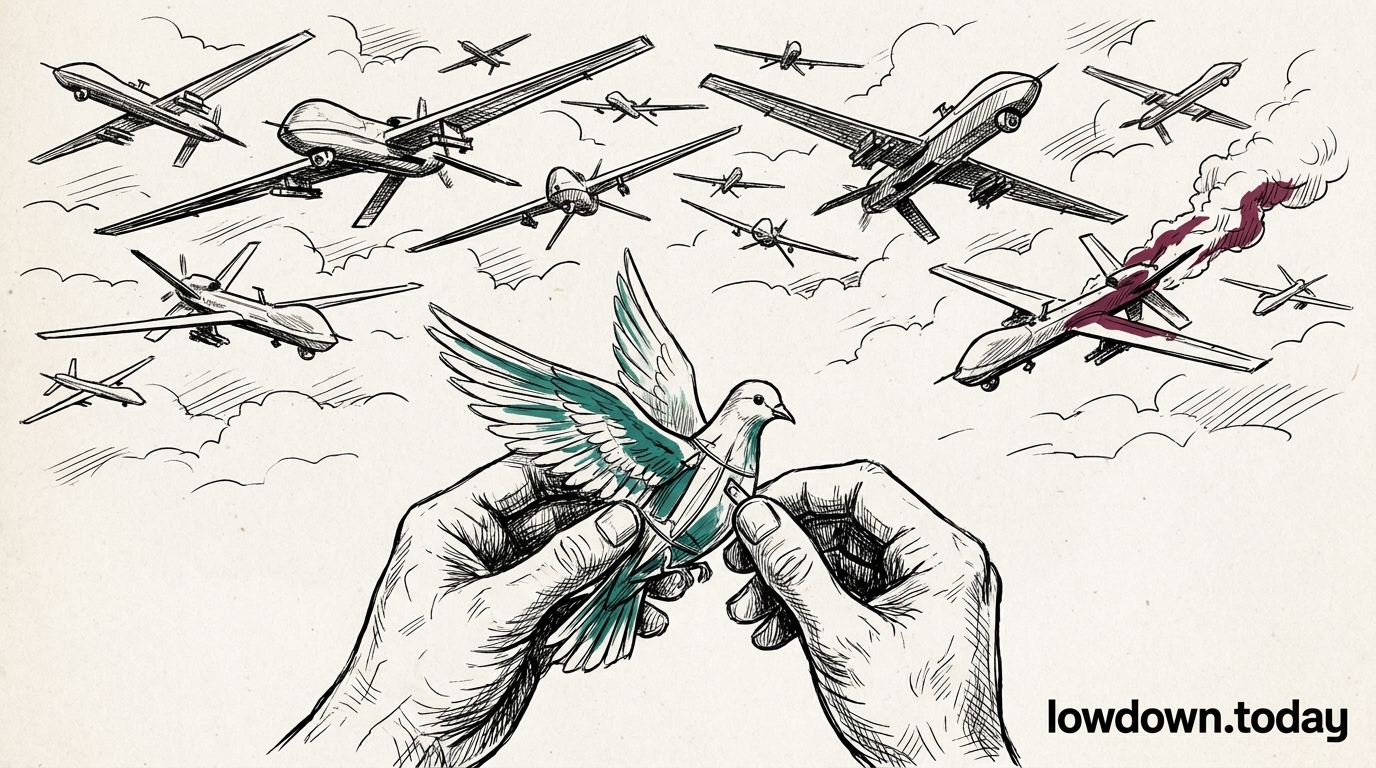
Russia launched 948 drones at Ukraine on 24 March, the largest single drone attack since the full-scale invasion began in February 2022 1. Strikes hit 11 oblasts in rare daytime waves, killing two people in Ivano-Frankivsk, two in Poltava, and one each in Vinnytsia, Zaporizhzhia, Kherson, and Kharkiv.

The barrage dwarfed the previous record of 430 drones and 68 missiles on 13-14 March and continued a trajectory that saw 9,616 kamikaze drones launched on 17 March alone . Daytime attacks are operationally different from night strikes: thermal detection works best against dark skies, while cluttered urban environments in daylight demand radar-guided interception instead. Russia appears to be testing whether saturating both halves of the 24-hour cycle can overwhelm Ukrainian air defence scheduling.

Zelenskyy told the BBC two days later that 800 US-made interceptors were consumed in three days of the Iran war , against 700 Ukraine received over its entire winter. With American production at 60 to 65 Patriot rounds per month, replacing those 800 takes a full year. Russia's spring offensive launched in the window of maximum interceptor scarcity.

In Lviv, a UNESCO World Heritage city 750 kilometres from the front line, the 16th-century Bernardine monastery lost its tower and the Church of St Mary Magdalene had its windows shattered 2. UNESCO dispatched experts to assess the cultural damage. The reach of the barrage, far beyond the eastern front, signals a deliberate effort to stretch Ukrainian air defences across the country's entire depth.

Deep Analysis

In plain English

Russia launched nearly 1,000 drones at Ukraine in a single day — more than double its previous record. Think of it as flooding every intersection in a city with cars at once: no matter how many traffic police you have, some will get through. Ukraine uses expensive missiles (think £1 million each) to shoot down cheap drones (think £10,000 each). Russia is betting it can exhaust Ukraine's missiles before Ukraine gets more. The timing matters because the US — Ukraine's main missile supplier — is currently using its own stockpile in a separate war against Iran.

Deep Analysis
Root Causes

Russia's drone escalation stems from three structural factors not visible in the daily headlines.

First, Iran's supply of Shahed-136 production licences in 2023 enabled Russia to manufacture at scale domestically, breaking its dependence on imported units and absorbing Western supply interdiction.

Second, Ukrainian air defence is fundamentally reactive: it must cover the entire country's depth, while Russia chooses when and where to strike. The 948-drone barrage across 11 oblasts simultaneously exploits that asymmetry.

Third, the Iran war created a window of US interceptor scarcity that Russia's military planners almost certainly anticipated from the moment American involvement in the Middle East became probable.

First Reported In

Update #8 · Pentagon diverts funds; 948 drones fired

Al Jazeera· 27 Mar 2026
Read original
Different Perspectives
NATO eastern flank (B9 + Nordics)
The B9+Nordic Bucharest joint statement on 13 May reaffirmed Ukraine's sovereignty within internationally recognised borders and backed NATO eastern flank reinforcement; the summit accepted Zelenskyy's bilateral drone deal proposal as a structural alternative to the stalled US export approval pathway, treating it as a European defence architecture question rather than aid delivery.
IAEA / Rafael Grossi
Grossi is still negotiating a sixth ZNPP repair ceasefire with no agreement after 50 days of 750 kV line disconnection; the 3 May ERCL drone strike that destroyed environmental monitoring equipment represents a qualitative escalation in infrastructure degradation that the IAEA has documented but cannot compel either party to halt.
Péter Magyar / Hungary
Magyar's incoming foreign minister pledged on 12 May that Hungary will stop abusing EU veto rights; the pledge is a statement of intent rather than a binding legal commitment, and Magyar's MEPs voted against the €90 billion loan as recently as April, while a planned referendum on Ukraine's EU accession preserves a downstream blocking lever.
EU Council and European Commission
The Magyar cabinet formation on 12 May removes the Hungary veto that had blocked the €9.1 billion first tranche since February; the Commission is now coordinating the three-document disbursement package for an early-June vote. The structural blocker is gone; the disbursement question is now scheduling, not politics.
Donald Trump / White House
Trump announced a 9-11 May three-day ceasefire with a 1,000-for-1,000 prisoner exchange attached, then called peace 'getting very close' on 11-13 May while Russia's 800-drone barrage was under way; his public framing adopted Russian diplomatic language without securing any Russian operational concession or verifying the exchange was agreed.
Vladimir Putin / Kremlin
Putin told reporters on 9 May the war is 'coming to an end' while Peskov confirmed on 13 May that territorial demands are unchanged and Russia requires full Ukrainian withdrawal from all four annexed regions; the verbal accommodation costs Moscow nothing and conditions any summit on a pre-finalised treaty Kyiv cannot accept.
