Skip to content
Welcome, thoughtbot's Giant Robots listeners!Start here
Pandemics and Biosecurity
25JUN

Kerala catches a Nipah case early again

3 min read
15:53UTC

Kerala confirmed a Nipah case in Kozhikode on 11 June, a 43-year-old man critical on a ventilator after cleaning a bat-infested building. ICMR traced about 100 contacts, 58 of them healthcare workers.

ScienceDeveloping
Key takeaway

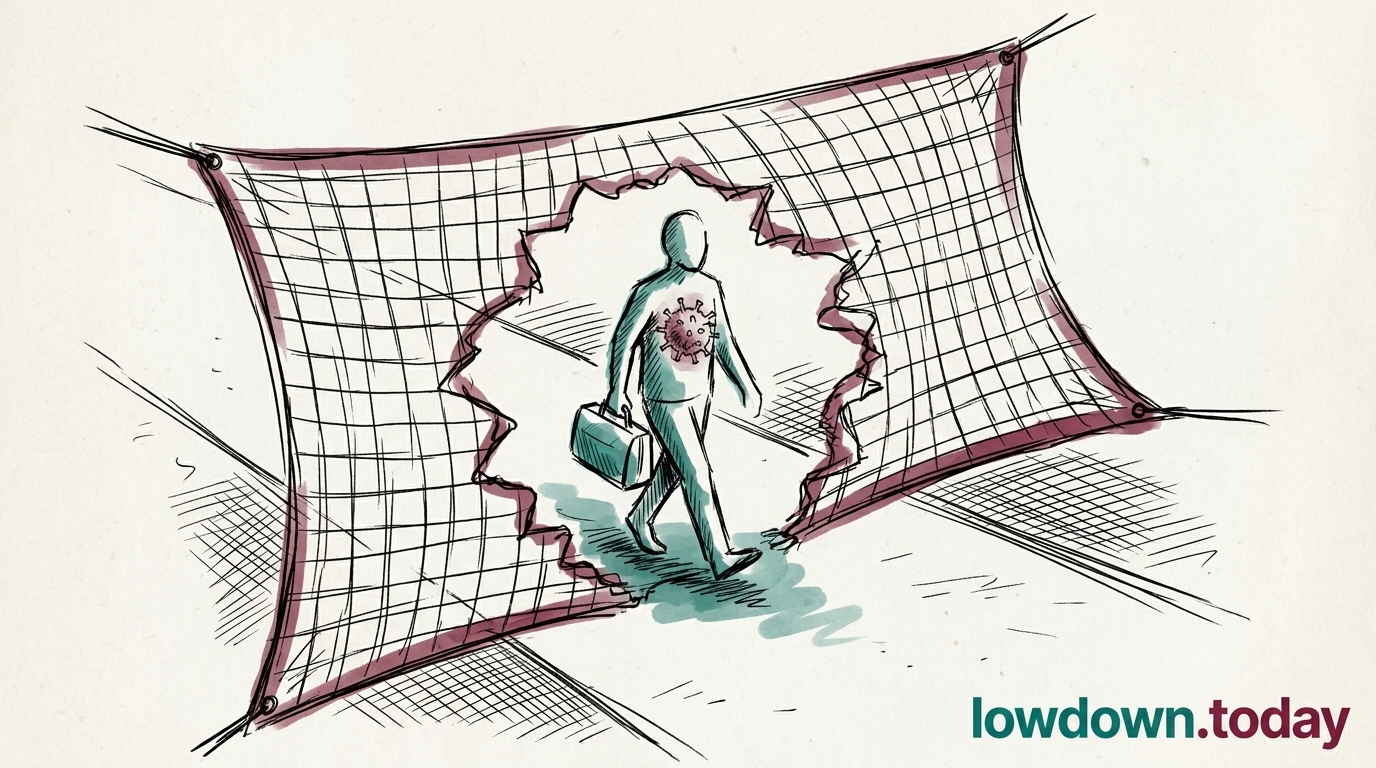
Kerala traced 100 contacts within days of confirming Nipah, the speed that has contained every outbreak since 2018.

Kerala confirmed a fresh Nipah case in Kozhikode on 11 June: a 43-year-old man in a critical condition on a ventilator, with suspected exposure from cleaning a bat-infested building⁠1. Nipah is a Paramyxovirus carried by fruit bats; it spills into people through contaminated food, animal contact or, in hospital settings, from patient to patient. Kerala, a southern Indian state, has faced recurring Kozhikode outbreaks since 2018.

The Indian Council of Medical Research, India's apex biomedical research body, deployed a team, and contact tracing reached about 100 people, 58 of them healthcare workers, the group at highest secondary-infection risk because Nipah amplifies inside hospitals. Speed is the only instrument that works here: Nipah kills 40 to 75 percent of those it infects and has no licensed vaccine, which is why it sits on the WHO R&D Blueprint's Paramyxovirus priority roadmap. With no countermeasure to deploy, the interval between symptom onset and isolation decides whether a case stays a case or becomes a chain.

Later reporting recorded three consecutive days with no fresh positives and the easing of containment-zone restrictions, the pattern of early containment rather than the start of an outbreak. This is what containment looks like when it works, achieved through tracing and isolation alone, and it stands apart from the West Bengal healthcare-worker cluster earlier this year.

Deep Analysis

In plain English

Nipah virus is a rare but serious disease that spreads from bats to humans, usually when people come into contact with bat droppings or partially eaten fruit. It can also spread between people, particularly in close-contact settings like hospital wards. There is no licensed vaccine or treatment; it kills between 40 and 75 percent of people it infects. Kerala, a state in southern India, has had multiple Nipah outbreaks since 2018. Each time, the state has managed to contain it before it spread widely. This week, a man in Kozhikode was confirmed infected on 11 June after cleaning a building where bats roosted. The Indian Council of Medical Research deployed a team immediately, and about 100 contacts, including 58 healthcare workers, were traced and monitored. Three days passed without any new cases, and restrictions were being eased when this briefing was written.

What could happen next?
  • Precedent

    Kerala's sixth successful single-case containment since 2018 represents a reproducible model for high-CFR zoonotic spillover response, based on standing protocols rather than ad hoc mobilisation.

  • Risk

    Each Kerala Nipah event involves bat colonies in proximity to dense human settlement. Without structural measures to reduce bat-roost contact, a longer-term ecological intervention, annual or biennial spillover events can be expected to continue.

First Reported In

Update #7 · Bundibugyo's fork stays open

ETV Bharat· 16 Jun 2026
Read original →
Causes and effects
This Event
Kerala catches a Nipah case early again
Nipah kills 40 to 75 percent of those it infects and has no vaccine, yet Kerala's surveillance has caught every local outbreak since 2018.
Different Perspectives
IGWG co-chair Tovar da Silva Nunes
The Brazilian co-chair closed the eighth pathogen-sharing session on 18 September without an agreed annex text, the second session in a row to end that way. He presented the outcome as continued commitment, with adoption due at the World Health Assembly in May 2027.
Fraport
Fraport
The Frankfurt Airport operator has told staff to watch for fever, hessenschau reported, after six airport workers caught malaria. Germany does not require insecticide spraying of arriving aircraft cabins, and parasite genotyping to trace the source is due at the end of October.
European Centre for Disease Prevention and Control
ECDC reported the eight Frankfurt Airport malaria cases on 18 September and considers repeated arrivals of infected mosquitoes on aircraft likely. It has not ruled out local mosquitoes, and awaits genotyping due at the end of October.
Pan American Health Organization
PAHO counted 53,957 measles cases in the Americas by 19 September and is supporting Peru's response in Puno and Arequipa. It warns that October's Señor de los Milagros festivities and Pope Leo XIV's November visit could increase transmission.
Bangladesh Directorate General of Health Services
The DGHS recorded 1,030 measles-related deaths and 172,720 suspected cases by 14 September, after a campaign that reached 19.75 million children. Its disease-control director, Halimur Rashid, said further vaccination rounds were expected within two weeks.
Minapharm
Minapharm
The Egyptian drugmaker and its Berlin subsidiary ProBioGen were awarded up to US$16.5m by CEPI on 27 August to take a Bundibugyo vaccine into a Phase 1 trial in Africa. Final manufacture is planned for Cairo, making it CEPI's first Bundibugyo candidate with an African producer.
