Skip to content
You can now search across every topic, entity and event.What's new
Pandemics and Biosecurity
31JUL

Nine of twelve Djugu posts shut

2 min read
10:28UTC

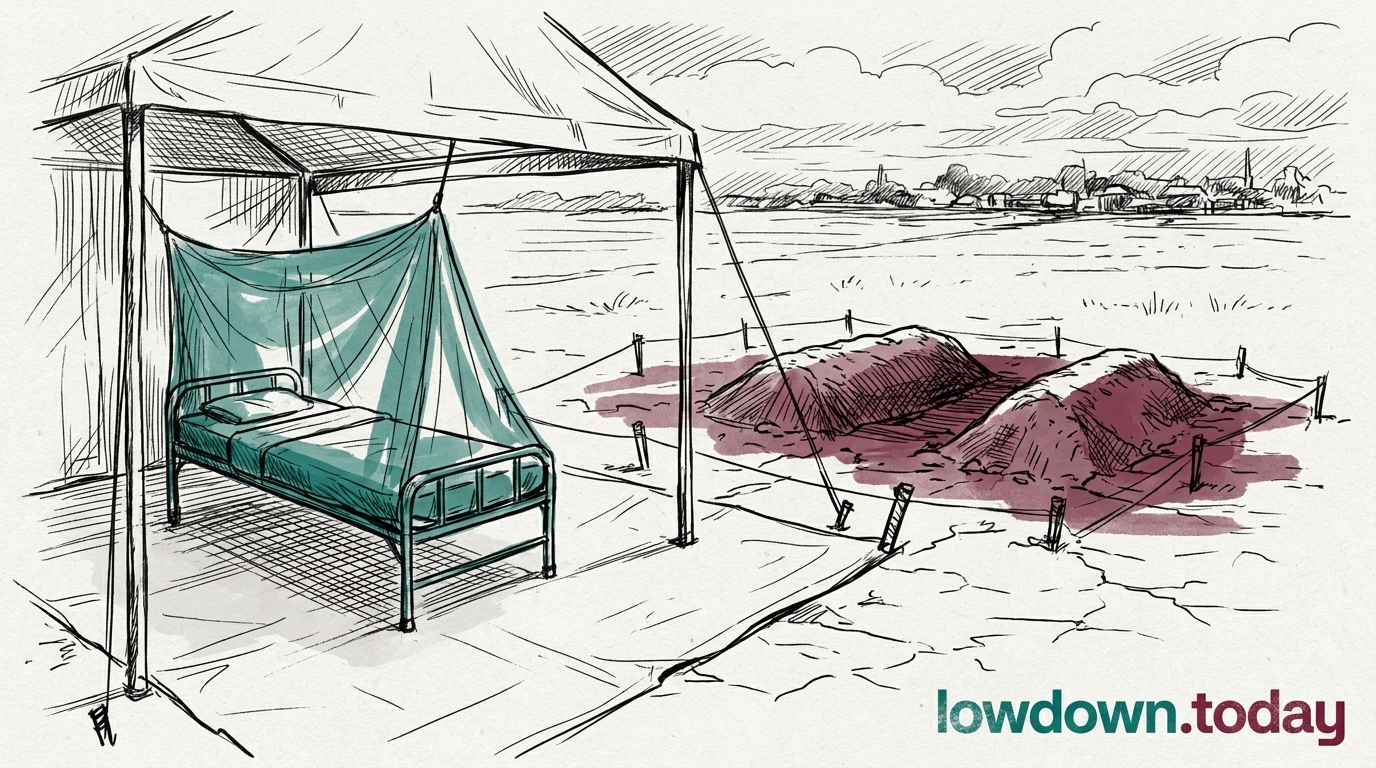
Radio Okapi reported on 15 July that nine of the twelve health posts in Djugu Territory's Heritage health area had closed, overwhelmed by patients. Customary chiefs raised the alarm, not the health ministry.

ScienceDeveloping
Key takeaway

Djugu's closed health posts stop treating patients and stop counting them at the same moment.

Nine of the twelve health posts in the Heritage health area of Djugu territory, in Ituri Province, have closed after being overwhelmed by patient numbers, Radio Okapi reported on Wednesday 15 July 1. Djugu is a territory of roughly a million people in north-eastern DR Congo, already displaced in large numbers by a decade of militia violence, and its health posts are the first and often only clinical contact most residents have.

Customary chiefs raised the alarm rather than the health ministry, which is itself a measure of how far the formal reporting line has thinned. One sector chief told Radio Okapi the closures had "already caused the death of more than one hundred people" 2. That is his own assertion and not verified surveillance data; no health ministry or WHO bulletin has published a figure for the Heritage health area at all. He named community resistance to sanitation protocols in the Djatsi and Pitsi sectors as accelerating the chains of infection.

A closed health post does two things at once, and the second is the one that shows up in the national numbers later. It stops treating people, and it stops reporting them. Ebola surveillance in DRC is built upwards from exactly these facilities, so a case that never reaches a post never enters the count. Responder infections had already tripled to 112 with 35 dead before the posts began closing , and the staff WHO would reopen them come from the same shrinking pool.

Deep Analysis

In plain English

Health posts are small, local clinics, often the first place someone with symptoms goes for care. In Djugu, an area of eastern DR Congo, nine out of twelve of these clinics have now closed because they could not cope with the number of Ebola patients arriving. A local official said the closures have already led to more than a hundred deaths, but that is his own estimate, not a confirmed count from health authorities.

Deep Analysis
Root Causes

Djugu Territory sits within a CODECO-contested zone that has constrained health workforce presence for years before this outbreak began; a caseload surge on top of that pre-existing under-staffing, not the outbreak alone, tips facilities into closure.

A second cause is structural rather than security-related: nine of twelve posts closing at once suggests the health area had no surge capacity built in, so any caseload spike above baseline overwhelms the same facilities that were already running near their limit.

What could happen next?
  • Meaning

    The closures show the outbreak reaching a point where formal health infrastructure, not just contact tracing, has started to give way.

  • Risk

    Patients turned away from closed posts likely seek care informally or not at all, feeding directly into the untraced-case pattern WHO reported for the wider outbreak.

First Reported In

Update #11 · Ebola outruns its own contact tracing

Radio Okapi· 21 Jul 2026
Read original
Causes and effects
This Event
Nine of twelve Djugu posts shut
A health area that loses three quarters of its treatment points stops producing the case reports that the national surveillance picture is assembled from.
Different Perspectives
Chinese health authorities
China reported three human H9N2 cases to WHO between 10 and 16 July: two four-year-olds recovered, a 44-year-old man remains in intensive care, the first severity signal in a cluster that has produced 173 cases and 2 deaths globally since 2015. The subtype is distinct from the H5N1 series this topic otherwise tracks.
US public health authorities
CIDRAP and Dr Andrew Racine, president of the American Academy of Pediatrics, call 2026's 2,318 confirmed measles cases by 24 July the worst year since 1991's 2,126. Zero deaths against three in 2025 and a 7% hospitalisation rate, down from 11%, show record case counts have not brought record severity.
CEPI
CEPI
CEPI put an rVSV-platform vaccine candidate specific to Bundibugyo ebolavirus into trial-production on 31 July, developed by Hilleman Laboratories with MSD manufacturing and IAVI's reference virus, funded up to $8.5m. Eleven weeks into the third-largest Ebola outbreak on record, this is the first species-matched candidate; the licensed vaccine covers only Zaire ebolavirus.
Médecins Sans Frontières
MSF reports sexual-violence care in Ituri is almost non-existent, with 7 of 14 health centres closed or relocated by fighting, as Panzi Hospital logs 646 new survivors in six months, an 85% rise. Withdrawn US funding for post-exposure prophylaxis has left clinics across three provinces without PEP kits for months, a crisis running alongside Ebola, not caused by it.
DRC health workers at Elikya Ebola Treatment Centre
Staff at DRC's Elikya Ebola Treatment Centre walked out on 25 July over unpaid wages, the second such action after Rwampara, while unconfirmed suspects occupy up to 64% of the country's isolation beds awaiting lab results. Workers are absorbing a response that has grown faster than its payroll and its labs.
Uganda's Ministry of Health
Uganda's ministry says it discharged its last confirmed patient on 16 June, completed every contact's 21-day follow-up, and declared the country Ebola-free on 28 July, exactly 42 days later. It names Hon. Dr Chris Baryomunsi, Minister of Health, as overseeing a 20-case, 2-death outbreak it now considers closed.