Skip to content
You can now search across every topic, entity and event.What's new
Pandemics and Biosecurity
31JUL

Ituri outbreak ran undetected for weeks

3 min read
10:28UTC

Imperial College London assessed the Bundibugyo outbreak had likely spread undetected for several weeks or months before WHO received its 5 May signal; 246 suspected cases and 80-plus deaths span three Ituri health zones.

ScienceDeveloping
Key takeaway

The largest Bundibugyo outbreak on record was already at 246 cases when international surveillance saw it.

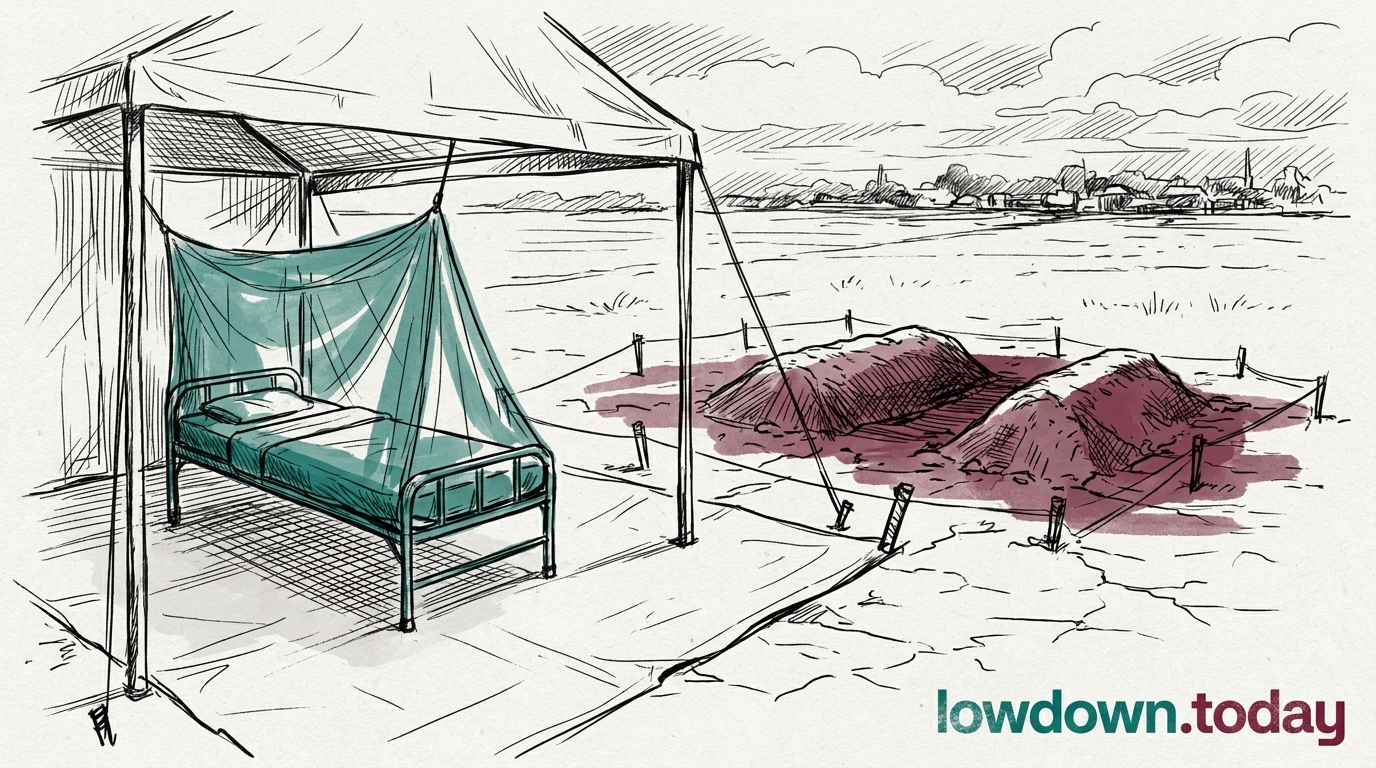
The Bundibugyo outbreak in Ituri Province, eastern DR Congo, has reached 246 suspected cases and 80 suspected deaths across the Bunia, Rwampara and Mongbwalu health zones, per the WHO PHEIC technical assessment 1. Anne Cori, Neil Ferguson and seven Imperial College London colleagues published a Q&A on Sunday assessing the outbreak had "likely gone undetected and spread for several weeks or months" before WHO received its signal on Tuesday 5 May 2. Provincial health authorities in Ituri told RFI Afrique that the first haemorrhagic-fever deaths in Djugu and Irumu territories were recorded in April 3. April community deaths to the 5 May WHO signal is at least four weeks of undetected onward transmission.

The scale already makes this the largest documented Bundibugyo outbreak on record, surpassing the 2007 Uganda outbreak's 131 cases. Imperial's panel estimates the Bundibugyo case-fatality rate at 30 to 40 per cent, lower than Zaire ebolavirus's 50 per cent average but still in the highest tier of human-pathogen lethality. At a 35 per cent rate, 246 suspected cases imply roughly 80 to 90 deaths if the chain runs to clinical conclusion, a figure the 80-plus suspected deaths already approach. Mongbwalu sits inside Djugu territory and Rwampara inside Irumu; both host active armed groups that constrain medical-team deployment.

The surveillance gap converts the headline figure from a story about African detection speed into a story about regional surge capacity. The pre-outbreak Filovirus roadmap had named precisely this scenario, non-Zaire Ebola species and the detection apparatus around them. The ECDC's parallel posture review of European preparedness reached compatible conclusions on detection lag. Imperial's "weeks or months" assessment is the operational consequence: by the time INRB confirmed species on 14 May, secondary chains inside the Bundibugyo 8 to 10 day incubation window were already running in three health zones, and contact tracing was opening at scale rather than at index.

Deep Analysis

In plain English

Ituri is a province in northeastern DR Congo, near the Uganda border. It has been caught in armed conflict for years, with armed groups attacking civilians and health facilities. Spotting an outbreak early is very hard there: health workers are scarce, clinics have closed, and people move around constantly because of the fighting. Bundibugyo ebolavirus spreads through direct contact with blood or bodily fluids of a sick person. It does not spread through the air. But in a setting with no hospitals and frightened communities, sick people may have contact with many family members and carers before anyone realises what they are dealing with. By the time the first samples reached Kinshasa's national laboratory on 5 May, people in Ituri had likely been dying from it since April.

Deep Analysis
Root Causes

Ituri Province sits at the intersection of three structural risk amplifiers. Alliance of Democratic Forces (ADF) armed activity in Irumu territory, directly south of Mongbwalu, has degraded healthcare infrastructure and displaced health workers repeatedly since 2019. By 17 May 2026, four healthcare workers in Ituri had died from confirmed Bundibugyo infection.

Gold mining drives internal migration between Mongbwalu (Ituri's main mining hub) and Bunia, creating a mobile population that carries transmission chains across health-zone boundaries before detection. The WHO R&D Blueprint Filovirus roadmap specifically named Ituri-type conflict-endemic zones as the highest-risk geography for non-Zaire Ebola detection failure in its March 2026 assessment.

The DRC's community surveillance network was rebuilt after the 2018-2020 Kivu Ebola crisis, but the ADF resurgence post-2021 destroyed community health worker networks in Irumu and parts of Djugu, the two territories where this outbreak is concentrated. The March 2026 Blueprint roadmap named this surveillance gap as unresolved.

What could happen next?
  • Risk

    Active ADF armed operations in Irumu territory, where part of the outbreak is concentrated, will restrict contact-tracing teams' access, potentially forcing response teams to work only in Bunia and Mongbwalu health zones.

    Immediate · 0.85
  • Consequence

    The four healthcare worker deaths already recorded in Ituri will deter local health staff from engaging with cases, compressing the already-thin response workforce further.

    Short term · 0.8
  • Risk

    If the outbreak's true onset was April rather than early May, the 30-40% of contacts who survived mild infection may have already returned to communities, mining sites, and cross-border routes without being traced.

    Short term · 0.7
First Reported In

Update #3 · WHO calls Ebola PHEIC, no treatment exists

World Health Organization· 17 May 2026
Read original
Causes and effects
This Event
Ituri outbreak ran undetected for weeks
An outbreak that surfaces at 246 cases already past four-plus weeks of community transmission has slipped the surveillance window that early countermeasures depend on.
Different Perspectives
Chinese health authorities
China reported three human H9N2 cases to WHO between 10 and 16 July: two four-year-olds recovered, a 44-year-old man remains in intensive care, the first severity signal in a cluster that has produced 173 cases and 2 deaths globally since 2015. The subtype is distinct from the H5N1 series this topic otherwise tracks.
US public health authorities
CIDRAP and Dr Andrew Racine, president of the American Academy of Pediatrics, call 2026's 2,318 confirmed measles cases by 24 July the worst year since 1991's 2,126. Zero deaths against three in 2025 and a 7% hospitalisation rate, down from 11%, show record case counts have not brought record severity.
CEPI
CEPI
CEPI put an rVSV-platform vaccine candidate specific to Bundibugyo ebolavirus into trial-production on 31 July, developed by Hilleman Laboratories with MSD manufacturing and IAVI's reference virus, funded up to $8.5m. Eleven weeks into the third-largest Ebola outbreak on record, this is the first species-matched candidate; the licensed vaccine covers only Zaire ebolavirus.
Médecins Sans Frontières
MSF reports sexual-violence care in Ituri is almost non-existent, with 7 of 14 health centres closed or relocated by fighting, as Panzi Hospital logs 646 new survivors in six months, an 85% rise. Withdrawn US funding for post-exposure prophylaxis has left clinics across three provinces without PEP kits for months, a crisis running alongside Ebola, not caused by it.
DRC health workers at Elikya Ebola Treatment Centre
Staff at DRC's Elikya Ebola Treatment Centre walked out on 25 July over unpaid wages, the second such action after Rwampara, while unconfirmed suspects occupy up to 64% of the country's isolation beds awaiting lab results. Workers are absorbing a response that has grown faster than its payroll and its labs.
Uganda's Ministry of Health
Uganda's ministry says it discharged its last confirmed patient on 16 June, completed every contact's 21-day follow-up, and declared the country Ebola-free on 28 July, exactly 42 days later. It names Hon. Dr Chris Baryomunsi, Minister of Health, as overseeing a 20-case, 2-death outbreak it now considers closed.