Skip to content
You can now search across every topic, entity and event.What's new
Pandemics and Biosecurity
31JUL

Ebola's responders are dying in Ituri

2 min read
10:28UTC

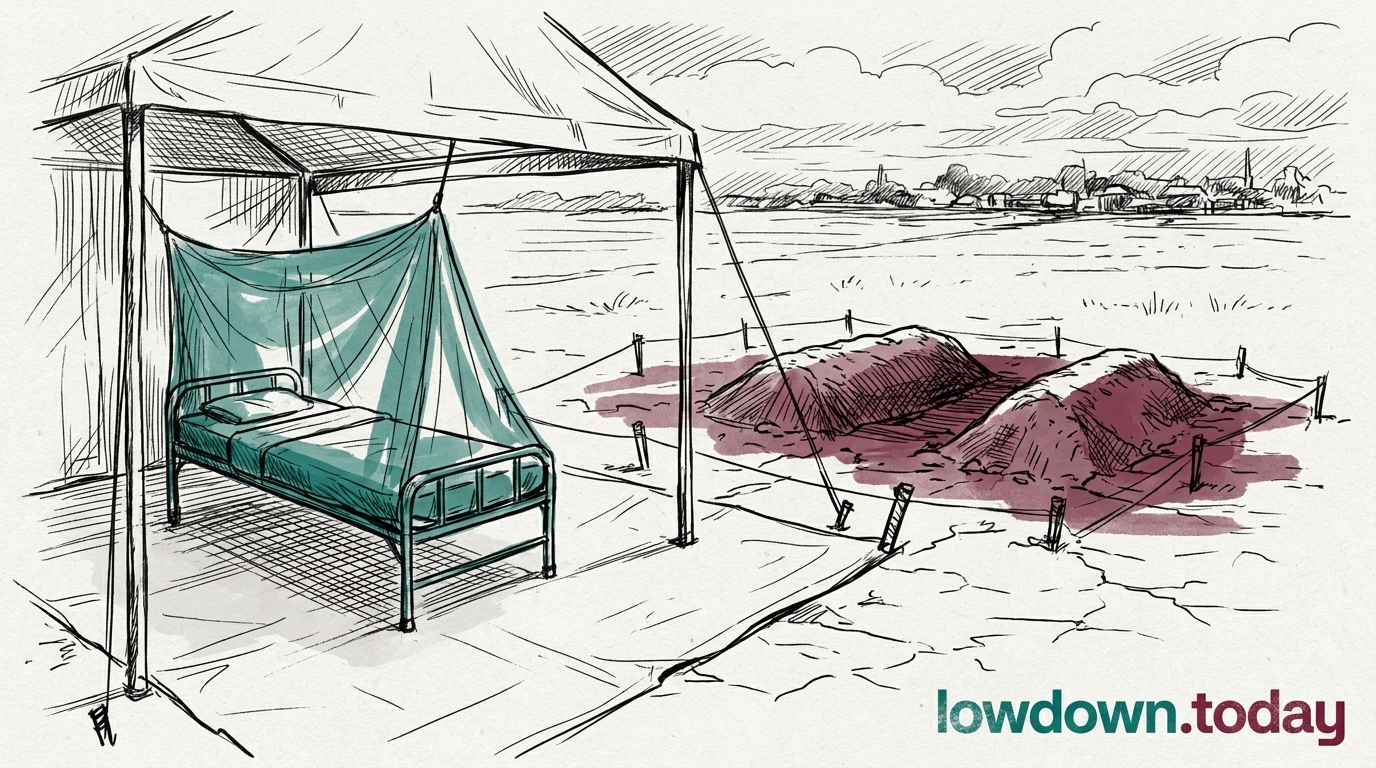
Africa CDC issued a formal responder-protection appeal on 11 July after health-worker infections in the Bundibugyo response tripled to 112, with 35 dead.

ScienceAssessed
Key takeaway

Bundibugyo has no vaccine, so responder safety rests on equipment and training, and both are failing as infections triple.

Africa CDC, the African Union's Africa Centres for Disease Control and Prevention, issued a formal appeal for responder protection on Saturday 11 July, its first move from quiet monitoring to a public demand for protective equipment, training and psychosocial support. Health-worker infections in the response to Bundibugyo, a rare Ebola species first identified in Uganda in 2007, had tripled from 34 in mid-June to 112, of whom 35 have died 1.

Bundibugyo has no licensed vaccine, so responder safety rests entirely on protective equipment, training and infection control, the exact inputs Africa CDC named as failing. In a filovirus outbreak a rising staff-infection count doubles as a warning: each hospital-acquired case marks a ward where the virus is amplifying rather than being contained. The appeal asks donors and deploying agencies to close that gap before the toll climbs again.

Deep Analysis

In plain English

Ebola causes severe bleeding and organ failure, and it spreads through direct contact with the bodily fluids of someone who is sick or has died from it. The people most exposed are the nurses, doctors and burial teams who treat patients every day. In DR Congo's Ituri Province, the number of these health workers who have caught the virus themselves has more than tripled in a month, and 35 of them have died. Africa CDC, the African Union's public health agency, is now formally asking for better protective gear, training and mental health support for the staff still working the wards.

Deep Analysis
Root Causes

Testing capacity in the affected provinces only rose from 200-400 to over 2,000 samples a day on 2 July, after WHO's Emergency Use Listing cleared the first Bundibugyo molecular diagnostic. Before that upgrade, health workers were routinely exposed to patients still awaiting results rather than confirmed cases, extending the window in which infection-control precautions were relaxed.

Ituri's health zones also draw staff from the same communities they treat, so an infected worker often continues informal caregiving contact with family after a shift ends, a transmission route no training programme currently covers.

What could happen next?
  • Risk

    If health-worker infections keep rising, treatment centres may lose enough trained staff to force ward closures independent of bed capacity.

First Reported In

Update #10 · Ebola's responders are now the casualties

Africa CDC· 14 Jul 2026
Read original
Different Perspectives
Chinese health authorities
China reported three human H9N2 cases to WHO between 10 and 16 July: two four-year-olds recovered, a 44-year-old man remains in intensive care, the first severity signal in a cluster that has produced 173 cases and 2 deaths globally since 2015. The subtype is distinct from the H5N1 series this topic otherwise tracks.
US public health authorities
CIDRAP and Dr Andrew Racine, president of the American Academy of Pediatrics, call 2026's 2,318 confirmed measles cases by 24 July the worst year since 1991's 2,126. Zero deaths against three in 2025 and a 7% hospitalisation rate, down from 11%, show record case counts have not brought record severity.
CEPI
CEPI
CEPI put an rVSV-platform vaccine candidate specific to Bundibugyo ebolavirus into trial-production on 31 July, developed by Hilleman Laboratories with MSD manufacturing and IAVI's reference virus, funded up to $8.5m. Eleven weeks into the third-largest Ebola outbreak on record, this is the first species-matched candidate; the licensed vaccine covers only Zaire ebolavirus.
Médecins Sans Frontières
MSF reports sexual-violence care in Ituri is almost non-existent, with 7 of 14 health centres closed or relocated by fighting, as Panzi Hospital logs 646 new survivors in six months, an 85% rise. Withdrawn US funding for post-exposure prophylaxis has left clinics across three provinces without PEP kits for months, a crisis running alongside Ebola, not caused by it.
DRC health workers at Elikya Ebola Treatment Centre
Staff at DRC's Elikya Ebola Treatment Centre walked out on 25 July over unpaid wages, the second such action after Rwampara, while unconfirmed suspects occupy up to 64% of the country's isolation beds awaiting lab results. Workers are absorbing a response that has grown faster than its payroll and its labs.
Uganda's Ministry of Health
Uganda's ministry says it discharged its last confirmed patient on 16 June, completed every contact's 21-day follow-up, and declared the country Ebola-free on 28 July, exactly 42 days later. It names Hon. Dr Chris Baryomunsi, Minister of Health, as overseeing a 20-case, 2-death outbreak it now considers closed.