Skip to content
You can now search across every topic, entity and event.What's new
Pandemics and Biosecurity
31JUL

Ebola crosses into M23-held South Kivu

3 min read
10:28UTC

The first confirmed Bundibugyo case in South Kivu appeared in territory held by the M23 rebel movement, where the patient died undiagnosed and residents torched a treatment facility as responders arrived.

ScienceDeveloping
Key takeaway

An outbreak that reaches rebel-held South Kivu outlasts the institutions built to contain it.

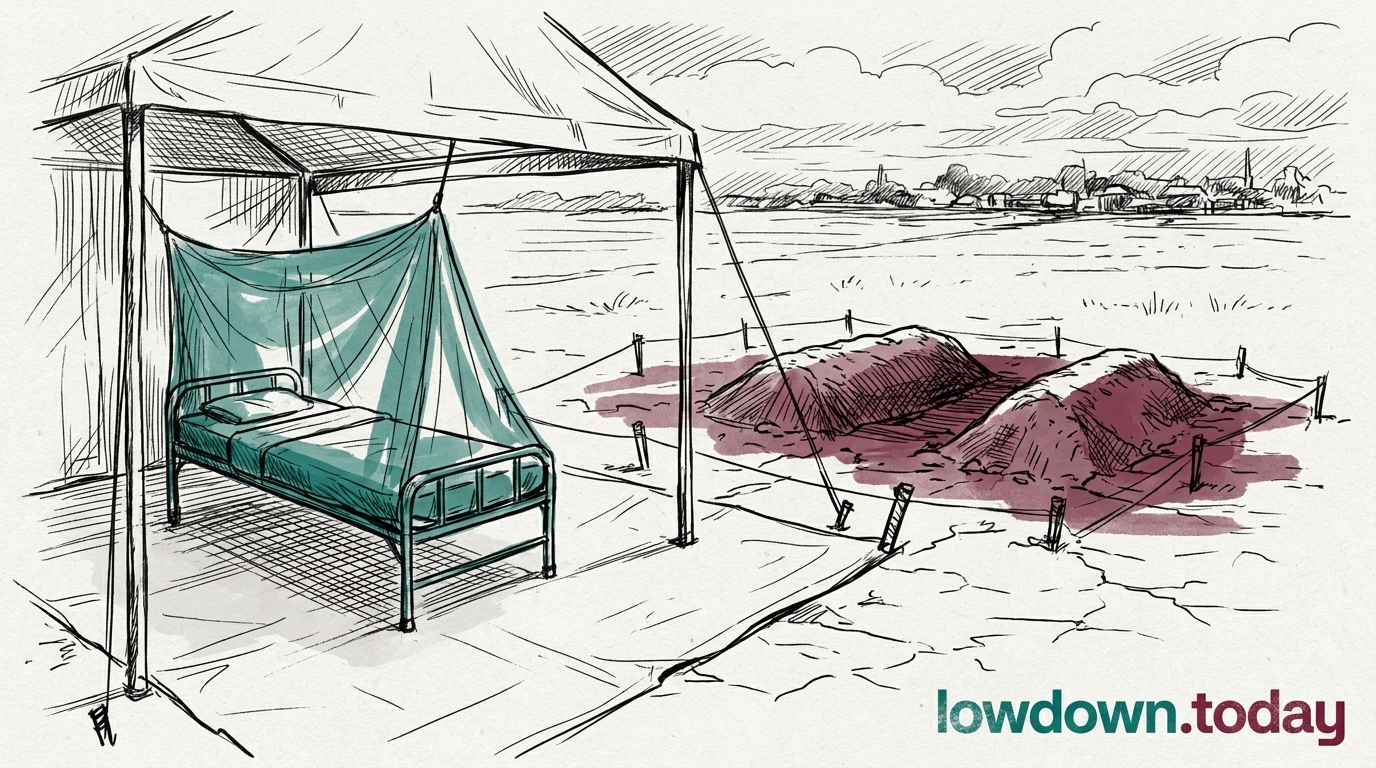
The first confirmed Bundibugyo Ebola case outside Ituri has appeared in South Kivu, the eastern DRC province held by the M23 rebel movement since February 2025 1. The patient, a 28-year-old, died before the diagnosis could be confirmed, and residents set fire to a treatment facility as responders arrived 2. M23 is a Rwandan-backed armed group; the territory it governs has no outbreak-management apparatus and no prior Ebola experience.

The crossing changes what kind of problem this is. Inside Ituri the response is at least a contest, however badly it is going under the 21% tracing ceiling logged in WHO's outbreak data . South Kivu offers no institution to work with at all. The 21-day contact monitoring, isolation wards and safe-burial teams that define an Ebola response all assume a public authority that can compel and protect; a rebel administration provides none of that, and the torched clinic shows the local trust deficit a response would have to overcome before it could begin.

This is the mechanism by which an outbreak outlasts its own emergency declaration. Africa CDC moved early and Uganda contained two imported cases with no onward spread , which shows containment is possible where the state functions. South Kivu removes that precondition. The India-Africa summit was postponed as the geography shifted 3, a small diplomatic casualty that signals how quickly a contained DRC health event becomes a regional one once it escapes the zones where anyone can act on it.

Deep Analysis

In plain English

South Kivu is a province in eastern DRC that has been controlled since February 2025 by M23, a rebel armed group backed by Rwanda. M23 has no hospitals, no disease-monitoring systems, and no government health authority. When Ebola crosses into territory they control, the standard outbreak tools cannot be used: tracing who a patient has been near, isolating them, monitoring for symptoms. A 28-year-old patient died there before doctors could even confirm the diagnosis. Local residents, frightened by the arrival of health teams in protective equipment, set fire to a treatment facility. This is not unusual: distrust of outside health workers was also a problem during the 2018-2020 DRC Ebola outbreak, the deadliest in that country's history.

Deep Analysis
Root Causes

South Kivu's inclusion in the outbreak corridor follows directly from Ituri's 21% contact follow-up rate (event-00): untraced contacts become the transmission chains that cross provincial and armed-group borders through gold-trade movement corridors.

The INRB (Institut National de Recherche Biomedicale) nine-day species confirmation lag meant the community-to-signal gap was over four weeks; by the time Bundibugyo was identified, transmission chains were already multi-generational. M23 has no public-health counterpart; it has no equivalent of the DRC Ministry of Health's operational reach, however imperfect that reach is in Ituri itself.

What could happen next?
  • Risk

    M23-held territory has no outbreak-management infrastructure; a transmission cluster establishing there would be functionally invisible to WHO and Africa CDC surveillance systems until patients cross into DRC government-held areas.

  • Precedent

    The South Kivu crossing sets a structural precedent for this PHEIC: if a single untraced contact can reach armed-group territory, the IHR Temporary Recommendations on exit screening are inadequate for an outbreak whose geographic perimeter includes ungoverned space.

First Reported In

Update #4 · Ebola triples, response misfires

Al Jazeera· 24 May 2026
Read original
Different Perspectives
Chinese health authorities
China reported three human H9N2 cases to WHO between 10 and 16 July: two four-year-olds recovered, a 44-year-old man remains in intensive care, the first severity signal in a cluster that has produced 173 cases and 2 deaths globally since 2015. The subtype is distinct from the H5N1 series this topic otherwise tracks.
US public health authorities
CIDRAP and Dr Andrew Racine, president of the American Academy of Pediatrics, call 2026's 2,318 confirmed measles cases by 24 July the worst year since 1991's 2,126. Zero deaths against three in 2025 and a 7% hospitalisation rate, down from 11%, show record case counts have not brought record severity.
CEPI
CEPI
CEPI put an rVSV-platform vaccine candidate specific to Bundibugyo ebolavirus into trial-production on 31 July, developed by Hilleman Laboratories with MSD manufacturing and IAVI's reference virus, funded up to $8.5m. Eleven weeks into the third-largest Ebola outbreak on record, this is the first species-matched candidate; the licensed vaccine covers only Zaire ebolavirus.
Médecins Sans Frontières
MSF reports sexual-violence care in Ituri is almost non-existent, with 7 of 14 health centres closed or relocated by fighting, as Panzi Hospital logs 646 new survivors in six months, an 85% rise. Withdrawn US funding for post-exposure prophylaxis has left clinics across three provinces without PEP kits for months, a crisis running alongside Ebola, not caused by it.
DRC health workers at Elikya Ebola Treatment Centre
Staff at DRC's Elikya Ebola Treatment Centre walked out on 25 July over unpaid wages, the second such action after Rwampara, while unconfirmed suspects occupy up to 64% of the country's isolation beds awaiting lab results. Workers are absorbing a response that has grown faster than its payroll and its labs.
Uganda's Ministry of Health
Uganda's ministry says it discharged its last confirmed patient on 16 June, completed every contact's 21-day follow-up, and declared the country Ebola-free on 28 July, exactly 42 days later. It names Hon. Dr Chris Baryomunsi, Minister of Health, as overseeing a 20-case, 2-death outbreak it now considers closed.