Skip to content
Welcome, thoughtbot's Giant Robots listeners!Start here
Is Britain Actually Broke?
28NOV

We left the UK row of the table empty

3 min read
11:43UTC

The IMF's tables, statistical appendix and DataMapper interface returned access errors across five URLs on two attempts, so this briefing publishes a G7 debt comparison with no British figure in it.

EconomicDeveloping
Key takeaway

A blank cell with a stated reason beats a plausible figure measuring the wrong thing.

The International Monetary Fund April 2026 World Economic Outlook puts general government gross debt at 204.4% of GDP in Japan, 138.4% in Italy, 125.8% in the United States, 118.4% in France, 110.7% in Canada and 64.6% in Germany⁠1. Germany is the only G7 member below 100%. Those six figures reach us through a secondary compilation of the IMF database rather than the IMF's own tables, which is a weaker provenance than every other cell in this briefing.

We left the British row blank on purpose. The IMF's tables, statistical appendix and DataMapper interface returned access errors across five separate URLs on two independent attempts this run, so we do not hold a UK figure on that standardised basis. The temptation is to reach for the 94.9% net debt figure the Office for National Statistics publishes and drop it in. That would be wrong twice over: public sector net debt is a different measure on a different definition, and general government gross debt already puts the UK above 100% on the IMF's convention. Two numbers in the same column measuring different things is the exact error this register was built to avoid, and a blank cell with a stated reason is more useful to a reader than a plausible wrong one.

Two British positions do stand out against that peer group, pointing in opposite directions. The average maturity of the gilt stock was 13.9 years at the end of December 2025, longer than the G7 average⁠2. Long maturities mean only a fraction of the debt has to be refinanced in any one year, so a buyers' strike would hurt Britain slowly rather than overnight, which is a genuine and underrated buffer. Against that, the UK carries the highest share of index-linked debt in the G7, the feature that blocks the inflation route out.

This briefing attempts no per-ledger international comparison, and later runs will not either. Section 114 notices, Office for Students returns and Regulator of Social Housing gradings have no foreign equivalents to compare against. The next run will try the IMF statistical appendix again; until then the cell stays empty.

Deep Analysis

In plain English

When comparing how much different countries owe, economists use a standardised measure called general government gross debt, tracked by the International Monetary Fund (IMF) so that every country is measured the same way. This is different from the UK's own headline figure, public sector net debt, which uses a different definition and cannot simply be swapped in. This week, the IMF's own website blocked every attempt to retrieve the UK's specific figure on that standardised basis, so this briefing reports Japan, Italy, the United States, France, Canada and Germany's figures but leaves the UK's blank rather than guess or substitute a different measure that would compare apples to oranges.

Deep Analysis
Root Causes

The IMF's World Economic Outlook database is the standardised source most cross-country debt comparisons rely on precisely because it applies one consistent methodology (general government gross debt) across member states, unlike each country's own domestic debt measure.

When that single source becomes technically unreachable, there is no equally authoritative substitute; a domestic figure like the UK's own PSND measure cannot simply be substituted, because it is not calculated on the same basis.

The access failure itself traces to standard web infrastructure (Akamai/edgesuite bot protection) applied to the IMF's domain, the kind of protection large institutional websites commonly deploy against automated scraping, which becomes a research obstacle specifically for anyone trying to fetch data programmatically rather than reading it manually in a browser.

What could happen next?
  • Risk

    Readers or other outlets substituting the ONS's 94.9% net-debt figure into an international gross-debt comparison table would be making a genuine category error, understating where the UK actually sits against G7 peers on the IMF's own convention.

First Reported In

Update #1 · The distress moved from banks to councils

Mappr· 27 Jul 2026
Read original →
Causes and effects
This Event
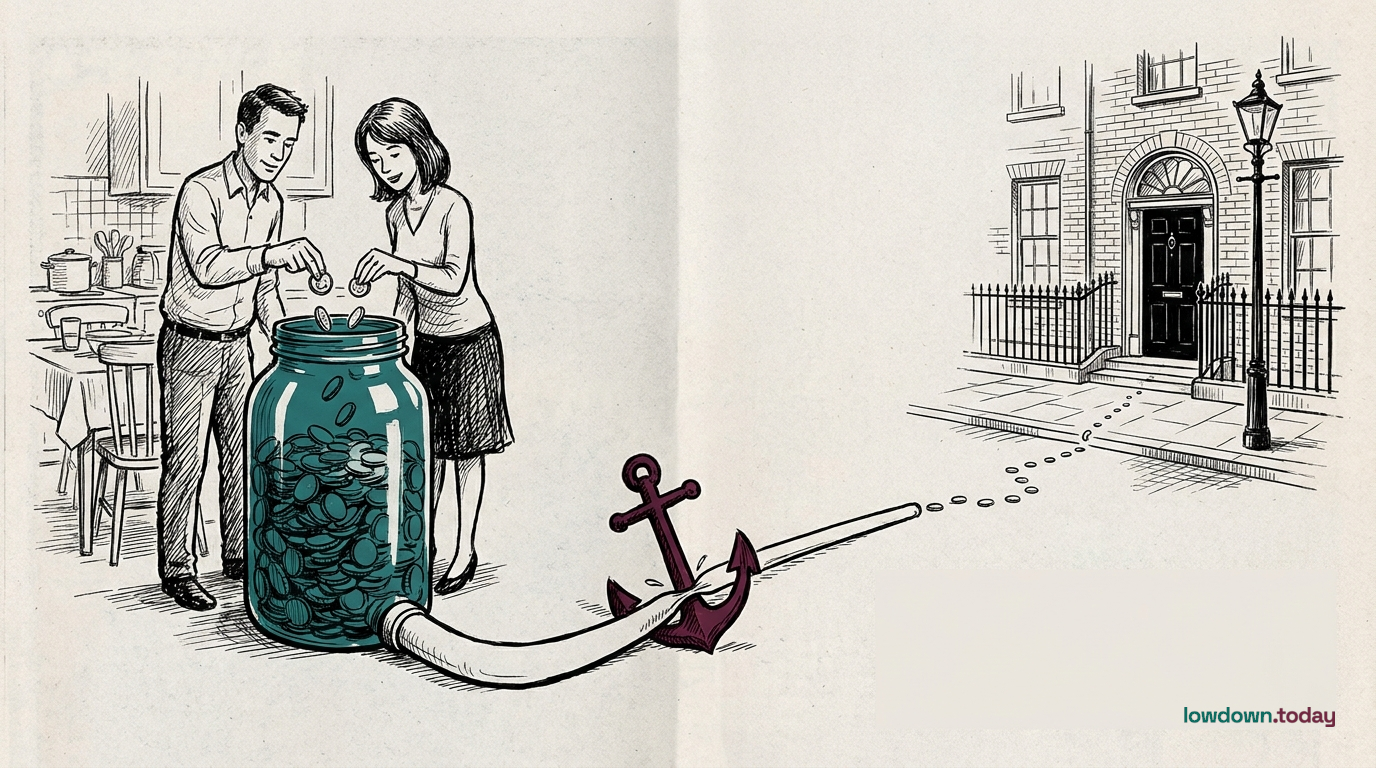
We left the UK row of the table empty
The obvious fix would be to drop Britain's 94.9% into the gap, and it would be a category error dressed up as completeness.
Different Perspectives
The fiscal hawk case
Borrowing has run over the March plan for four months, October's £11.2bn interest bill was the highest October since 1997, and the OBR's ready reckoner adds £8.6bn of interest in 2027-28 for each lasting point of inflation. Hawks argue £15bn of headroom leaves little room for another shock before taxes rise again.
The not-broke case
The not-broke case
HMRC receipts are up £33.4bn on a year earlier, the current budget is about £0.5bn under the March plan, GDP grew 0.7% in the third quarter, and the OBR calls borrowing broadly in line. On this reading Britain is paying more to borrow while its power to raise money holds.
Ministry of Housing Communities and Local Government
The housing ministry gave English councils over £80bn of core spending power for 2027/28 on 26 November, over £3bn more, and kept Exceptional Financial Support only on a temporary footing with outside checks on the books. A council in trouble can still get help, but not open-ended help.
National Institute of Economic and Social Research
The independent forecaster said on 19 November that policy is pushing households out of cash, most recently through the Budget's higher tax on savings interest, and that this alone will do little for UK firms. On October's inflation it found energy the main driver, with little sign of a wage-price spiral.
Resolution Foundation
The centre-left think tank said on 17 November that real pay growth, 0.2% in July to September, will go negative this winter as inflation heads towards 5% by spring. On its reading, household budgets tighten while the Treasury's tax take grows.
Bank of England
Bank of England
The Bank said on 26 November that about 6.5 million mortgages face higher payments as fixes end, by about £100 a month for a typical borrower, but arrears are close to their long-run average. It judged the banking system well capitalised, so lenders can absorb the squeeze without pulling credit.

Written with AI from Lowdown's published reporting. Not individually reviewed by an editor. Editorial standards.