Skip to content
Briefings are running a touch slower this week while we rebuild the foundations.See roadmap
Iran Conflict 2026
11MAY

EU bans Russian LNG from 25 April

4 min read
14:01UTC

The EU's phased ban on Russian gas imports begins 25 April with LNG, all Russian gas banned by year-end — closing the last major European energy link to Moscow as oil revenues have already collapsed 65%.

ConflictAssessed
Key takeaway

The April LNG cutoff ends Russia's last meaningful energy leverage over EU member states.

The EU Council approved a phased ban on Russian gas imports: LNG from 25 April 2026, with all Russian gas banned by year-end 1. The decision closes the final chapter in an energy relationship that, before February 2022, saw Russia supply roughly 40% of Europe's natural gas.

Much of the decoupling had already occurred by force or circumstance. The Nord Stream 1 and 2 pipelines were sabotaged in September 2022. Germany, the Netherlands, and Finland built emergency LNG import terminals. Norway, the United States, and Qatar replaced Russian volumes at pipeline-equivalent scale. When Ukraine declined to renew its gas transit agreement in December 2024, the last major overland pipeline route to central Europe shut. What remained was Russian LNG, still flowing through terminals in Belgium, France, and Spain — a trade European governments tolerated because spot LNG markets offered competitive prices and no single member state wanted to absorb the adjustment cost unilaterally. The January 2026 Council vote to ban it required months of negotiation, with Belgium and Spain the last holdouts.

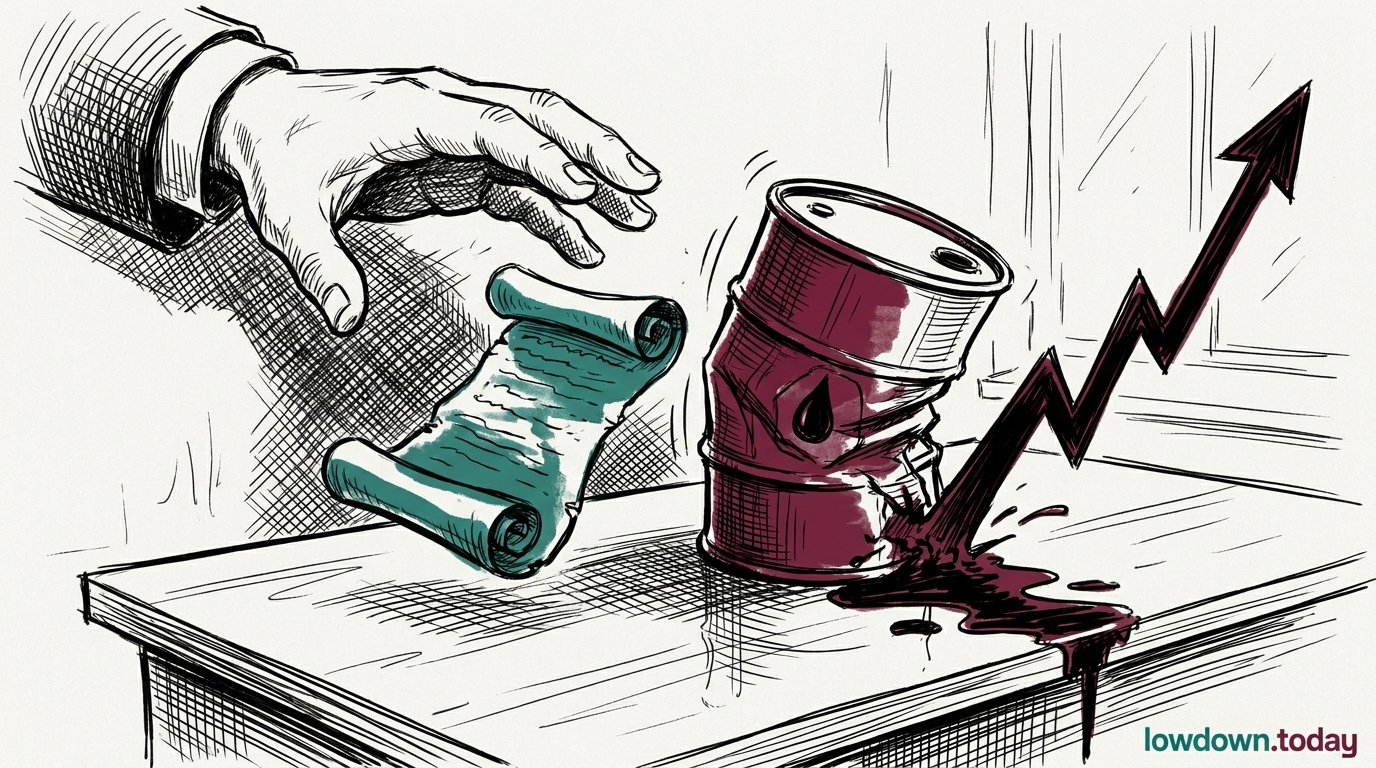
The ban's fiscal impact on Moscow compounds an already severe revenue collapse. Russian oil and gas revenues fell 65% year-on-year in January 2026, with Urals Crude trading at $38 per barrel against Brent at $62.50 2. Before the invasion, hydrocarbon revenues constituted roughly 40% of Russia's federal budget. Moscow has drawn down its National Wealth Fund to cover wartime deficits — a reserve that is finite and shrinking. The question is whether Asian buyers absorb displaced gas volumes at prices that compensate for the lost European premium. So far, they have not. China and India have both extracted steep discounts on Russian crude, and the Power of Siberia pipelineMoscow's primary gas route to China — has a capacity of roughly 38 billion cubic metres per year, a fraction of the 150 bcm Russia once exported annually to Europe. Power of Siberia 2, routed through Mongolia, remains unsigned.

The April start date carries practical logic: spring reduces European heating demand, giving importers a full summer to lock in alternative supply contracts before winter 2026–27. For Russia, the calendar is less forgiving. By the time the full ban takes effect in December, Moscow will have lost effectively all European energy income within a single year. The energy leverage that underpinned Russia's geopolitical position in Europe for three decades — the implicit threat that winter gas cuts could fracture European unity — is now a spent instrument.


Deep Analysis

In plain English

For decades, Russia piped natural gas into European homes and factories, giving Moscow political leverage — threaten to cut supplies and Europe suffers. Since 2022, Europe has been replacing that gas with shipments from the US, Norway, and Qatar. The April 2026 ban removes the last Russian gas from European markets. For most Europeans, the dependency is essentially over. The remaining question is cost: LNG from distant suppliers is more expensive than Russian pipeline gas was, and that price difference is embedded in energy bills and industrial production costs across the continent. Central and Eastern European countries that held out longest face the sharpest short-term adjustment.

Deep Analysis
Synthesis

The ban's April timing — arriving as Russian oil revenues are already down 65% year-on-year — creates compounding fiscal pressure on Moscow. The LNG cutoff adds an estimated $8–12bn in annual European revenue loss on top of the oil price collapse. Russia has no near-term mechanism to replace European demand at equivalent pricing: Asian buyers extract significant discounts given sanctions-related shipping and insurance complications.

Root Causes

Europe's structural dependency on Russian pipeline gas was the commercial legacy of Ostpolitik — deliberate post-Cold War economic integration policy that created purpose-built pipeline infrastructure and long-term supply contracts. Market signals alone could not unwind this lock-in; it required the political shock of a full-scale invasion to override the embedded industrial and political interests sustaining the relationship.

What could happen next?
2 consequence1 risk1 precedent1 opportunity
  • Consequence

    Russia loses its last direct energy-revenue channel from EU markets, compounding the oil revenue decline already recorded in January 2026.

    Immediate · Assessed
  • Risk

    Central European gas-intensive industries may face competitive pressure as energy costs rise relative to pre-ban levels during the supply adjustment window.

    Short term · Suggested
  • Consequence

    Russian LNG will compete on Asian spot markets at a discount, reducing Novatek's per-unit revenue and limiting Moscow's capacity to offset the EU market loss.

    Medium term · Assessed
  • Precedent

    The EU ban establishes that a major economy can structurally divorce a dominant energy supplier within four years under sufficient political will.

    Long term · Assessed
  • Opportunity

    US LNG exporters and Norwegian gas producers gain structurally permanent European market share that Russian pipeline pricing had previously foreclosed.

    Long term · Assessed
First Reported In

Update #1 · Ukraine best month as Russia triples drones

EU Council· 3 Mar 2026
Read original
Different Perspectives
International human rights monitors (NetBlocks, IHR, Hengaw)
NetBlocks recorded 1,704 cumulative hours of near-total internet blackout for roughly 90 million Iranians on Day 74, while IHR documented ongoing executions under emergency provisions. These organisations are the only active monitoring windows into a civilian population cut off from the global internet for 71 consecutive days.
UK / France coalition
The Royal Navy confirmed HMS Dragon's Hormuz deployment on its own website on 11 May, converting a press-reported presence into declared force posture; UK and French defence ministers hosted a coalition meeting the same day. Britain and France are now the only named contributors to a Hormuz escort mission all five allies Trump originally asked had declined.
Saudi Aramco / Gulf producers
Saudi Aramco CEO Amin Nasser warned on 11 May that a Hormuz closure could remove 100 million barrels of weekly supply from global markets (roughly 15 million barrels per day for a week), a figure that dwarfs any OPEC+ swing capacity. The warning functions as both a price-floor signal and a public pressure on Washington to protect transit.
Beijing / Chinese Government
China has not publicly acknowledged the four Hong Kong-registered entities designated on 11 May or extended MOFCOM's Blocking Rules cover to HK-domiciled firms. Xi Jinping hosts Trump on 14–15 May having already de-risked state-bank balance sheets via NFRA's quiet loan halt, entering the summit partially compliant before any negotiation.
Tehran / Iranian Government
Foreign Minister Araghchi described Iran's 10-point counter-proposal as 'reasonable and responsible' via spokesman Baqaei on 11 May, and widened the mediator pool by meeting Turkish, Egyptian, and Dutch counterparts in a single day. Tehran is buying procedural runway while Trump's verbal rejection went unmatched by any written US counter.
Trump White House
Trump White House
Trump called the ceasefire 'on massive life support' and dismissed Iran's 10-point counter-proposal as 'a piece of garbage' on 11 May, while departing for Beijing two days later with no signed Iran instrument to show Congress. The verbal maximum and the paper void coexist: the administration is running a legal pressure campaign through Treasury while the president free-lances the rhetoric.



