Skip to content
Welcome, thoughtbot's Giant Robots listeners!Start here
Iran Conflict 2026
10MAY

TTF round-trips on Hormuz, ends Q2 down

3 min read
14:22UTC

TTF round-tripped from a €43.6 two-week high to a €40.6 two-month low and back to €43.62 over 27-30 June, yet still closed the quarter down more than 14%.

ConflictDeveloping
Key takeaway

TTF round-tripped on Hormuz headlines over four sessions but still closed the quarter down more than 14%.

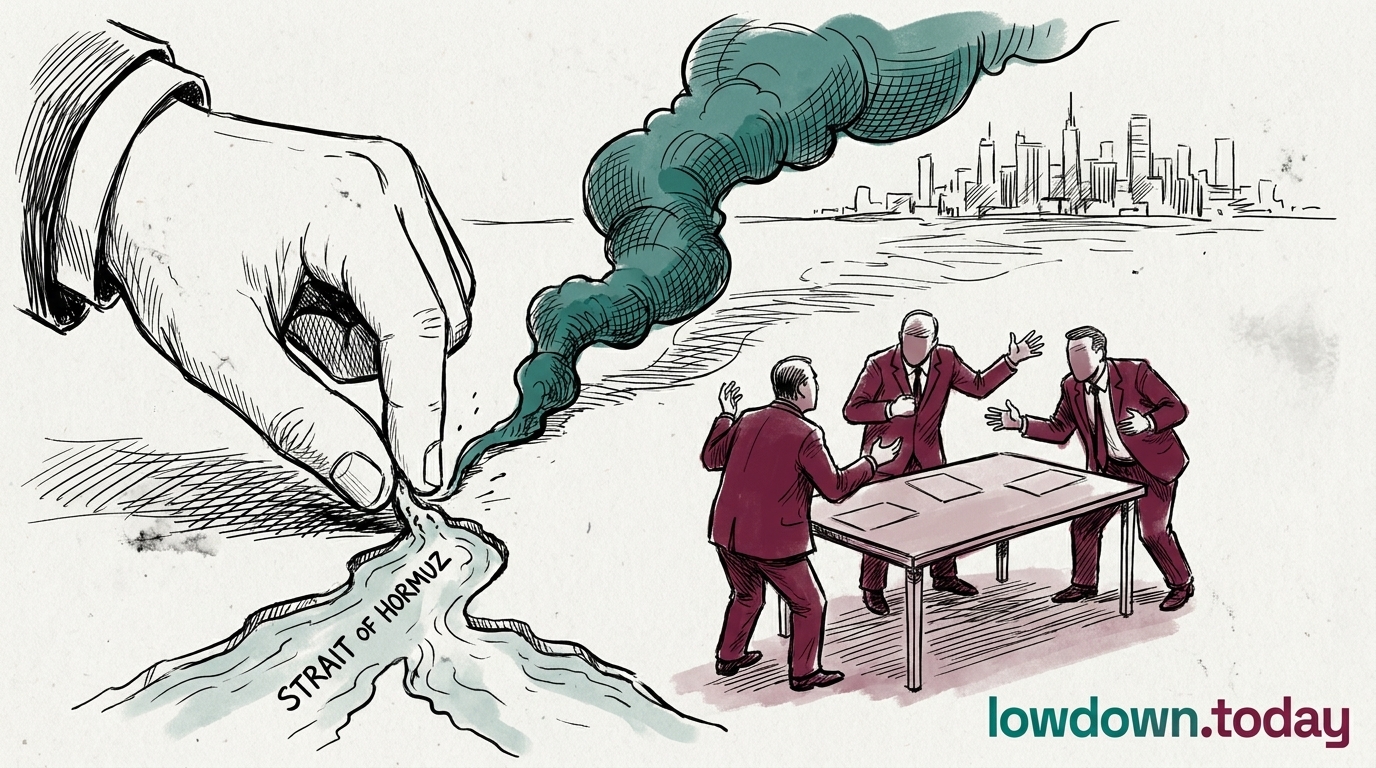
TTF ran a full round-trip in four sessions. The European benchmark gas price touched roughly €43.6/MWh on 27 June, a two-week high on fears a Gulf strike would choke tanker traffic, then fell to €40.6 on 29 June, a two-month low, once the verbal US-Iran stand-down pulled the risk premium back out⁠1. By 30 June it had snapped back to €43.62, up 7.6% intraday, as heat returned and Gulf risk re-bid.

TTF, the Title Transfer Facility, is the Dutch hub price every European gas contract references, and it has spent the season taking its cue from Hormuz headlines rather than from any shift in the physical balance. Across 27 to 30 June, tanker-traffic fear, the stand-down, then a fresh re-escalation moved the front month nearly €3 in either direction while storage filled steadily underneath⁠2.

For all that motion, the quarter closed lower. TTF fell more than 5% across June and more than 14% over the quarter⁠3. The same stand-down lifted Brent only 1.3%, to $72.91, the oil benchmark reading The Gulf far more calmly than the gas one. Crude barely moved while European gas ran from its two-month low back to its prior level inside a week, and that gap puts Hormuz risk into gas before it touches oil in the current supply environment.

Deep Analysis

In plain English

TTF is the Dutch Title Transfer Facility, the main pricing point for wholesale gas in Europe. When you buy gas in Europe, the price is usually set by reference to TTF. Between 27 and 30 June, TTF swung from €43.6 to €40.6 and back to €43.62, a round-trip caused by news reports from the strait of Hormuz, the narrow sea channel through which most Middle Eastern gas tankers must pass. Oil prices barely moved on the same news, rising just 1.3% on the stand-down announcement. European gas moved more than seven times as much. That gap exists because Saudi Arabia can send its oil through an overland pipeline to bypass Hormuz, but there is no equivalent pipeline bypass for Qatar's gas. If Hormuz closes, European gas has no alternative supply route; oil has at least a partial one. The quarter closed with European gas down more than 14% overall, because the same Hormuz-de-escalation trade that lifted prices briefly in April reversed more permanently through June.

Deep Analysis
Root Causes

European gas has no strategic reserves equivalent to the IEA's 90-day oil stock mechanism, which allows oil markets to absorb a physical supply interruption without an immediate spot price response. European gas storage carries a structural buffer, but at 48.62% fill on 28 June it stood 31 points below the statutory 80% floor target, meaning the entire physical buffer was at risk under a closed-corridor scenario with no draw capacity to suppress price signals.

The JKM-TTF arb had already compressed to near-parity by 29-30 June, removing the Atlantic cargo routing flexibility that in a wider-arb environment would have dampened European price spikes: flexible US LNG cargoes could not divert to Europe without accepting parity-or-worse netback economics. Every Hormuz headline therefore hit a market with thin inventory, no strategic reserve backstop, and no Atlantic cargo pipeline to provide counter-cyclical supply.

Brent's relative insensitivity to the same news reflects Saudi Arabia's East-West crude pipeline, which can bypass Hormuz for roughly 5 million barrels per day of Saudi export capacity. No equivalent gas bypass exists for Qatari LNG.

What could happen next?
  • Risk

    A single Gulf re-escalation headline can move TTF front-month EUR 2-3/MWh within hours at current inventory levels, giving gas market participants limited ability to hedge headline risk through physical buffers alone.

  • Consequence

    The Q2 TTF decline above 14% reduces the embedded cost in next-winter forward contracts and may lower projected household energy bills relative to Q1 forecasts, provided Hormuz remains open through the autumn injection season.

First Reported In

Update #22 · Germany refills as the autumn cliff nears

Trading Economics· 30 Jun 2026
Read original →
Different Perspectives
Office for Budget Responsibility
The OBR's 28 October forecast assumed $82 oil for 2026 and 2027, from market prices for the ten working days to 19 August, and blamed dearer wholesale energy on the war without naming Iran. It expects CPI inflation close to 4% in early 2027 even at that price.
Hengaw, Kurdish rights group
Hengaw reported the 3 November hangings of Amirhossein Maleki and Amirhossein Ebrahimi in Isfahan, saying Ebrahimi was tortured into confessing and that nine of 12 people sentenced to death in the case have now been hanged. Iran's judiciary holds that the defendants killed members of the security forces.
FINTRAC, Canada's financial intelligence unit
FINTRAC worked with the US Treasury on the 6 November designation of eight money services businesses in British Columbia, Ontario and Quebec. Treasury says the businesses still operate, some under new names, so closing them falls to Ottawa.
Abdul Qadir al-Dakhil, Governor of Nineveh
Al-Dakhil cancelled three Mosul International Airport contracts on 7 November over alleged links to armed groups, after meeting Prime Minister Ali al-Zaidi in Baghdad. He named no group or company, and said the contracts will go to international companies.
Kuwait
Kuwait
Kuwait condemned the Houthi missile fired towards the Madinah region on 5 November and restated its support for Saudi Arabia, the Qatar News Agency reported. Its state tanker company, Kuwait Oil Tankers Company, is among the Gulf state fleets on Iran's expanded Hormuz list.
Scott Bessent, US Treasury Secretary
Treasury designated an alleged Chandigarh false-flag network on 4 November and eight Canadian exchangers on 6 November, while State sanctioned alleged MANPADS intermediaries. None of the actions touches an oil buyer; they target the paper, cash and procurement around Iran's trade.

Written with AI from Lowdown's published reporting. Not individually reviewed by an editor. Editorial standards.
