Skip to content
Briefings are running a touch slower this week while we rebuild the foundations.See roadmap
Iran Conflict 2026
17APR

Khamenei invisible for 17 days

2 min read
09:52UTC

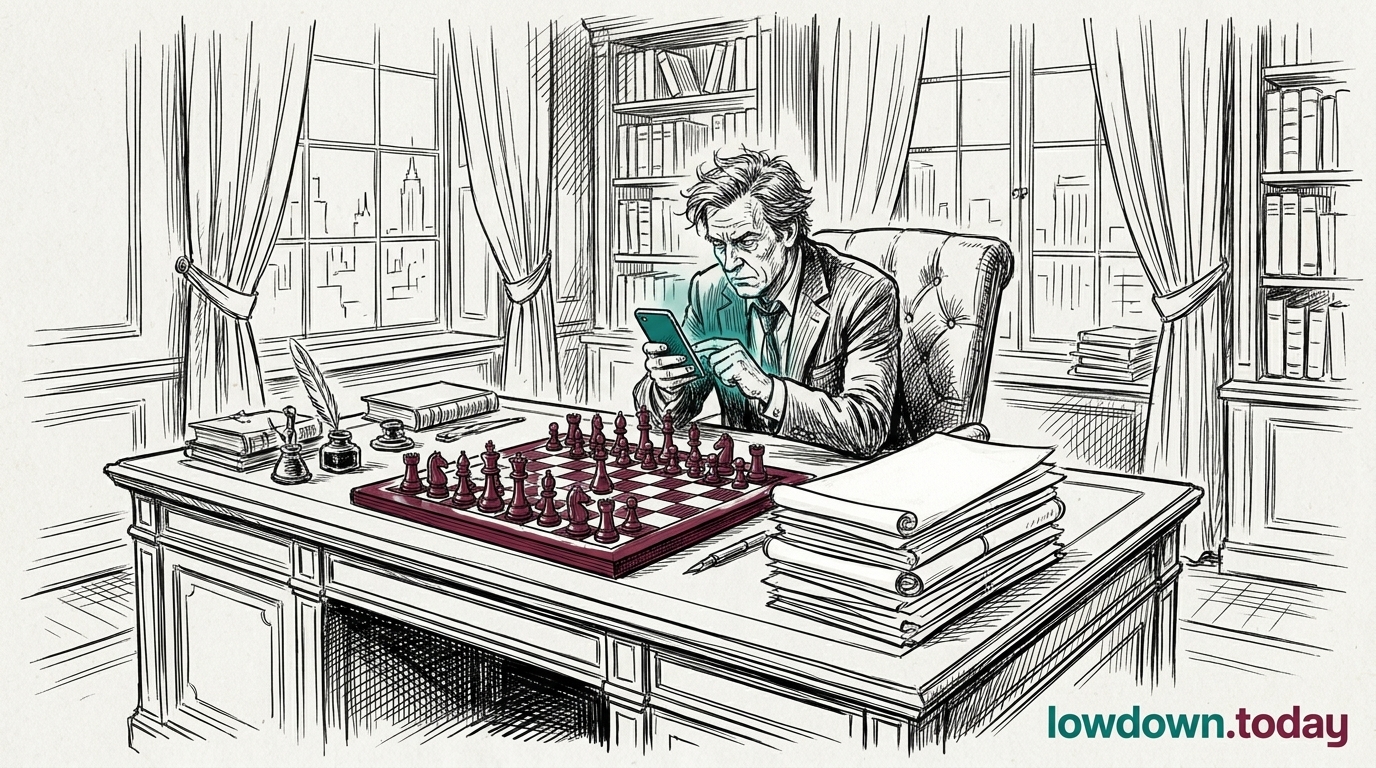
No video. No audio. One written statement read by a TV anchor over a still photograph. The longest absence of any Supreme Leader since 1979.

ConflictDeveloping
Key takeaway

Iran's wartime decisions lack visible supreme-leader authority.

Supreme Leader Mojtaba Khamenei had not appeared in public for at least 17 days as of 30 March, the longest absence of any Supreme Leader since the 1979 revolution. 1 2 His only communication was a written statement read by a state TV anchor over a still photograph. No video or audio of Khamenei himself has been released.

The absence coincides with the most consequential period of the war: ground forces converging on The Gulf, a third Bushehr strike, the NPT withdrawal bill, and 1,700 wartime arrests. Jerusalem Post sources described the Iranian power arrangement: 'The Revolutionary Guards are controlling him, not the other way around.' A Middle East Institute senior fellow assessed that Mojtaba Khamenei 'owes his position to the Revolutionary Guards.'

Whether the absence reflects security precautions, incapacity, or IRGC-imposed isolation cannot be determined from open sources. The CIA, Mossad, and allied agencies were actively searching for evidence he is alive and functioning as of Day 23. His predecessor missed no Nowruz address in the revolution's entire history; Mojtaba's silence over the Persian New Year on 20 March remains the most striking public absence.

The practical consequence is institutional: the IRGC appears to be the decision-making authority in a wartime state that constitutionally vests supreme authority in a single individual. The 1,700 arrests across Kurdish provinces , the Hormuz toll system, and the university ultimatum all bear IRGC institutional fingerprints. Who authorised them is an open question.

Deep Analysis

In plain English

Iran's Supreme Leader is the highest authority in the country, above the president, above parliament. For seventeen days, no video and no audio of the current Supreme Leader, Mojtaba Khamenei, has been released. His only communication was a written statement that a news presenter read on television over a photograph. This is the longest any Supreme Leader has been absent from public view since the Islamic Republic was founded in 1979. During those seventeen days, major decisions have been taken: the NPT withdrawal bill was filed, the Bushehr reactor was struck three times, 1,700 people were arrested, and Iran has been managing a war against the United States and Israel. But the person who is constitutionally in charge has not been seen. The Revolutionary Guards appear to be making the decisions. Whether the Supreme Leader is directing them privately, is incapacitated, or is under their control is genuinely unknown.

What could happen next?
  • Risk

    A wartime state where executive authority is constitutionally vested in one person who has not been publicly visible for 17 days faces a succession ambiguity that could fracture decision-making at a critical moment.

  • Meaning

    If the IRGC is exercising de facto command without visible supreme-leader authority, the institution is operating as an autonomous wartime decision-maker, not an instrument of political oversight.

First Reported In

Update #52 · Trump wants Iran's oil; 3,500 Marines land

CNBC / Financial Times· 30 Mar 2026
Read original
Causes and effects
This Event
Khamenei invisible for 17 days
The 17-day absence raises questions about whether the IRGC is operating independently of visible political authority. Wartime decisions are being made, but the head of state is not visibly making them.
Different Perspectives
Human rights monitors (Hengaw, Amnesty International, Iran HRM)
Monitors documented a second death sentence for Zahra Tabari, 68, reported cemetery record deletions at Behesht-e Zahra, and a poll showing 81.5% of medical residents want to emigrate, against a background of 200+ confirmed executions since February. Iran's security courts operate at uninterrupted wartime tempo regardless of the diplomatic track.
Pakistan (mediator)
Pakistan (mediator)
Islamabad carried Trump's revised MOU demanding HEU destruction to Iranian negotiators, formally inheriting the role of sole active mediator after Oman's forced withdrawal. Pakistan lacks Oman's banking infrastructure for frozen-asset routing and carries its own regional stakes, making it a less structurally neutral broker.
Kuwait
Kuwait
Kuwait intercepted Iranian missiles and drones for a second time in days on 1 June, with air-raid sirens sounding nationwide, after invoking Article 51 self-defence on 28 May following the Ali Al Salem ballistic-missile strike. The repeated interceptions test whether Kuwait's domestic politics can sustain hosting US forces as a de facto co-belligerent.
China (PRC)
China (PRC)
Beijing sent scholars to Shangri-La rather than its defence minister and addressed Taiwan without mentioning Iran, maintaining bilateral energy corridor protection with Tehran while refusing diplomatic exposure at multilateral forums. Trump barred China as an HEU custodian on 27 May, removing Beijing from the deal architecture while China continues supplying DPI hardware that caps Iran's internet.
Lloyd's of London / war-risk underwriters
Lloyd's held its Hormuz war-risk designation at $10-14 million per voyage while Brent recovered to $93.91, maintaining the structural divergence from futures pricing that has persisted since late May. Underwriters require a UN Security Council resolution or government certification letter, not diplomatic optimism.
Gulf Cooperation Council states (Saudi Arabia, UAE, Bahrain, Qatar)
Five Gulf states wrote to the IMO on 21 May rejecting Iran's PGSA transit authority over international waters; Saudi Arabia and the UAE have not confirmed participation in the European Hormuz mission. The GCC is navigating between US security guarantees and exposure to Iranian fire, with no Gulf state formally co-belligerent except Kuwait.