Skip to content
Briefings are running a touch slower this week while we rebuild the foundations.See roadmap
Iran Conflict 2026
14APR

Sweden detains Sea Owl I captain

3 min read
09:22UTC

The Sea Owl I is the largest shadow fleet vessel seized in European waters — and the first case to produce a criminal detention of a crew officer.

ConflictDeveloping
Key takeaway

Criminal detention of the captain marks the first personal criminal accountability in the European shadow fleet enforcement campaign.

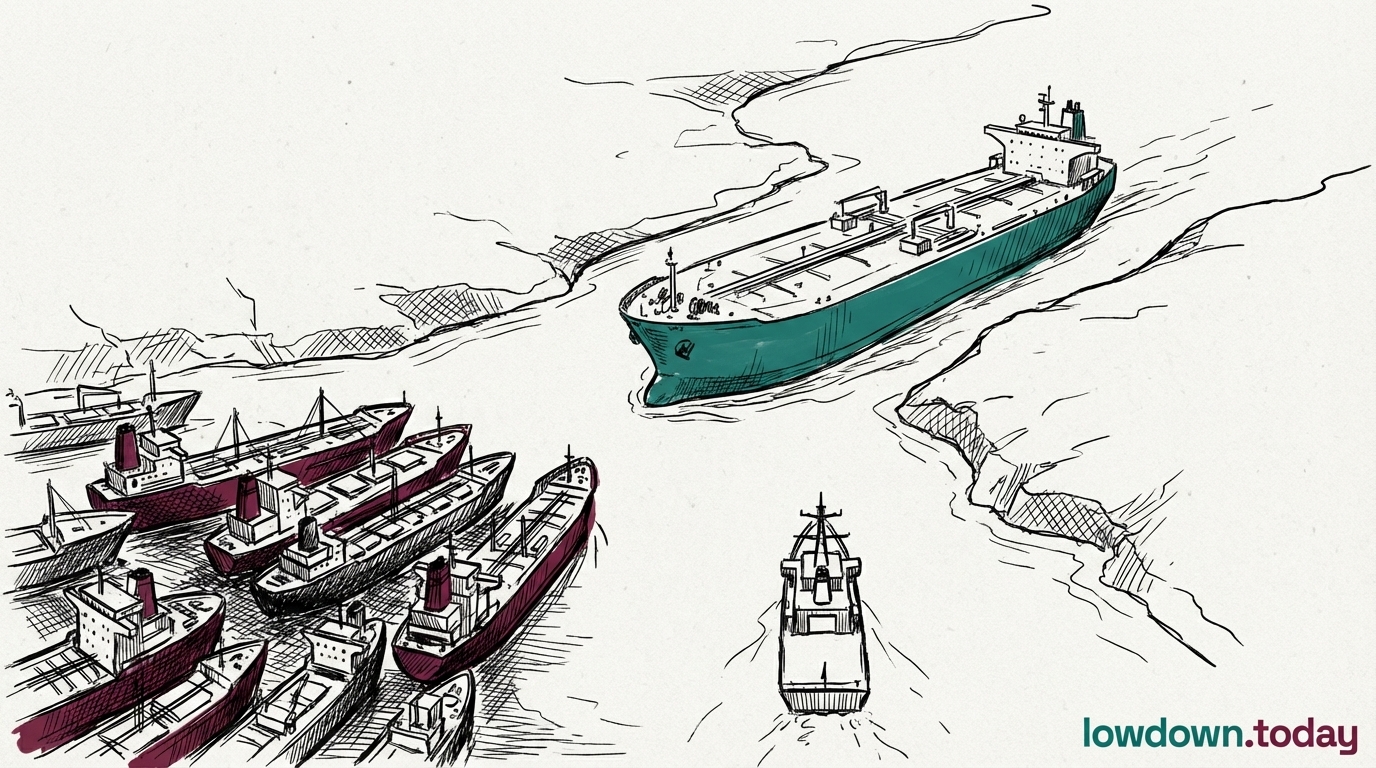
Swedish coast guard officers boarded the 228-metre tanker Sea Owl I off Trelleborg on 12 March — the largest Russian-linked vessel seized in European waters during the current enforcement campaign. The ship had departed Santos, Brazil on 15 February with Tallinn declared as its destination. Swedish authorities determined the actual heading was Primorsk, a Russian oil export terminal near St Petersburg 1. A Swedish court detained the vessel's 55-year-old Russian captain on 15 March for using falsified documents.

The Sea Owl I was the third shadow fleet vessel taken in European waters within two weeks. Belgium and France seized the Ethera on 28 February under Operation Blue Intruder ; Sweden itself took the Caffa near Trelleborg on 6 March, with Ukrainian authorities alleging it had carried grain from occupied Sevastopol 2 . Each case features the same deception architecture: fraudulent flags of convenience, fictitious port declarations, forged documentation. The consistency points to an organised system, not improvised evasion by individual masters.

The captain's detention introduces a dimension previous enforcement actions lacked. Seizing a vessel is an asset action against a ship's owner — often an opaque shell company registered in a permissive jurisdiction. Detaining the officer who navigated the ship criminalises the human labour the fleet depends on. Officers willing to crew shadow fleet voyages already face denial of Western port access, exclusion from standard maritime insurance, and the physical risks exposed by the destruction of the Arctic Metagaz off Libya on 3 March . Adding criminal prosecution in a Swedish court raises the personal cost further. CREA data showed 56% of Russian crude moved on sanctioned shadow tankers in February . If crew recruitment becomes harder or commands a risk premium, operating costs rise for a fleet that already cannot access standard P&I insurance.

The three seizures concentrate in the Baltic — the corridor where shadow fleet traffic is densest and European patrol presence strongest. Whether enforcement extends into less-policed waters, where the bulk of shadow fleet voyages transit, will determine whether the seizure campaign constrains Russian oil revenue or merely displaces the routes.

Deep Analysis

In plain English

Russia moves its oil using ships that disguise their origins — flying false flags and filing false destination documents to avoid Western sanctions. Sweden has now done something new: it arrested the ship's captain personally, charging him with document fraud. Previously, the worst outcome for a shadow fleet vessel was having the ship temporarily seized. Personal criminal charges create a very different risk calculation for maritime professionals who crew and command these vessels.

Deep Analysis
Synthesis

The Sea Owl I prosecution, combined with Kallas's operator-targeting declaration (Event 9), represents a three-tier enforcement chain — vessels, operators, individuals — mirroring FATF anti-money-laundering doctrine applied to maritime sanctions. Each tier raises the compliance cost for the next actor in the chain. Whether Nordic criminal jurisdiction survives a Russian flag-state challenge at the IMO will determine whether personal criminal liability becomes a replicable enforcement model across EU member states.

Root Causes

False destination declarations exploit a structural gap in the international maritime system: flag-state primacy under UNCLOS means Russia has no enforcement incentive for reflagged vessels. AIS transponder manipulation and false port filings are therefore near-zero-risk practices absent port-state criminal jurisdiction — which Sweden has now exercised, testing the limits of UNCLOS Article 97.

Escalation

The Swedish court's detention moves enforcement from civil asset seizure (in rem) to individual criminal prosecution (in personam). This is a qualitative legal escalation — it creates personal liberty and career risk for maritime professionals, not just commercial risk for vessel owners. No previous European shadow fleet action has reached this threshold.

What could happen next?
  • Precedent

    Personal criminal prosecution of shadow fleet commanders establishes a replicable model for EU member states exercising port-state criminal jurisdiction.

    Medium term · Assessed
  • Consequence

    Russia may accelerate full reflagging of shadow fleet vessels to its own registry to reduce exposure to Nordic criminal jurisdiction.

    Short term · Assessed
  • Risk

    A Russian flag-state challenge at the IMO could produce a ruling that limits port-state criminal jurisdiction, cutting against the entire enforcement escalation.

    Medium term · Suggested
First Reported In

Update #6 · Ukraine sends negotiators as front reverses

Euronews· 20 Mar 2026
Read original
Causes and effects
This Event
Sweden detains Sea Owl I captain
Criminal prosecution of the captain establishes personal liability for shadow fleet operations, targeting the labour supply these voyages depend on beyond asset seizures alone.
Different Perspectives
Iran human rights monitors (Amnesty International, Iran HRM, Hengaw)
Monitors documented 30 women held on capital moharebeh charges in a basement prison ward, Benyamin Naqdi's death sentence with a forced-confession broadcast, and 39 political executions since February. Iran's security courts have processed protest cases at uninterrupted wartime tempo regardless of the diplomatic track.
Lloyd's of London (war-risk underwriters)
Lloyd's held its Hormuz war-risk designation at $10-14 million per voyage while Brent fell 19%, maintaining a structural divergence from futures pricing. Underwriters require a UN Security Council resolution or government certification letter, not diplomatic optimism, before de-listing the strait.
Oman (Sultan Haitham's government)
Muscat issued a mine alert in its own territorial waters while denying any Hormuz toll plan after US Treasury threatened sanctions. A suspected mine in Omani waters on the same weekend as US financial pressure forces Muscat to demonstrate sovereignty without appearing to choose sides.
China (PRC)
China (PRC)
Beijing sent scholars rather than its defence minister to Shangri-La for the second year running and addressed Taiwan and multilateralism without mentioning Iran. China maintains its bilateral energy corridor protection with Tehran while refusing the diplomatic exposure of a public position at multilateral forums.
Iran Supreme National Security Council
The SNSC framed the unsigned MOU as a 10-point Iranian victory with enrichment already recognised, and the foreign ministry rejected Trump's nuclear conditions within hours. Tehran treats each unsigned day as validation that Iran has retained its stockpile without surrendering it.
Trump administration (CENTCOM/White House)
Trump posted three non-negotiable public conditions while CENTCOM disabled a commercial ship and Hegseth threatened resumed strikes from Singapore. The administration treats the unsigned MOU as leverage to extract maximum Iranian concessions before any ceasefire instrument is committed to paper.