Skip to content
Briefings are running a touch slower this week while we rebuild the foundations.See roadmap
Iran Conflict 2026
30MAR

Russia strips Victory Day of hardware

3 min read
08:00UTC

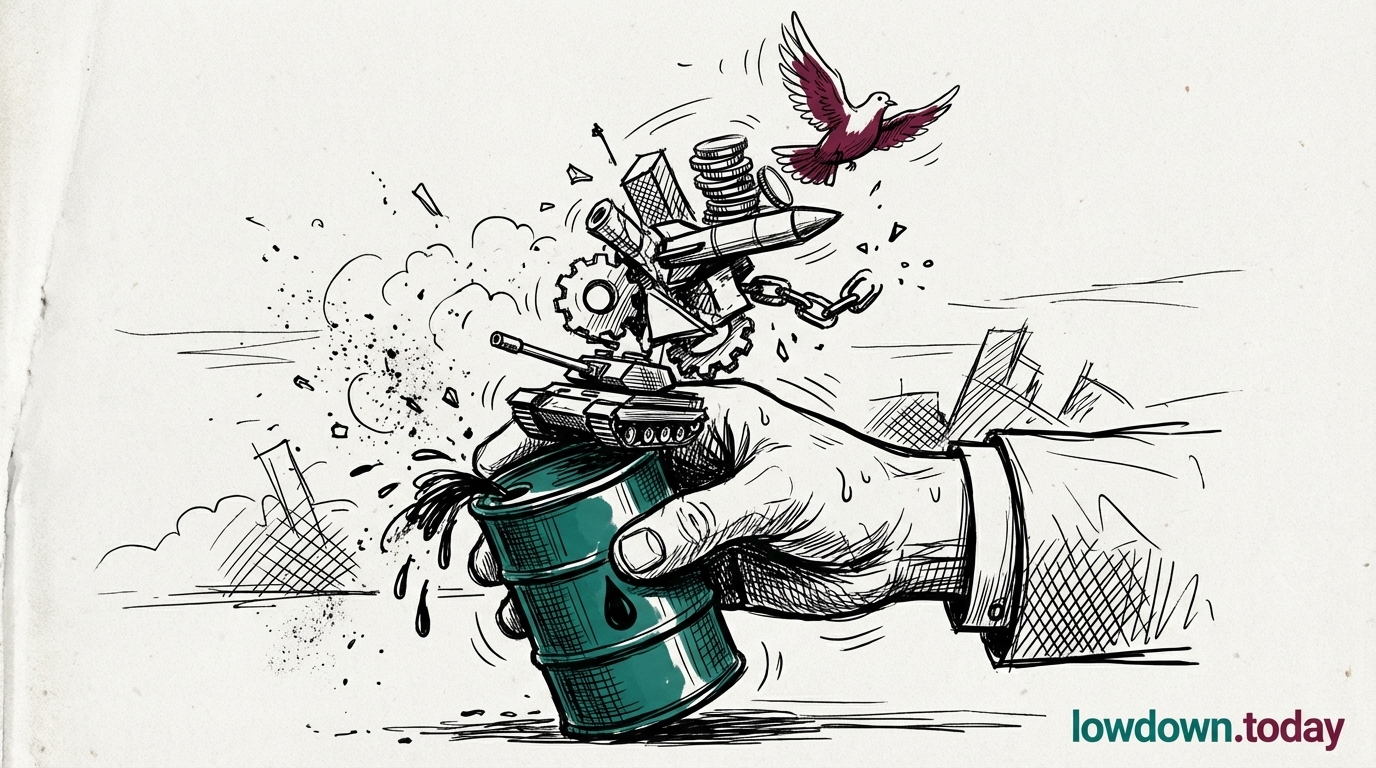
Russia's Ministry of Defence stripped tanks, Iskander launchers and Yars carriers from the 9 May Victory Day parade, the first foot-only column on Tverskaya Street in roughly twenty years.

ConflictDeveloping
Key takeaway

Russia is hiding its hardware on its biggest day because Ukraine can now hit it in central Moscow.

On 29 April Russia's Ministry of Defence announced that the 9 May Victory Day parade on Red Square would feature troops marching on foot but no tanks, missile launchers, or armoured vehicles. Iskander short-range ballistic launchers and Yars intercontinental carriers, both standard fixtures, will not roll down Tverskaya Street. It is the first hardware-free Red Square parade in roughly twenty years.

Victory Day, marking the Soviet defeat of Nazi Germany in 1945, is the central choreographed event of the Russian state calendar. The hardware column has been the parade's visual signature since the Soviet era and was reinstated under Vladimir Putin in 2008. Russian milbloggers and Western analysts attributed the change directly to Ukraine drone forces and the deep-strike reach now extending into Moscow oblast. An Atlantic Council analyst described the parade format as one that 'once projected power; now it reveals Russia's weakness'. Ukraine's deep-strike doctrine is detailed elsewhere in this briefing alongside the 2-3 May drone-exchange reversal.

The Federal Security Service (FSB) cannot guarantee static air defence over the parade route while a hardware column moves at three kilometres per hour. A drone striking an empty truck cab is a security incident; a drone striking an Iskander launcher in front of the Kremlin wall is a state-television problem the Kremlin cannot edit out.

The parade decision sits inside the same week Putin requested a parade-day truce from Trump, the third commemorative-truce gesture of 2026 after the Easter decree and its violation-heavy expiry and the 324-drone post-Easter barrage . The hardware-strip is the first physical, datable concession that Ukraine's deep-strike campaign has reshaped Russian domestic ceremony.


Deep Analysis

In plain English

Russia holds a huge military parade every year on 9 May to celebrate the Soviet Union's victory over Nazi Germany in World War Two. For the past twenty years, that parade has featured tanks, missile launchers, and other heavy weapons rolling through Red Square in Moscow. This year Russia announced none of that hardware will appear, only soldiers marching on foot. The reason, according to Western defence analysts and Russia's own military bloggers, is that Ukraine now has drones capable of reaching Moscow. Russia's air defences cannot reliably protect a column of expensive tanks and missile systems rolling through the city centre, so the army chose not to risk them. It is the first concrete change to Russian domestic behaviour that can be directly attributed to Ukraine's long-range strike campaign.

Deep Analysis
Root Causes

Ukraine's long-range FPV and loitering munition programme crossed a threshold in early 2026 that changed the operational calculus for central Moscow. The MoD's security perimeter for the Red Square route runs roughly 80 km from the city centre; Shahed-class Ukrainian drones with the 2025 guidance upgrade have a confirmed strike range that covers that radius from launch points inside Ukrainian-controlled territory.

The second structural cause is the depletion of Russian short-range air-defence assets at the parade perimeter. Pantsir and Tor systems that would normally form the parade's inner-ring defence layer have been redistributed to the front and to oil infrastructure protection since late 2024. The Ministry of Defence cannot credibly guarantee hardware safety over a Red Square column without pulling systems back from operationally critical positions, and it chose not to.

Russian milbloggers have been publicly attributing the hardware decision to Ukraine's reach since mid-April, meaning any attempt to move tanks to the capital now would be read domestically as a response to Ukrainian pressure rather than as a confidence display. The MoD's information environment has no clean path back to the equipment-column format while that attribution is live in the Russian-language blogosphere.

What could happen next?
  • Consequence

    The parade decision hands Ukraine's communications teams a datable, first-party-confirmed data point for the argument that deep-strike reach is changing Russian domestic behaviour beyond the battlefield.

    Immediate · 0.88
  • Risk

    If the Victory Day ceasefire holds and is seen as enabling a safe parade, the Kremlin may claim retroactively that the hardware decision was strategic rather than security-driven, muddying the evidentiary record.

    Short term · 0.72
  • Precedent

    The 2026 hardware-free parade sets a baseline: future parades stripped of equipment will be read as evidence of ongoing strike vulnerability rather than tradition, regardless of official framing.

    Medium term · 0.85
First Reported In

Update #15 · Hardware-free parade; crude waiver lives on

Kyiv Independent· 3 May 2026
Read original
Causes and effects
This Event
Russia strips Victory Day of hardware
First time in two decades a Russian leadership has visibly conceded a Victory Day staging ground to an active adversary's reach.
Different Perspectives
IAEA
IAEA
Director General Rafael Grossi appeared in person at the UNSC on 19 May and warned that a direct hit on an operating reactor 'could result in very high release of radioactivity'. The session produced a condemnation record but no resolution, and the Barakah perimeter was already struck on 17 May.
Hengaw (Kurdish rights monitor)
Hengaw documented three judicial executions and the detention of Kurdish writer Majid Karimi in Tehran on 19 May, establishing Khorasan Razavi province as the newest geography in Iran's wartime judicial record. The organisation's Norway-based operation continues to surface a domestic repression track running in parallel with every diplomatic and military development.
India
India
Six India-flagged vessels conducted a coordinated cluster transit under PGSA bilateral assurances during the 17 May window, paying no yuan tolls. New Delhi's inclusion in Iran's state-to-state passage track insulates Indian energy supply without requiring endorsement of the PGSA's yuan-toll architecture or alignment with the US coalition.
Pakistan
Pakistan
Pakistan is the only functioning diplomatic bridge between Tehran and Washington. Its role is relay, not mediation in the settlement sense: it conveyed Iran's 10-point counter-MOU in early May, relayed the US rejection, and is now passing 'corrective points' in the third documented exchange of this sub-cycle without either side working from a shared text.
UK and France (Northwood coalition)
Twenty-six coalition members have published no rules of engagement eight days after the Bahrain joint statement; Lloyd's underwriters have conditioned war-risk reopening on written ROE from either Iran or the coalition. Italian and French mine-countermeasures deployments are operating on the in-water clearance task CENTCOM Admiral Brad Cooper's 90% mine-stockpile claim does not address.
Saudi Arabia
Saudi Arabia
Riyadh has not publicly commented on the Barakah strike or the 50-47 discharge vote. Saudi output feeds the IEA's $106 base case; the $5 Brent premium above that model reflects institutional uncertainty no Gulf producer can compress through supply adjustment alone.



