Skip to content
Briefings are running a touch slower this week while we rebuild the foundations.See roadmap
Iran Conflict 2026
27MAR

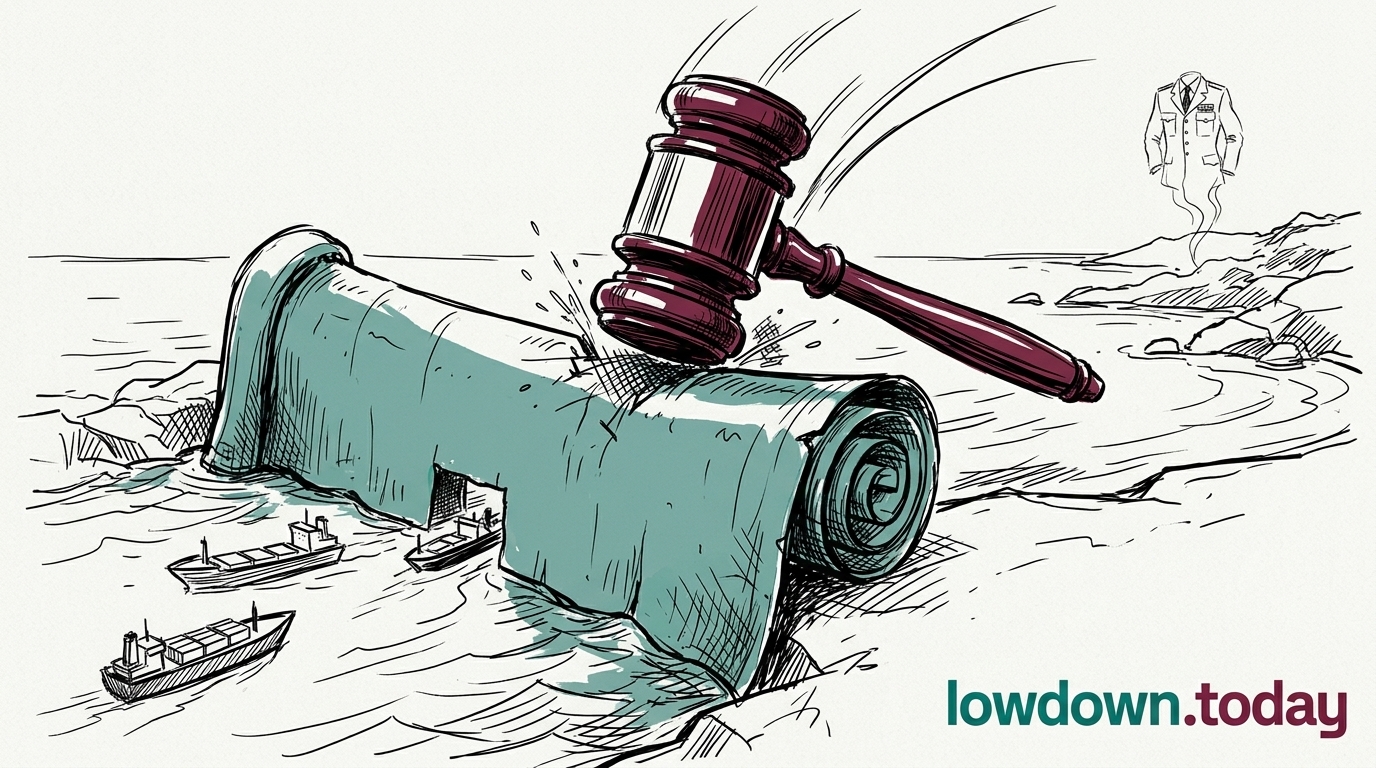
Majlis codifies Hormuz toll in law

2 min read
14:13UTC

The blockade that began as a military measure is becoming domestic legislation, with projected revenues reaching $800 million per month.

ConflictDeveloping
Key takeaway

Iran is converting a wartime blockade into permanent law, making reversal a sovereignty question.

Iran's Majlis began drafting legislation on 31 March to codify the IRGC's Hormuz toll into permanent domestic law. 1 A vote was expected before the end of March but cannot proceed until Parliament reconvenes. At projected scale, revenue estimates reach $600 million to $800 million per month from oil tankers and LNG carriers combined.

The legislative step matters because it changes the nature of what the toll is. An operational wartime measure can be reversed by the military that imposed it. A law can only be reversed by the Parliament that passed it, with Guardian Council approval, after a political process that no Iranian politician has incentive to initiate. Shadow fleet vessels already account for 80% of Hormuz transits , and the toll is being paid by state-backed Chinese container ships. The infrastructure is built. Legislation is the lock.

The last time a state imposed transit fees on a major international waterway was the Ottoman Empire's Bosphorus tolls, abolished by the 1936 Montreux Convention. Iran's version is being codified in real time during an active war. The NPT withdrawal bill remains frozen in the same parliament : the Majlis has not sat in 31 days, with no reconvening date announced. When it does sit, both bills advance simultaneously.

Deep Analysis

In plain English

Iran's parliament is writing a law to permanently charge ships a toll to cross the Strait of Hormuz. The law has not passed yet because parliament has not met in over a month. The difference between a wartime toll and a permanent law is significant. A wartime toll can end when the war ends. A law can only be changed by parliament, which means it could last for decades regardless of how the war ends. The last time a country charged transit fees on a major international waterway was the Ottoman Empire, which charged Bosphorus tolls until a 1936 international agreement abolished them. Iran is trying to do the same thing in 2026.

What could happen next?
  • Precedent

    If enacted, this would be the first domestic law codifying a sovereign charge on an international strait in modern maritime history, challenging UNCLOS innocent passage rights.

    Long term · 0.85
  • Consequence

    Reversing the toll post-war becomes a sovereignty dispute requiring treaty revision rather than a military question, making it functionally permanent.

    Medium term · 0.8
  • Risk

    When parliament reconvenes, both the toll bill and the NPT withdrawal bill advance simultaneously, presenting the international community with two irreversible legislative facts at once.

    Short term · 0.7
First Reported In

Update #53 · Trump drops Hormuz goal; toll becomes law

NBC News / Lloyd's List· 31 Mar 2026
Read original
Different Perspectives
Gulf shipping and insurance markets
With Hormuz and Bab el-Mandeb both hostile at once, war-risk underwriters face their first dual-chokepoint pricing problem; the rerouting hedge that absorbed one closure is gone for Israeli-linked hulls. Any deal that reopens Hormuz without a Houthi stand-down clause delivers only partial shipping relief.
Russia and China
Russia and China
Russia and China met IAEA chief Grossi jointly in Geneva on 5 June to coordinate an advance blocking position against Washington's censure resolution, the first documented instance of proactive pre-session obstruction rather than reactive post-vote dissent. Beijing's move came four days after OFAC designated Shanghai Qianye Energy under Iran energy sanctions.
Saudi Arabia
Saudi Arabia
Saudi Arabia was left out of the emergency $4.01 billion Patriot waiver Qatar received on 2 May as its own PAC-3 stocks ran near-empty from intercepting Iranian salvoes over Aramco facilities. Riyadh is on a standard 18-month FMS queue behind a production line booked through 2030, with no equivalent priority to Qatar's Al Udeid basing role.
Houthis (Ansar Allah)
The Houthis declared a complete ban on Israeli Red Sea navigation on 8 June and struck Jaffa, their first attack on Israeli territory since April, seven days after the Tasnim authorisation to activate other fronts including Bab el-Mandeb. The declaration put both chokepoints under hostile authority simultaneously.
Iran
Iran
Iran agreed the 9 June mutual halt after the Mahshahr exchange and coordinated with Russia and China to block Washington's IAEA censure resolution, using the Board as a second front while the bilateral pause held on the military one. Tehran's acceptance of the Lebanon carve-out contradicts the linkage position it stated on 1 June.
Benjamin Netanyahu and the IDF
Israel struck the Karun Petrochemical plant at Mahshahr on 8 June over Trump's explicit objection, then agreed a halt with Iran the following day scoped on Israeli terms with Lebanon carved out. Netanyahu's posture is that the IDF will not accept Iranian missile factories as off-limits regardless of US diplomatic timelines.