
Skip to content
Briefings are running a touch slower this week while we rebuild the foundations.See roadmap
Iran Conflict 2026
1MAR

Day 2: Khamenei killed; Iran fires on 7 countries

4 min read
08:00UTC

An Israeli airstrike killed Supreme Leader Ali Khamenei and Iran's top military leadership on 1 March 2026. Iran retaliated with ballistic missiles at 27 US installations across seven countries and closed the Strait of Hormuz to all shipping. Iranian civilians celebrated Khamenei's death in the streets, confirming the collapse of domestic legitimacy that the December 2025 protests had already exposed.

Key takeaway

The Islamic Republic's constitutional order has been destroyed — not just its leader but the mechanism for replacing him — while the IRGC's Hormuz closure and the Minab school deaths have expanded the conflict from a bilateral military operation into a global economic and humanitarian crisis.

This briefing mapped
Loading map…
Military
Humanitarian
Domestic

Iranian state media confirmed the Supreme Leader's death alongside three family members, ending the constitutional order that governed the Islamic Republic since 1979.

Sources profile:This story draws on centre-left-leaning sources from Iran, Qatar and 1 more
IranQatarUnited States

Iranian state media confirmed that Supreme Leader Ali Khamenei was killed in an Israeli airstrike on his Tehran compound. His daughter, son-in-law, and grandson died in the same strike. The government declared 40 days of national mourning.

The death of The Supreme Leader — the constitutional apex of the Islamic Republic, commander-in-chief, and final authority on foreign policy — creates a political vacuum with no institutional mechanism to resolve it, because the body tasked with selecting a successor was simultaneously destroyed. 

Sources:Iranian state media (IRNA / Press TV)·Al Jazeera·Axios
Briefing analysis

Iraq (2003) and Libya (2011) are the closest precedents — both produced state collapse, not orderly transition. De-Baathification gutted Iraq’s institutions and fuelled a decade of insurgency. Libya fragmented into militia fiefdoms that persist today. In both cases, destroying the leadership produced chaos, not compliance.

The contrasting case is Japan (1945), where the US deliberately preserved Emperor Hirohito to enable an orderly surrender. Iran combines the worst elements: like Iraq, the security establishment is decapitated; like Libya, the succession mechanism is destroyed; unlike Japan, there is no intact authority figure through whom a settlement can be channelled.

One hundred and forty-eight girls aged seven to twelve were killed in a single strike on a primary school in Minab, southern Iran — an atrocity whose attribution remains disputed but whose consequences for global diplomatic positioning do not.

Sources profile:This story draws on centre-left-leaning sources from United Kingdom
United Kingdom

The Iranian Red Crescent reported 148 girls aged 7 to 12 killed at a school in Minab, southern Iran, among 201 total dead and more than 700 injured in the conflict's first hours. The US and Israel have not claimed the strike. Iranian sources have not confirmed the weapon's origin.

The Minab school deaths will define the war's image across Arabic-language and Global South media regardless of attribution. Satellite imagery analysis published on 6 March concluded the strike was likely a US attack on a misidentified IRGC target — but that finding is not officially confirmed and the political half-life of 148 dead children is measured in years. 

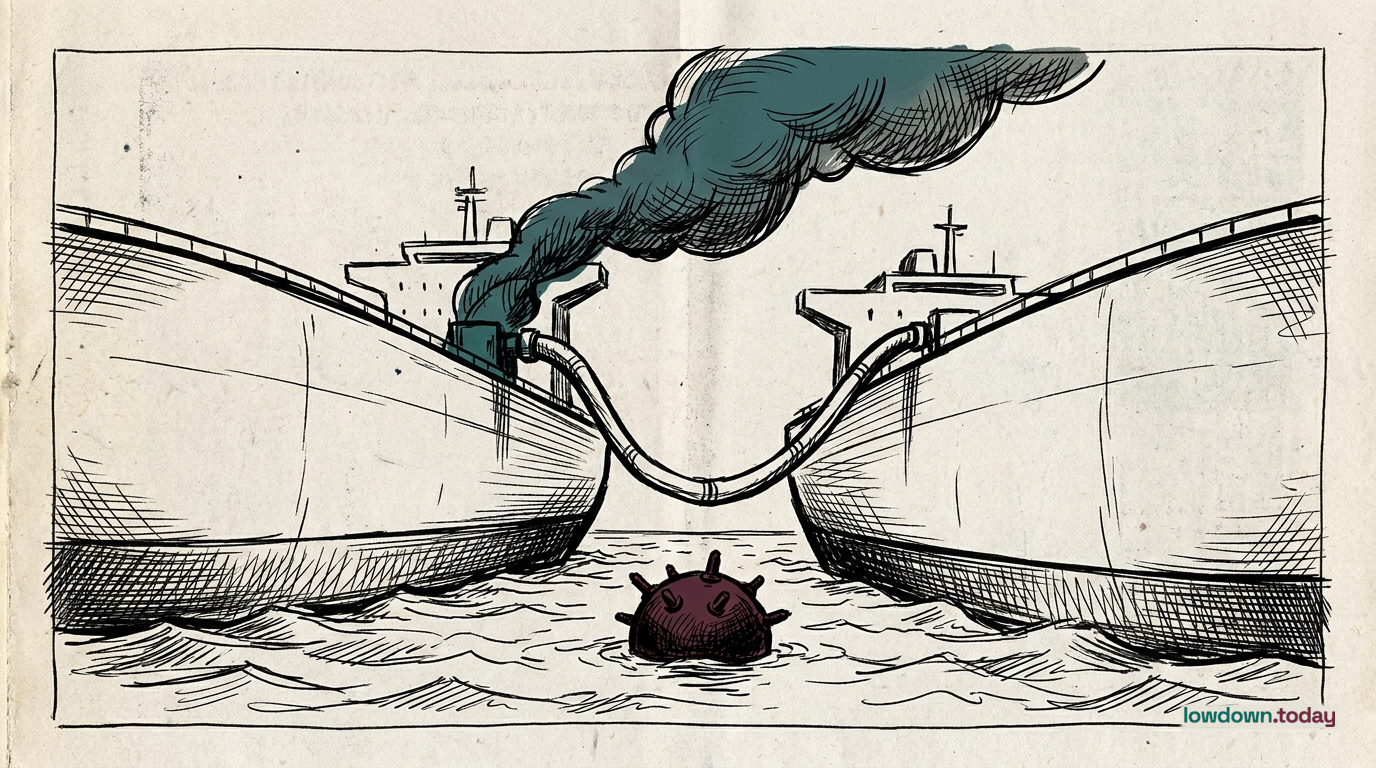
The IRGC invoked the one deterrent most analysts believed it would never use — closing the Strait of Hormuz within hours of the opening strikes, accepting the destruction of Iran's own export revenue as the price of maximum economic retaliation.

Sources profile:This story draws on right-leaning sources from United States
United States
LeftRight

The IRGC broadcast on VHF Channel 16 — the international maritime distress and calling frequency — that 'no ships may pass' through the strait of Hormuz, backed by anti-ship missiles, fast-attack boats, and mines. Hapag-Lloyd suspended all transit. Fourteen LNG tankers halted en route. Major oil companies stopped shipments. Approximately 20% of the world's traded oil passes through the strait.

The Hormuz closure transforms the conflict from a bilateral US-Israel-Iran military operation into a global economic event affecting every oil-importing nation. The IRGC's willingness to destroy its own export revenue signals that the surviving command has adopted a war-economy posture in which economic self-preservation is no longer the constraint Western strategy assumed it would be. 

The 88-member clerical body constitutionally tasked with selecting Iran's next Supreme Leader cannot convene — its Qom headquarters was hit directly.

Sources profile:This story draws on centre-right-leaning sources from United States
United States

The Assembly of Experts headquarters in Qom was struck directly in the US-Israeli operations. The 88-member clerical body, constitutionally tasked with selecting a new Supreme Leader, cannot convene. No constitutional provision exists for the simultaneous loss of The Supreme Leader and the selection body.

The destruction of the Assembly eliminates the only constitutional mechanism for Supreme Leader succession, transforming a leadership crisis into a systemic constitutional collapse with no lawful path to reconstitution. 

Ali Shamkhani joins the confirmed dead alongside Nasirzadeh and Pakpour, while thousands of IRGC personnel are reported killed or wounded — the entire senior command tier eliminated in a single night.

Sources profile:This story draws on centre-left-leaning sources from Qatar and United States
QatarUnited States

Iranian state television and Al Jazeera confirmed that Defence Minister Nasirzadeh, IRGC Commander Pakpour, and Ali Shamkhani were killed in the US-Israeli strikes. Thousands of IRGC personnel are reported killed or wounded.

The simultaneous elimination of the defence minister, the IRGC ground forces commander, and a senior political-military figure like Shamkhani removes the entire top tier of Iran's security establishment, opening a contest over both military command and the IRGC's $100 billion economic portfolio. 

Sources:Al Jazeera·Axios
Closing comments

The conflict has escalated beyond recovery to the pre-strike status quo. Iran's retaliation against 27 installations in seven countries means Gulf states, Jordan, and Iraq are now directly involved regardless of whether they participated. The Hormuz closure removes 17–20 million barrels per day from markets. Hezbollah's non-activation is one restraining factor, but the IRGC's willingness to close Hormuz — the action deterrence theory said was permanently off the table — indicates the surviving command operates outside the cost-benefit framework that informed pre-war escalation models. The next escalation node is whether the US Fifth Fleet attempts to force Hormuz open, which would mean direct naval combat with IRGC forces.

Emerging patterns

  • Escalation from counter-proliferation strikes (June 2025 Twelve-Day War targeting nuclear facilities) to leadership decapitation strikes targeting the political and military command structure.
  • The pattern of strikes on civilian-adjacent infrastructure — schools, hospitals, markets — and the subsequent contest over attribution is a recurring feature of modern air campaigns, from Syria to Yemen to Gaza. The Minab school strike fits precisely: a target identified by intelligence as a dual-use facility, struck with confidence, disputed when the civilian toll becomes visible. IRGC forces routinely embed command nodes in civilian infrastructure specifically because it forces adversaries to choose between striking military targets and accepting civilian casualties.
  • The Hormuz closure confirms a pattern visible in the IRGC's escalation playbook: when existential threats remove economic constraints, the organisation deploys maximum economic leverage immediately rather than holding it in reserve. The same logic appeared in the 2019 tanker attacks and the 2024 Red Sea interdiction campaign — each time, the IRGC deployed economic disruption proportional to the political pressure it faced.
  • Systematic destruction of both leadership and institutional succession mechanisms — striking not only the head of state but the constitutional architecture designed to survive his death.
  • Comprehensive decapitation of a state's entire senior military command in a single operational cycle, going beyond leadership strikes to eliminate the institutional capacity for reconstitution.
Different Perspectives
Hapag-Lloyd
Hapag-Lloyd
Immediately suspended all transit through the Strait of Hormuz following the IRGC closure broadcast, becoming the first major global shipping company to halt operations.
Iranian government
Iranian government
Declared 40 days of national mourning for Supreme Leader Khamenei — a period drawn from Shia Islamic mourning tradition — while the IRGC simultaneously escalated military operations.