Skip to content
Briefings are running a touch slower this week while we rebuild the foundations.See roadmap
Iran Conflict 2026
6MAR

NOPO seizes Evin Prison, food halted

3 min read
14:22UTC

Iran's riot police have taken control of Evin Prison, halted food distribution, and ordered the forced transfer of political detainees — including Nobel laureate Narges Mohammadi — while missiles breach the outer walls. Prisoners are resisting.

ConflictDeveloping
Key takeaway

The cessation of food distribution is the legally operative IHL trigger already in force — it is independently reportable under the Fourth Geneva Convention before any transfer has been executed.

NOPOIran's special forces riot police — seized control of Evin Prison on Day 7, displacing regular staff who abandoned their posts. Food distribution stopped in the women's ward and Ward 7. Authorities ordered financial prisoners transferred to Fashafuyeh prison in greater Tehran, and political prisoners and foreign nationals moved to Qom Prison, roughly 150 kilometres south. A missile struck near the outer perimeter and destroyed a section of the prison wall. Prisoners are resisting the forced transfers, according to the human rights monitor Iran HRM.

Evin has been the Islamic Republic's primary political detention facility since 1979. Among those currently held: Narges Mohammadi, awarded the Nobel Peace Prize in 2023 while imprisoned for campaigning against the death penalty; Zeynab Jalalian, a Kurdish activist whose death sentence was commuted to life imprisonment in 2012 after sustained international pressure; and British nationals whose status now becomes an urgent consular question — the UK withdrew embassy staff from Bahrain on Thursday but has not publicly addressed the safety of its citizens inside a facility under bombardment.

The transfer pattern sorts prisoners by political sensitivity, not security risk. Financial inmates go to Fashafuyeh, a lower-security facility. Political detainees and foreign nationals — the categories most consequential if killed in a strike or freed through a breached wall — go to Qom. The Assembly of Experts already relocated its emergency session to Qom, treating the city as beyond the primary strike zone . Israel struck the Assembly's Qom headquarters earlier that same week, which makes that assumption less certain. The transfers resemble wartime repositioning of assets more than prison management.

Forced transfers under active bombardment, with food already cut and a wall already breached, place detainees at immediate physical risk with no ability to refuse or protect themselves. During the Iran-Iraq War's final phase in 1988, the Islamic Republic executed thousands of political prisoners — an episode documented exhaustively by Amnesty International and raised by Iranian human rights organisations as context for their current demand for international monitoring of Evin's population. The NOPO deployment, the guard exodus, the wall breach, and the halted food supply describe a facility that has stopped functioning as a prison and become a problem the authorities are racing to disperse before it compounds.

Deep Analysis

In plain English

Evin Prison holds Iran's most prominent political prisoners — people locked up for opposing the government, foreign nationals including British citizens, and internationally recognised figures like Nobel Peace Prize winner Narges Mohammadi. A missile struck near the prison wall, regular guards abandoned their posts, and Iran's special riot police have taken over. The authorities are trying to move prisoners to jails further from Tehran — away from the bombing — but the prisoners are refusing, apparently fearing the journey itself is more dangerous than staying. Food has stopped reaching parts of the prison. Under international law, even in wartime, a government must continue to feed, provide medical care for, and maintain legal protections for everyone it holds in detention — the food stoppage already appears to breach those rules, and this has happened before any transfer has been completed.

Deep Analysis
Synthesis

The forced dispersal of internationally prominent detainees — Mohammadi, Jalalian, and foreign nationals — to locations with reduced international visibility removes the primary reputational constraint on Iran's treatment of those prisoners. Once transferred to Qom or Fashafuyeh under wartime conditions, with regular staff absent and ICRC access uncertain, the international community loses its principal monitoring leverage over a politically sensitive detainee population whose treatment had been a consistent source of diplomatic pressure on Tehran.

Root Causes

The Evin crisis is a symptom of broader Iranian institutional collapse under sustained bombardment: regular staff abandoning posts is not an isolated prison phenomenon but consistent with a general pattern of civilian state institutions failing under strike pressure while IRGC-adjacent forces substitute. Regular prison administration was not designed to function under an active air campaign, and no contingency planning for this scenario appears to have existed.

Escalation

The situation is escalatory on its own internal logic: regular staff abandonment deepens NOPO's coercive control and removes procedural checks on prisoner treatment. If forced transfers proceed under active air campaign conditions, prisoner casualties become likely regardless of intent — generating a new and independent international legal event on top of the existing IHL food-stoppage violation.

What could happen next?
1 meaning2 risk1 consequence1 precedent
  • Meaning

    The food stoppage in Ward 7 and the women's section constitutes a prima facie IHL violation already in progress, creating immediate legal accountability exposure for Iran and an ICRC reporting obligation.

    Immediate · Assessed
  • Risk

    British nationals and other foreign detainees face a consular communication breakdown if transferred to Qom, creating a direct UK government diplomatic emergency.

    Immediate · Assessed
  • Consequence

    Forced transfer of Nobel laureate Narges Mohammadi under active bombardment conditions would generate major international reaction capable of shifting third-party states' public positioning on the conflict.

    Short term · Assessed
  • Risk

    Transit of prisoners across Iranian territory under active US/IDF air campaign creates conditions for unintended prisoner casualties that neither party may be able to prevent.

    Short term · Suggested
  • Precedent

    Wartime dispersal of political prisoners to locations beyond established international monitoring networks may outlast the conflict as a fait accompli, making post-conflict accountability for their detention harder to enforce.

    Long term · Suggested
First Reported In

Update #24 · Trump demands unconditional surrender

IranWire· 6 Mar 2026
Read original
Causes and effects
This Event
NOPO seizes Evin Prison, food halted
Iran's most politically sensitive prisoners are being forcibly moved under active bombardment by special forces who have displaced regular staff. The operation raises immediate questions about detainee safety, legal protections during transit, and whether Iran is repositioning high-value prisoners before the strike zone reaches them.
Different Perspectives
Gulf shipping and insurance markets
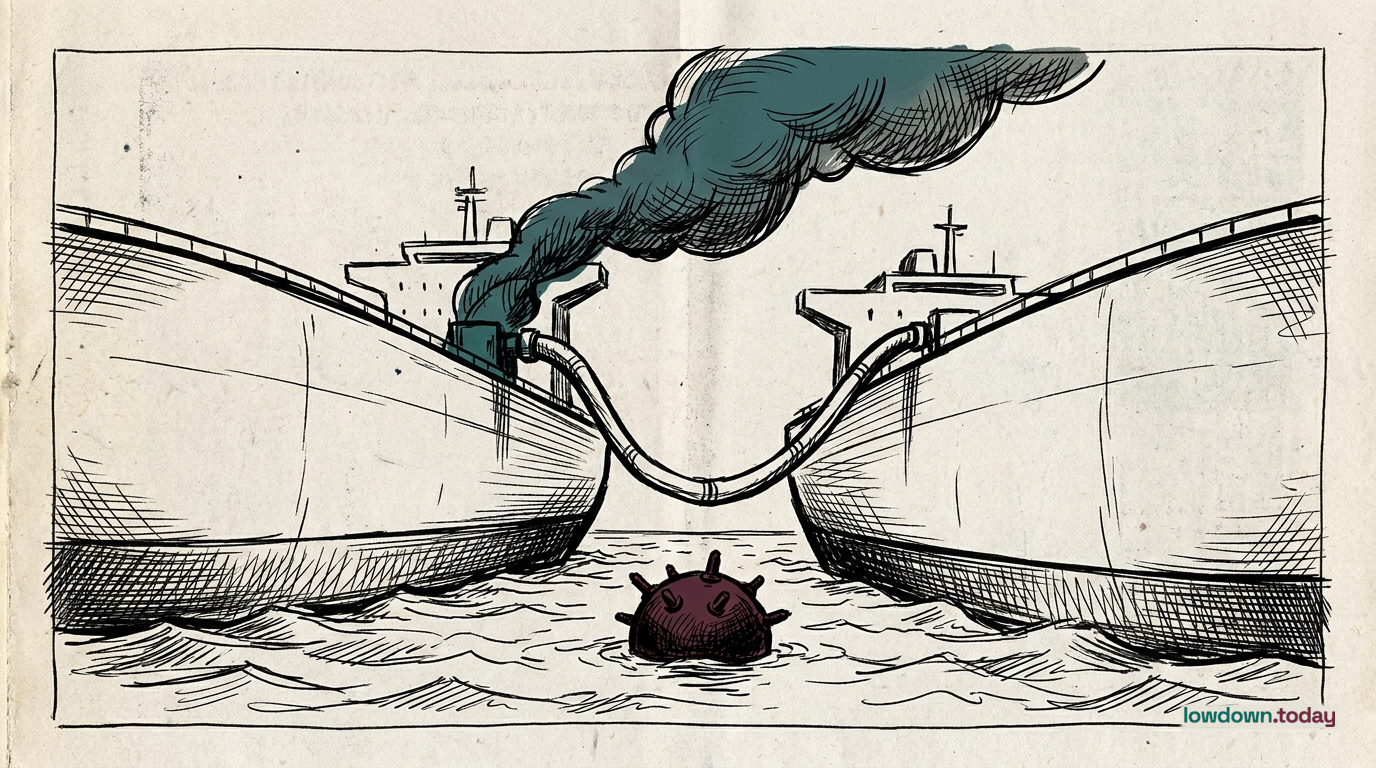
With Hormuz and Bab el-Mandeb both hostile at once, war-risk underwriters face their first dual-chokepoint pricing problem; the rerouting hedge that absorbed one closure is gone for Israeli-linked hulls. Any deal that reopens Hormuz without a Houthi stand-down clause delivers only partial shipping relief.
Russia and China
Russia and China
Russia and China met IAEA chief Grossi jointly in Geneva on 5 June to coordinate an advance blocking position against Washington's censure resolution, the first documented instance of proactive pre-session obstruction rather than reactive post-vote dissent. Beijing's move came four days after OFAC designated Shanghai Qianye Energy under Iran energy sanctions.
Saudi Arabia
Saudi Arabia
Saudi Arabia was left out of the emergency $4.01 billion Patriot waiver Qatar received on 2 May as its own PAC-3 stocks ran near-empty from intercepting Iranian salvoes over Aramco facilities. Riyadh is on a standard 18-month FMS queue behind a production line booked through 2030, with no equivalent priority to Qatar's Al Udeid basing role.
Houthis (Ansar Allah)
The Houthis declared a complete ban on Israeli Red Sea navigation on 8 June and struck Jaffa, their first attack on Israeli territory since April, seven days after the Tasnim authorisation to activate other fronts including Bab el-Mandeb. The declaration put both chokepoints under hostile authority simultaneously.
Iran
Iran
Iran agreed the 9 June mutual halt after the Mahshahr exchange and coordinated with Russia and China to block Washington's IAEA censure resolution, using the Board as a second front while the bilateral pause held on the military one. Tehran's acceptance of the Lebanon carve-out contradicts the linkage position it stated on 1 June.
Benjamin Netanyahu and the IDF
Israel struck the Karun Petrochemical plant at Mahshahr on 8 June over Trump's explicit objection, then agreed a halt with Iran the following day scoped on Israeli terms with Lebanon carved out. Netanyahu's posture is that the IDF will not accept Iranian missile factories as off-limits regardless of US diplomatic timelines.