Skip to content
Briefings are running a touch slower this week while we rebuild the foundations.See roadmap
Iran Conflict 2026
6MAR

IDF kills Hezbollah's intelligence chief

3 min read
04:48UTC

The most senior Hezbollah figure killed since the campaign began, eliminated as IRGC officers flee Beirut and Lebanon's government orders their arrest.

ConflictDeveloping
Key takeaway

The intelligence gap created by killing the intelligence chief is a time-limited exploitation window — probably two to six weeks — before Hezbollah's compartmentalised structure reconstitutes around new personnel.

An IDF strike killed Hussain Makled, described as Hezbollah's intelligence chief — the most senior Hezbollah figure killed since the campaign began on 28 February. The Times of Israel and other outlets reported the strike. Neither the IDF nor Hezbollah released details of the method or precise location.

Makled's death falls within 48 hours of dozens of IRGC Quds Force officers fleeing Beirut, a physical departure Israeli defence officials say they expect to continue. The Lebanese government had already ordered the arrest of any IRGC members on its territory and banned Hezbollah's military activities . Three pressures now operate simultaneously: Israeli strikes removing senior figures from above, the IRGC withdrawal hollowing out Iranian command links from within, and Lebanese state action withdrawing the political cover under which Iran's military infrastructure operated openly. The result is that Iran's roughly 40-year security architecture in Lebanon — constructed through the IRGC's relationship with Hezbollah since the organisation's founding during Israel's 1982 occupation — is being dismantled from three directions at once.

The intelligence function Makled oversaw is the hardest to reconstitute. Military commanders can be replaced from a chain of succession. Intelligence networks — agent relationships, source handling, signals infrastructure, institutional knowledge of Israeli military patterns — are built over decades. Israel's targeted killing of Imad Mughniyeh in Damascus in February 2008 degraded Hezbollah's external operations capability for years; Mughniyeh had been the organisation's most operationally capable figure, and the intelligence chief occupies an analogous position for internal security and counterintelligence. The Israeli Navy's killing of Hamas training commander Wasim Atallah Ali at the Beddawi camp in Tripoli compounds the pattern: armed organisations across Lebanon are losing senior personnel faster than institutional knowledge can be transferred.

The closest historical parallel is Syria's gradual acquiescence to Israeli strikes on IRGC positions after 2019 — a process in which Damascus concluded over several years that Iranian military presence attracted more Israeli attacks than it deterred. In Lebanon, the same calculation is compressing into days. The IRGC is not being expelled by the Lebanese state so much as departing because remaining has become a death sentence, while Beirut formalises the departure after the fact.

Deep Analysis

In plain English

An intelligence chief's most valuable asset is not his own knowledge but his relationships: the informants, the communication channels, the sources inside enemy services. When Israel kills him, those assets go dormant — nobody knows who they are except the dead man and his immediate subordinates. Israel's intelligence services will be racing to exploit any signals he left behind (phone contacts, meeting patterns, communication nodes) before Hezbollah can identify and neutralise them. This race is invisible but determines whether his death provides lasting advantage or only a temporary one.

Deep Analysis
Synthesis

Killing the intelligence chief simultaneously with the IRGC exodus (Event 5) creates a compound blind spot: Hezbollah loses both its external intelligence coordination (through IRGC liaison) and its internal collection and analysis function at the same moment. Standard counter-intelligence doctrine holds that organisations under this kind of simultaneous pressure are at peak vulnerability to penetration — the scramble to reconstitute creates security shortcuts. This window is likely the primary rationale for Israel's current operational tempo in Lebanon.

Escalation

Hezbollah has historically responded to high-profile assassinations with a combination of internal security purges (which further degrade operational capacity in the short term) and symbolic retaliatory strikes intended to demonstrate continued functionality to its membership and to Iran. Given the concurrent IRGC withdrawal, the pressure to demonstrate capability is higher than in past cases — a visible retaliation attempt is likely within days to weeks, even if operationally sub-optimal.

What could happen next?
  • Opportunity

    A two-to-six week intelligence exploitation window exists in which Hezbollah's situational awareness is degraded; Israel is likely planning further high-value targeting operations for this period.

    Immediate · Suggested
  • Risk

    Hezbollah may launch a visible retaliatory strike to demonstrate continued operational capacity, accepting tactical sub-optimality to meet the political imperative of signalling strength to its membership and Tehran.

    Immediate · Suggested
  • Consequence

    Hezbollah's intelligence reconstitution will require promoting officers with less operational experience and re-establishing source contacts under Israeli surveillance — a process likely to take 12–18 months to full capability.

    Medium term · Assessed
First Reported In

Update #23 · Iran loses half its navy; China eyes Hormuz

Al Jazeera· 6 Mar 2026
Read original
Different Perspectives
Gulf shipping and insurance markets
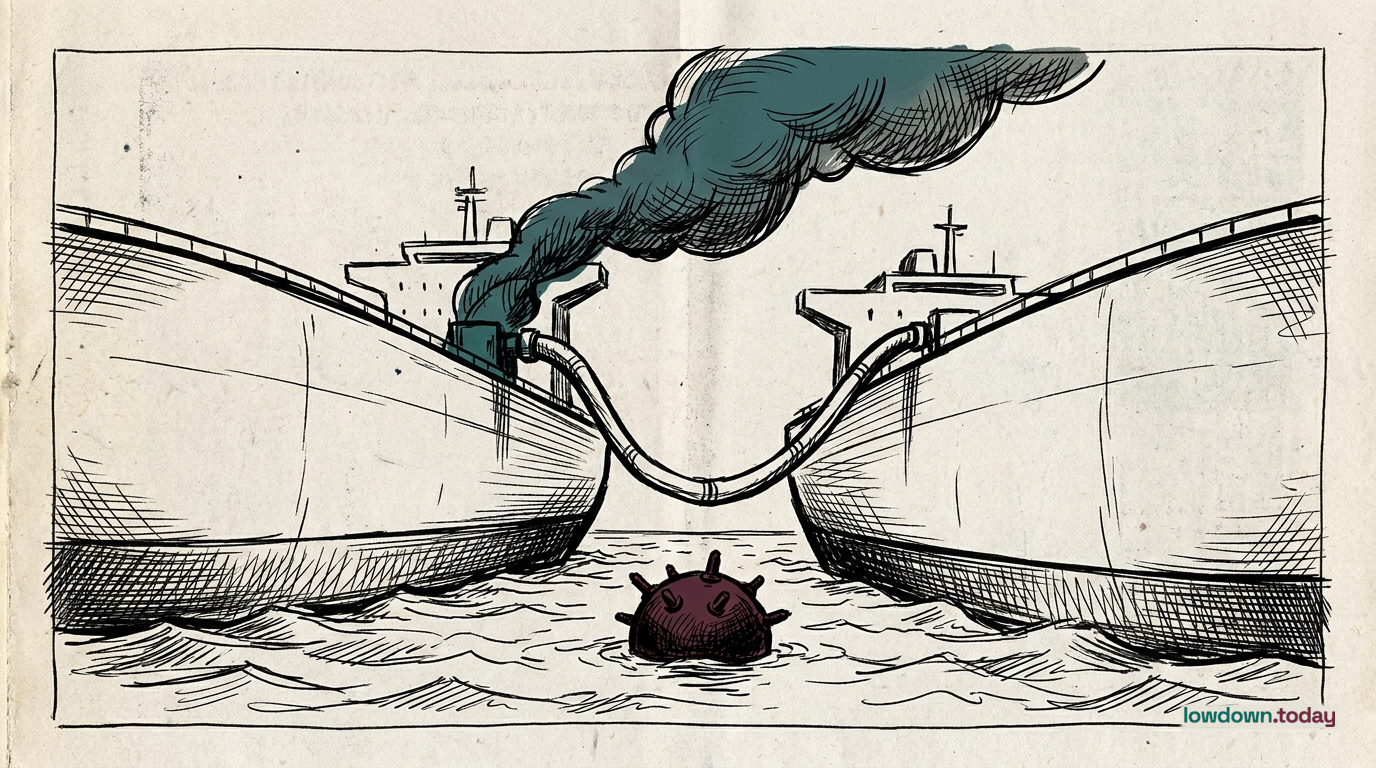
With Hormuz and Bab el-Mandeb both hostile at once, war-risk underwriters face their first dual-chokepoint pricing problem; the rerouting hedge that absorbed one closure is gone for Israeli-linked hulls. Any deal that reopens Hormuz without a Houthi stand-down clause delivers only partial shipping relief.
Russia and China
Russia and China
Russia and China met IAEA chief Grossi jointly in Geneva on 5 June to coordinate an advance blocking position against Washington's censure resolution, the first documented instance of proactive pre-session obstruction rather than reactive post-vote dissent. Beijing's move came four days after OFAC designated Shanghai Qianye Energy under Iran energy sanctions.
Saudi Arabia
Saudi Arabia
Saudi Arabia was left out of the emergency $4.01 billion Patriot waiver Qatar received on 2 May as its own PAC-3 stocks ran near-empty from intercepting Iranian salvoes over Aramco facilities. Riyadh is on a standard 18-month FMS queue behind a production line booked through 2030, with no equivalent priority to Qatar's Al Udeid basing role.
Houthis (Ansar Allah)
The Houthis declared a complete ban on Israeli Red Sea navigation on 8 June and struck Jaffa, their first attack on Israeli territory since April, seven days after the Tasnim authorisation to activate other fronts including Bab el-Mandeb. The declaration put both chokepoints under hostile authority simultaneously.
Iran
Iran
Iran agreed the 9 June mutual halt after the Mahshahr exchange and coordinated with Russia and China to block Washington's IAEA censure resolution, using the Board as a second front while the bilateral pause held on the military one. Tehran's acceptance of the Lebanon carve-out contradicts the linkage position it stated on 1 June.
Benjamin Netanyahu and the IDF
Israel struck the Karun Petrochemical plant at Mahshahr on 8 June over Trump's explicit objection, then agreed a halt with Iran the following day scoped on Israeli terms with Lebanon carved out. Netanyahu's posture is that the IDF will not accept Iranian missile factories as off-limits regardless of US diplomatic timelines.