Skip to content
You can now search across every topic, entity and event.What's new
Iran Conflict 2026
23AUG

Trilateral loses venue, keeps deadlock

3 min read
19:02UTC

The third US-Russia-Ukraine trilateral cannot meet in Abu Dhabi and may relocate to Istanbul, but the harder problem — Russia's demand that Ukraine cede four oblasts before talks continue — has not moved.

ConflictDeveloping
Key takeaway

Istanbul hosted a near-deal in 2022 that collapsed; its symbolic freight complicates its neutrality as a venue.

The third round of US-Russia-Ukraine trilateral negotiations, scheduled for 5–6 March, cannot proceed in Abu Dhabi because of the wider Middle East conflict. President Zelenskyy confirmed on 2 March that the talks are not cancelled — only the venue is unresolved 1. Bloomberg sources identified Istanbul as the front-runner replacement 2, and Turkey's Anadolu Agency separately reported that Russia confirmed the city 3. No final announcement had been made as of 5 March.

The venue disruption matters less than what awaits any table they sit around. Russia's precondition — that Ukraine formally cede Donetsk, Luhansk, Zaporizhzhia, and Kherson before talks continue — remains on the table. Moscow has issued structurally similar ultimatums before every round since 2022 and attended regardless, a pattern that suggests the demand functions as a negotiating anchor rather than a genuine walk-away trigger. The second Abu Dhabi round in February achieved technical progress on ceasefire monitoring mechanics but deadlocked on territory, security guarantees, and the composition of any monitoring force . None of those positions have shifted.

Three constraints define the negotiating space regardless of city. Trump told Zelenskyy on 25 February he wanted the war ended "in a month" ; Russia's stated position remains "no deadlines." The trilateral format excludes all 27 EU member states despite Europe having funded more of Ukraine's war effort than the United States — a gap Germany's chancellor addressed directly in Washington on 3 March. And the substantive deadlock is circular: Ukraine will not concede territory in advance, Russia will not negotiate without that concession, and Washington has not indicated which side's position it considers more negotiable.


Deep Analysis

In plain English

Peace talks between the US, Russia, and Ukraine were due in Abu Dhabi but had to move because of unrelated Middle East tensions. Istanbul is the replacement. Turkey has maintained relationships with both sides throughout the war — selling weapons to Ukraine while buying gas from Russia — which makes it acceptable to both parties as a host. The venue matters less than the substance. Russia still insists Ukraine formally hand over four regions before talks can proceed. Crucially, Ukraine's constitution prohibits surrendering territory without a national referendum — a legal barrier that no Ukrainian president can waive by executive decision, regardless of US pressure. Russia has made similar demands before every previous round and attended anyway, which suggests the precondition serves a domestic audience rather than being a genuine deal-breaker.

Deep Analysis
Synthesis

Ukraine's constitution (Article 157) bars altering state territory without a national referendum — a legal constraint Zelensky cannot waive by executive decision regardless of pressure from Washington. Russia's four-oblast precondition is therefore structurally incompatible with Ukrainian constitutional law, not merely with Ukrainian political will. This suggests the precondition functions as a procedural legitimisation device for Russian domestic audiences rather than a genuine negotiating position — which would explain why Russia consistently attends talks regardless of unmet demands.

What could happen next?
  • Risk

    Venue uncertainty delaying the 5–6 March meeting risks dissipating technical momentum from the second round's progress on ceasefire monitoring.

    Immediate · Assessed
  • Consequence

    A framework agreed before European observer status is secured gives Merz's implementation veto immediate practical teeth, creating post-agreement deadlock between the US-brokered text and European non-endorsement.

    Short term · Assessed
  • Precedent

    A deal concluded in trilateral format without European participation sets a structural template for US-Russia bilateralism that excludes EU institutional role in European security architecture.

    Medium term · Assessed
First Reported In

Update #2 · Shadow fleet tanker sunk, talks seek venue

Ukrainska Pravda· 5 Mar 2026
Read original
Different Perspectives
Hizballah
Hizballah
Has not commented on the US Treasury's 20 August designation of ten people, including named couriers, over a cash network Treasury says moved money to it from the IRGC-Qods Force. ACLED recorded a sharp rise in attacks around it the same day.
Kuwait
Kuwait
Kuwait's Chief of the General Staff, Lieutenant General Khaled al-Shriaan, co-chaired the 16th US-Kuwait Joint Military Commission at the Pentagon on 21 August. Kuwait has not published what was agreed; only a summary of the meeting's existence and attendees is sourced.
Qatar
Qatar
Has not commented publicly on the $4.5bn KC-46A tanker Foreign Military Sale notification the State Department approved on 20 August. The notification opens a sale process; Doha has not confirmed whether it will proceed to a signed transfer.
Mohammad Bagher Ghalibaf
Told a Baghdad business meeting on 20 August that Iran will not endure a hungry population regardless of its military strength, against 87.9% point-to-point inflation and 128.1% food inflation for Tir. His fellow Majlis Economic Committee member Samsami separately warned a petrol price rise would ignite unrest.
US Navy
US Navy
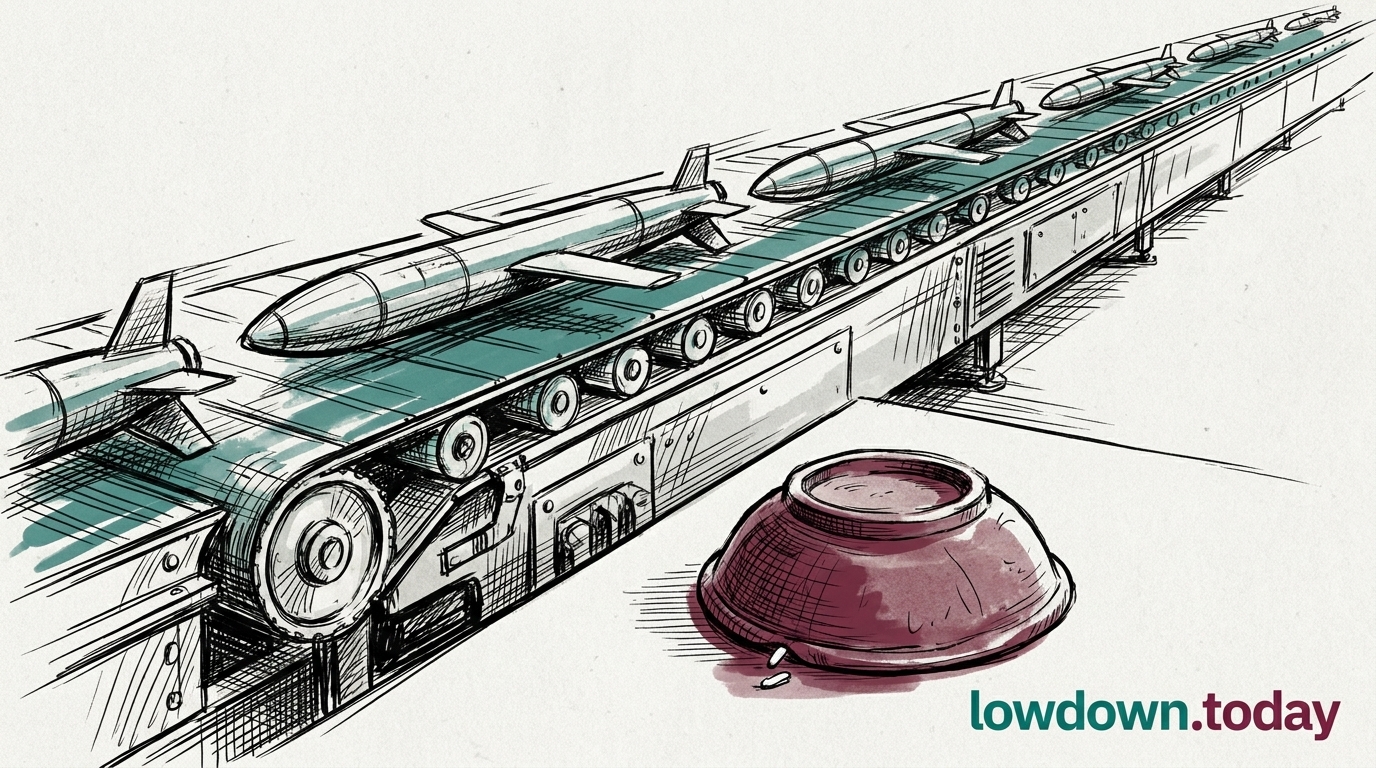
Signed a $22.9bn, seven-year contract with Raytheon on 17 August to raise Tomahawk output from about 60 a year to more than 1,000. The Acting Navy Secretary, quoted via an X post, framed it as the "Arsenal of Freedom" initiative; it replaces the 850 missiles fired by 1 April in about ten months at the new rate.
UK Maritime Trade Operations
UKMTO logged six armed men boarding a tanker 136 nautical miles east of Al Mukalla on 20 August and redirecting it toward Somalia. A vessel steered toward the Somali coast reads as an attempted seizure, a distinct hazard from the stand-off strikes the same lane has seen before.



