Skip to content
You can now search across every topic, entity and event.What's new
Iran Conflict 2026
23AUG

IAEA Board censures Iran 21-3 as ten members abstain

3 min read
19:02UTC

The IAEA Board of Governors adopted resolution GOV/2026/40 on 10 June by 21 votes to three, demanding Iran disclose its enriched-uranium stockpile and admit inspectors to four facilities; Russia, China and Niger voted against.

ConflictDeveloping
Key takeaway

The censure passed but ten abstentions blunt it, leaving the nuclear file split the day before the strikes widened.

The IAEA Board of Governors adopted resolution GOV/2026/40 on 10 June by 21 votes to three, with 10 members abstaining. The resolution advances the E3 and US draft tabled on 8 June and demands that Iran disclose its enriched-uranium stockpile and grant inspectors access to four enrichment facilities, denied for roughly a year. It follows the Board's 4 June finding that it could no longer account for 440.9 kilograms of highly enriched uranium .

Russia, China and Niger cast the three votes against, following through on the blocking position the two permanent members coordinated with Rafael Grossi in Geneva on 5 June . The ten abstentions matter as much as the three noes: a censure that passes without a broad majority signals to the Board that any move to escalate the file to the Security Council would splinter. Iran called the resolution a dangerous attempt at whitewashing aggression and warned the European states and the United States bear responsibility for consequences.

The vote landed the day before CENTCOM's second strikes, and against them. The institutional track is moving on the paperwork of non-compliance while the military track moves on the targets, and the two are now running on the same calendar without coordination. A demand for stockpile disclosure issued the day before air strikes on the capital is unlikely to be answered by a state that has just rejected the resolution outright.

Deep Analysis

In plain English

The International Atomic Energy Agency (IAEA) is the UN body that inspects countries' nuclear facilities to make sure they are not secretly making weapons. It adopted a formal censure resolution against Iran on the same day US aircraft struck Tehran's western suburbs for the first time, demanding that Iran reveal exactly how much enriched uranium it has and let inspectors back into four nuclear sites they have been blocked from for about a year. The vote was 21 countries in favour, three against, and ten abstaining. Russia and China voted against, as expected. The ten countries that abstained did not support Iran but also did not fully back the resolution. Iran rejected it outright and called it a tool to justify the military attacks happening at the same time.

Deep Analysis
Root Causes

The 440.9 kilograms of highly enriched uranium (HEU) that the IAEA Board acknowledged it could no longer account for as of 4 June represents a structural verification failure, not a new event. Iran terminated all IAEA cooperation after the Majlis voted 221-0 on 11 April following the February strikes, ending 97 days of inspector access.

The agency's 'loss of continuity of knowledge' declaration means the evidentiary chain that would allow a post-conflict verification agreement to reconstruct Iran's stockpile history no longer exists.

The Bulletin of the Atomic Scientists' satellite analysis from May 2026 estimated up to 540 kilograms of 60 per cent-enriched HEU may have been moved to Isfahan in June 2025, a figure 100 kilograms above the IAEA's last confirmed measurement of 440.9 kilograms. The resolution's stockpile disclosure demand is therefore being made against a moving target the agency cannot independently verify.

Escalation

Lateral escalation. The IAEA vote does not itself add military pressure but removes the last institutional pathway for a verified nuclear settlement. Iran's outright rejection and its warning that E3 and the US bear responsibility for consequences signals readiness to exit any remaining IAEA framework.

What could happen next?
  • Risk

    If Iran responds by formally withdrawing from the Non-Proliferation Treaty (NPT), as it threatened in 2020 before pulling back, the IAEA's legal basis for any Iran access disappears and no future deal can contain a verified nuclear component.

    Short term · Assessed
  • Consequence

    The ten abstentions deny the resolution the super-majority that would give a subsequent Security Council referral political legitimacy. Russia and China's veto means any referral produces no binding UN action, making the censure a political record rather than an enforcement instrument.

    Immediate · Reported
  • Precedent

    Passing a stockpile disclosure demand the day before the second US air strikes on Tehran establishes a pattern where the institutional and military tracks run on the same calendar without coordination, increasing the chance that Iranian decision-makers conflate the two.

    Medium term · Assessed
First Reported In

Update #124 · IRGC declares Hormuz shut; US strikes again

UK Government (FCDO) / Tehran Times· 11 Jun 2026
Read original
Different Perspectives
Hizballah
Hizballah
Has not commented on the US Treasury's 20 August designation of ten people, including named couriers, over a cash network Treasury says moved money to it from the IRGC-Qods Force. ACLED recorded a sharp rise in attacks around it the same day.
Kuwait
Kuwait
Kuwait's Chief of the General Staff, Lieutenant General Khaled al-Shriaan, co-chaired the 16th US-Kuwait Joint Military Commission at the Pentagon on 21 August. Kuwait has not published what was agreed; only a summary of the meeting's existence and attendees is sourced.
Qatar
Qatar
Has not commented publicly on the $4.5bn KC-46A tanker Foreign Military Sale notification the State Department approved on 20 August. The notification opens a sale process; Doha has not confirmed whether it will proceed to a signed transfer.
Mohammad Bagher Ghalibaf
Told a Baghdad business meeting on 20 August that Iran will not endure a hungry population regardless of its military strength, against 87.9% point-to-point inflation and 128.1% food inflation for Tir. His fellow Majlis Economic Committee member Samsami separately warned a petrol price rise would ignite unrest.
US Navy
US Navy
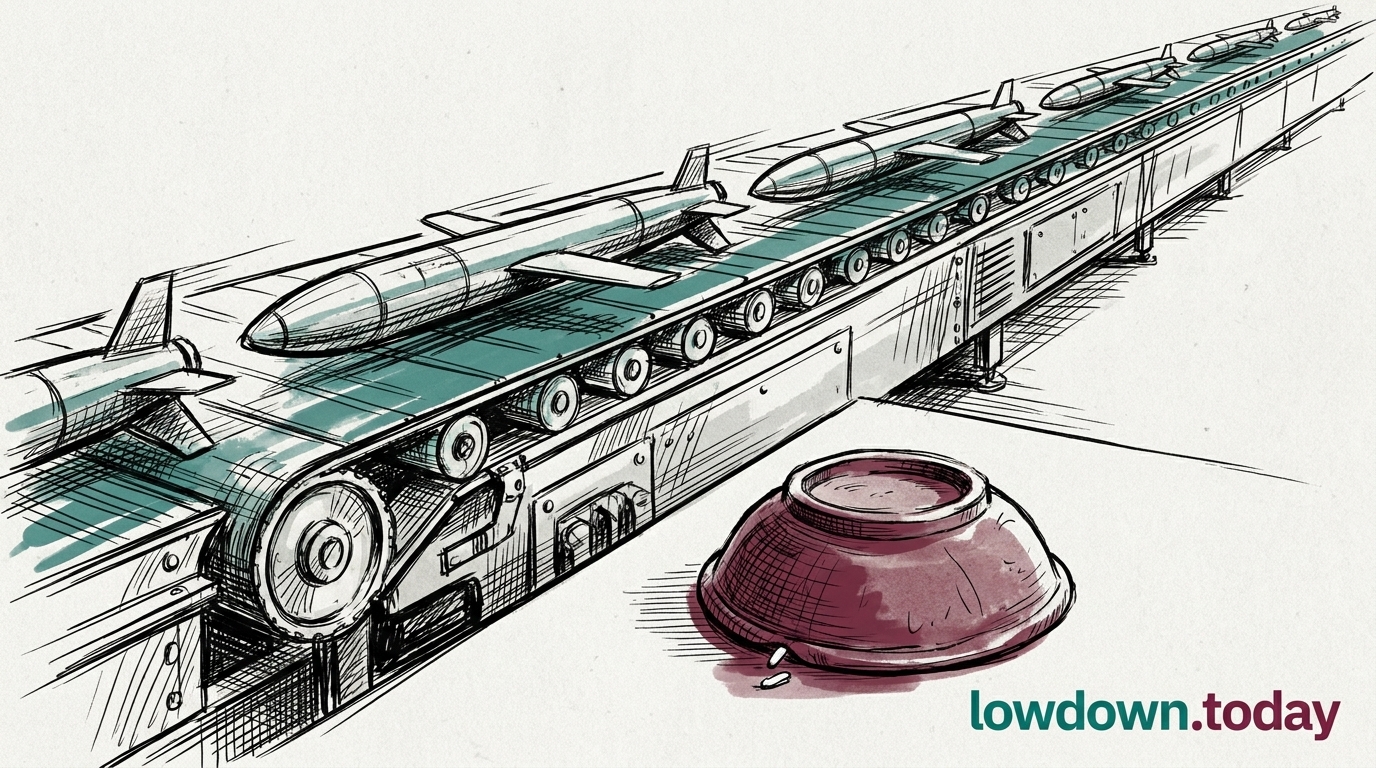
Signed a $22.9bn, seven-year contract with Raytheon on 17 August to raise Tomahawk output from about 60 a year to more than 1,000. The Acting Navy Secretary, quoted via an X post, framed it as the "Arsenal of Freedom" initiative; it replaces the 850 missiles fired by 1 April in about ten months at the new rate.
UK Maritime Trade Operations
UKMTO logged six armed men boarding a tanker 136 nautical miles east of Al Mukalla on 20 August and redirecting it toward Somalia. A vessel steered toward the Somali coast reads as an attempted seizure, a distinct hazard from the stand-off strikes the same lane has seen before.