Skip to content
You can now search across every topic, entity and event.What's new
Iran Conflict 2026
23AUG

Gulf States Collectively Invoke Self-Defence Rights

2 min read
19:02UTC

All six GCC members affirmed Article 51 rights against Iran, establishing a legal framework for collective military action while insisting diplomacy remains the preferred path.

ConflictAssessed
Key takeaway

Legal framework established; operational commitment absent.

The full Gulf Cooperation Council, not just Saudi Arabia , collectively affirmed UN Charter Article 51 self-defence rights at their 50th Extraordinary Ministerial Council. The statement cited Iranian attacks on civilian airports, oil facilities, desalination plants, and ports. It called on the UN Security Council to ensure cessation of Iranian aggression.

But the same statement declared that dialogue and diplomacy remain the optimal path. This is a legal framework without an operational commitment. Article 51 does not require Security Council approval; it enables a state, and its allies, to act in collective self-defence against armed attack. The GCC has now positioned the legal instrument. Whether any member state converts that instrument into military action remains an open question.

The record so far: legal posture, diplomatic language, zero kinetic response. The simultaneous assertion of self-defence rights and preference for dialogue is standard diplomatic positioning: maximise legal options while minimising operational commitment. The GCC has never conducted a collective military operation against a state actor. The Article 51 invocation is a ceiling-raising exercise, expanding what is legally permissible without committing to what will actually be done.

Deep Analysis

In plain English

All six Gulf states together said they have the legal right to defend themselves against Iran's attacks, citing strikes on water plants, airports, and oil facilities. Having the right to act is not the same as planning to act. They also said they still prefer talking. But the legal permission is now on the table if they change their minds.

Deep Analysis
Root Causes

Iran's escalating strikes on Gulf civilian infrastructure (Kuwait desalination plants supplying 90% of drinking water, Mina al-Ahmadi refinery, Abu Dhabi aluminium smelters) crossed a threshold that individual bilateral responses could not adequately address. The collective framework consolidates the legal position of six nations simultaneously.

Escalation

Potentially escalatory in legal terms but not yet in operational terms. The Article 51 framework creates permissive conditions for military action that did not previously exist in collective form. The probability of GCC military action remains low but the legal barrier has been removed.

What could happen next?
  • Legal basis for collective Gulf military action established without UNSC approval

  • Iran must now factor collective Gulf response into its targeting calculations

First Reported In

Update #60 · Pakistan's Ceasefire Plan Fills the Vacuum

GCC Secretariat / Arabian Business· 6 Apr 2026
Read original
Causes and effects
This Event
Gulf States Collectively Invoke Self-Defence Rights
This expands the legal framework from Saudi Arabia's individual Article 51 invocation {{EVREF:/t/iran-conflict-2026/59/saudi-arabia-invokes-article-51-after-water-strikes/}} to a collective Gulf position. Article 51 does not require Security Council approval; it enables a state, and its allies, to act in collective self-defence against armed attack. The GCC has now positioned the legal instrument. Whether any member state converts that instrument into military action remains an open question.
Different Perspectives
Hizballah
Hizballah
Has not commented on the US Treasury's 20 August designation of ten people, including named couriers, over a cash network Treasury says moved money to it from the IRGC-Qods Force. ACLED recorded a sharp rise in attacks around it the same day.
Kuwait
Kuwait
Kuwait's Chief of the General Staff, Lieutenant General Khaled al-Shriaan, co-chaired the 16th US-Kuwait Joint Military Commission at the Pentagon on 21 August. Kuwait has not published what was agreed; only a summary of the meeting's existence and attendees is sourced.
Qatar
Qatar
Has not commented publicly on the $4.5bn KC-46A tanker Foreign Military Sale notification the State Department approved on 20 August. The notification opens a sale process; Doha has not confirmed whether it will proceed to a signed transfer.
Mohammad Bagher Ghalibaf
Told a Baghdad business meeting on 20 August that Iran will not endure a hungry population regardless of its military strength, against 87.9% point-to-point inflation and 128.1% food inflation for Tir. His fellow Majlis Economic Committee member Samsami separately warned a petrol price rise would ignite unrest.
US Navy
US Navy
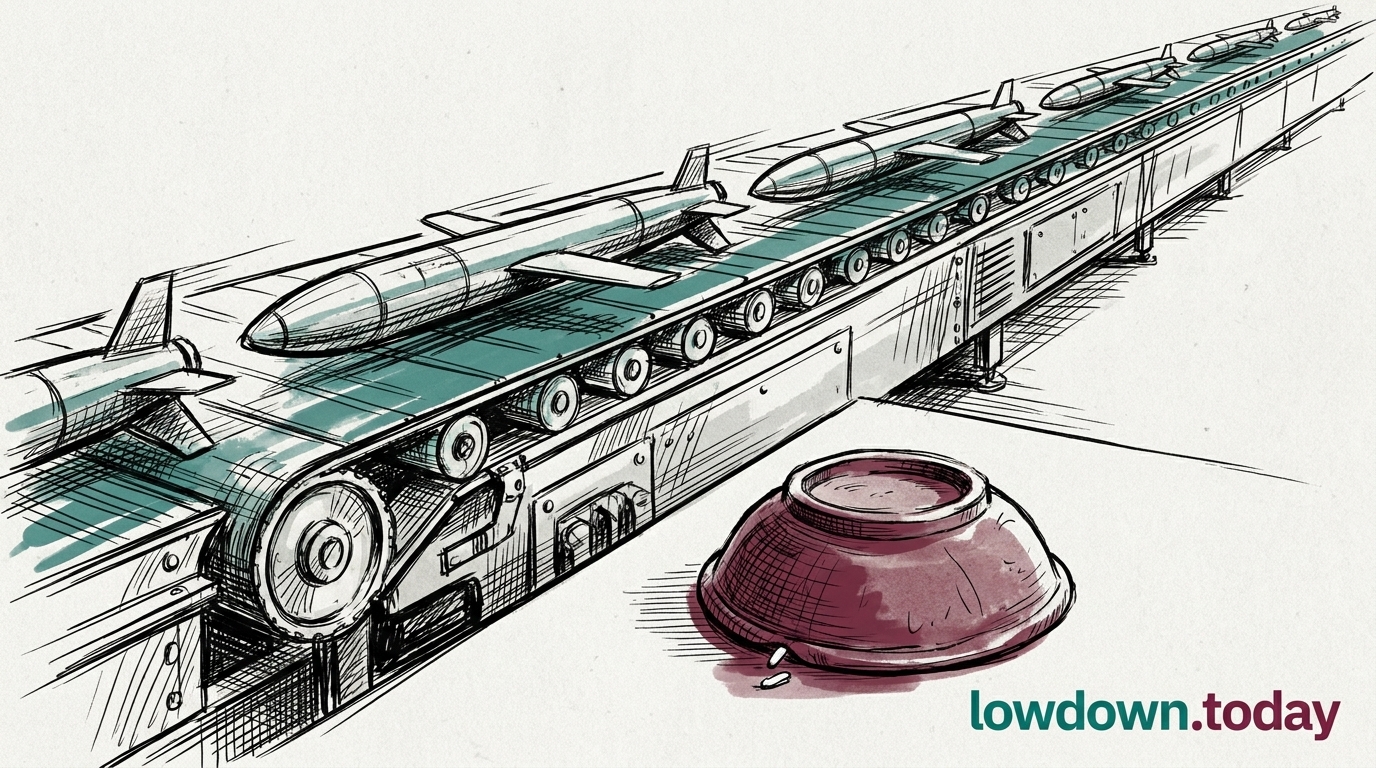
Signed a $22.9bn, seven-year contract with Raytheon on 17 August to raise Tomahawk output from about 60 a year to more than 1,000. The Acting Navy Secretary, quoted via an X post, framed it as the "Arsenal of Freedom" initiative; it replaces the 850 missiles fired by 1 April in about ten months at the new rate.
UK Maritime Trade Operations
UKMTO logged six armed men boarding a tanker 136 nautical miles east of Al Mukalla on 20 August and redirecting it toward Somalia. A vessel steered toward the Somali coast reads as an attempted seizure, a distinct hazard from the stand-off strikes the same lane has seen before.