Skip to content
You can now search across every topic, entity and event.What's new
Iran Conflict 2026
23AUG

First sailors die in the tanker war

2 min read
19:02UTC

The IRGC disabled two supertankers in Omani waters on 14 July, killing one seafarer by UAE count and two by the International Maritime Agency's, the first crew deaths of the shipping war.

ConflictDeveloping
Key takeaway

The first crew deaths give war-risk insurers a body count to cite, freezing even legally shippable Gulf cargoes.

The Islamic Revolutionary Guard Corps (IRGC) disabled two supertankers in Omani waters on 14 July, saying it acted after "repeated warnings" 1. United Arab Emirates (UAE) reporting put the crew toll at one killed; the International Maritime Agency counted two seafarers dead 2. Every prior tanker strike had produced damage without confirmed fatalities, from the Qatari carrier Al Rekayyat on 7 July to the container ship GFS Galaxy on 12 July, both of which left crews shaken but alive.

Those deaths sharpen the insurance squeeze that has strangled the strait since the first strike. London's Protection and Indemnity (P&I) clubs have held their Hormuz war-risk exclusion in force since Al Rekayyat , and a confirmed fatality gives underwriters a harder reason to keep it there. Licensed cargoes cannot sail while the exclusion stands, whatever a sanctions licence permits, so the human cost feeds straight back into the freight that is not moving.

One caution on the count itself. Neither the one-death nor the two-death figure has been independently corroborated, and the discrepancy between the UAE and the International Maritime Agency is unresolved 3.

Deep Analysis

In plain English

Ships have been damaged in the strait for months without anyone dying. This is different because sailors were actually killed, which raises the moral and legal stakes and makes any future strike harder to treat as an acceptable risk of doing business.

Deep Analysis
Root Causes

The competing casualty counts stem from parallel, uncoordinated reporting chains: UAE authorities report through their own maritime rescue apparatus while the International Maritime Agency compiles figures from vessel operators and insurers, with no shared methodology for confirming a death at sea.

A deeper cause is the absence of a sanctioned exit route: the IMO evacuation corridor has been suspended since the Ever Lovely strike in late June, leaving crews with no safe passage and raising the odds that any strike produces a confirmed fatality rather than a near-miss.

What could happen next?
  • Consequence

    Confirmed deaths, rather than vessel damage, typically harden flag-state and insurer positions on a route permanently rather than provisionally, raising the odds that Hormuz war-risk premiums stay elevated even if the blockade itself eases.

First Reported In

Update #154 · US enforces Hormuz closure with blockade

Al Jazeera· 15 Jul 2026
Read original
Different Perspectives
Hizballah
Hizballah
Has not commented on the US Treasury's 20 August designation of ten people, including named couriers, over a cash network Treasury says moved money to it from the IRGC-Qods Force. ACLED recorded a sharp rise in attacks around it the same day.
Kuwait
Kuwait
Kuwait's Chief of the General Staff, Lieutenant General Khaled al-Shriaan, co-chaired the 16th US-Kuwait Joint Military Commission at the Pentagon on 21 August. Kuwait has not published what was agreed; only a summary of the meeting's existence and attendees is sourced.
Qatar
Qatar
Has not commented publicly on the $4.5bn KC-46A tanker Foreign Military Sale notification the State Department approved on 20 August. The notification opens a sale process; Doha has not confirmed whether it will proceed to a signed transfer.
Mohammad Bagher Ghalibaf
Told a Baghdad business meeting on 20 August that Iran will not endure a hungry population regardless of its military strength, against 87.9% point-to-point inflation and 128.1% food inflation for Tir. His fellow Majlis Economic Committee member Samsami separately warned a petrol price rise would ignite unrest.
US Navy
US Navy
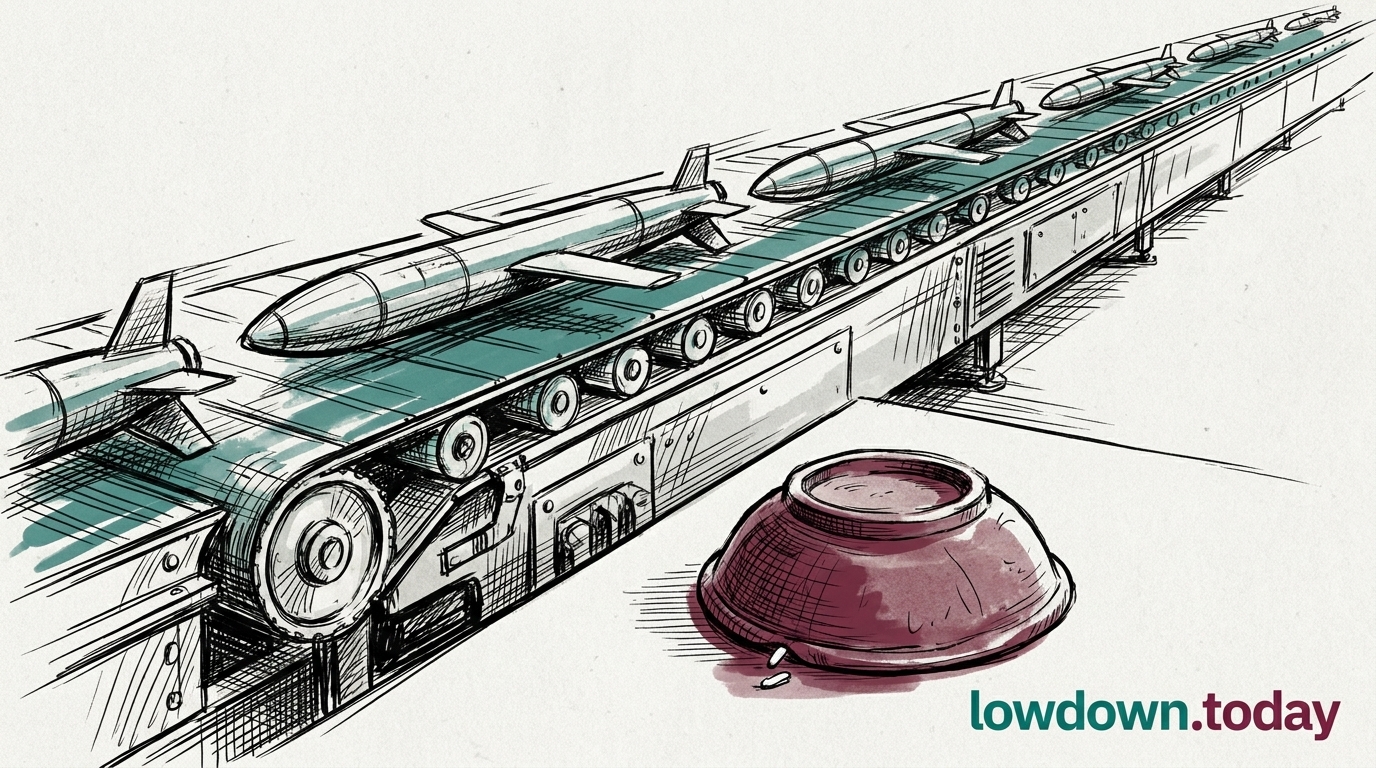
Signed a $22.9bn, seven-year contract with Raytheon on 17 August to raise Tomahawk output from about 60 a year to more than 1,000. The Acting Navy Secretary, quoted via an X post, framed it as the "Arsenal of Freedom" initiative; it replaces the 850 missiles fired by 1 April in about ten months at the new rate.
UK Maritime Trade Operations
UKMTO logged six armed men boarding a tanker 136 nautical miles east of Al Mukalla on 20 August and redirecting it toward Somalia. A vessel steered toward the Somali coast reads as an attempted seizure, a distinct hazard from the stand-off strikes the same lane has seen before.