Skip to content
You can now search across every topic, entity and event.What's new
Iran Conflict 2026
23AUG

Artesh claims Kuwait and Bahrain strikes

2 min read
19:02UTC

Iran's regular army, not the IRGC, claimed the 16 July drone strikes on Kuwait and Bahrain and named them phase ten of Operation Saeqeh.

ConflictDeveloping
Key takeaway

Iran's regular army claimed the Kuwait and Bahrain strikes under its own named operation, stepping out of the IRGC's shadow.

The regular Army of the Islamic Republic of Iran (Artesh), not the IRGC, claimed the 16 July drone strikes on Kuwait's Ali Al Salem Air Base and Bahrain's Sheikh Isa air base, and gave the campaign a name: the tenth phase of Operation Saeqeh (Lightning). 1

Every prior Gulf reprisal in this war had carried the IRGC's name. The IRGC fired on Jordan's Azraq base and struck three Gulf states on 9 July , and ran the Gulf-wide retaliation that answered the blockade . This time the IRGC claimed only the separate hit on Jordan's Azraq base, while the Artesh took Kuwait and Bahrain under its own banner.

A named, numbered, multi-phase operation implies sustained institutional planning, distinct from the corps' improvised strike-and-claim pattern. The Artesh has spent this war in the IRGC's shadow as the conventional-defence force; a numbered army operation is a bureaucratic claim on the war's prestige, and such claims outlast the strikes that prompt them. Mojtaba Khamenei was installed through IRGC channels, so an army asserting its own operational brand under a Supreme Leader it did not choose is a fault line worth watching.

Kuwait's armed forces said their air defences intercepted hostile drones on 16 July, independent, non-Iranian confirmation that the attack was real. 2 A quieter reading also fits: the two forces may simply be dividing targets, with no rivalry implied. Even so, no earlier Iranian strike this war has carried a numbered army operation's name.

Deep Analysis

In plain English

Iran has two separate armed forces that don't answer to a single military command: the regular Army, called Artesh, and the Islamic Revolutionary Guard Corps, or IRGC, which is the more ideological force that has led most of the war's retaliatory strikes. This time it was Artesh, not the IRGC, that claimed credit for drone strikes on air bases in Kuwait and Bahrain, giving its campaign the name Operation Saeqeh and calling this attack its tenth phase.

Deep Analysis
Root Causes

Iran's constitution establishes Artesh and the IRGC as parallel, formally equal armed forces answering separately to the Supreme Leader, with neither holding overall operational primacy over the other.

That dual-track structure gives each branch an incentive to publicise its own named, numbered campaign, Artesh's Operation Saeqeh among them, rather than issue a single joint claim.

What could happen next?
  • Meaning

    Artesh's willingness to publicise its own named campaign suggests the regular Army wants independent credit for retaliation, rather than letting the IRGC's messaging define the war's narrative.

First Reported In

Update #155 · US bombing moves inland as blockade hardens

Tech Times· 18 Jul 2026
Read original
Different Perspectives
Hizballah
Hizballah
Has not commented on the US Treasury's 20 August designation of ten people, including named couriers, over a cash network Treasury says moved money to it from the IRGC-Qods Force. ACLED recorded a sharp rise in attacks around it the same day.
Kuwait
Kuwait
Kuwait's Chief of the General Staff, Lieutenant General Khaled al-Shriaan, co-chaired the 16th US-Kuwait Joint Military Commission at the Pentagon on 21 August. Kuwait has not published what was agreed; only a summary of the meeting's existence and attendees is sourced.
Qatar
Qatar
Has not commented publicly on the $4.5bn KC-46A tanker Foreign Military Sale notification the State Department approved on 20 August. The notification opens a sale process; Doha has not confirmed whether it will proceed to a signed transfer.
Mohammad Bagher Ghalibaf
Told a Baghdad business meeting on 20 August that Iran will not endure a hungry population regardless of its military strength, against 87.9% point-to-point inflation and 128.1% food inflation for Tir. His fellow Majlis Economic Committee member Samsami separately warned a petrol price rise would ignite unrest.
US Navy
US Navy
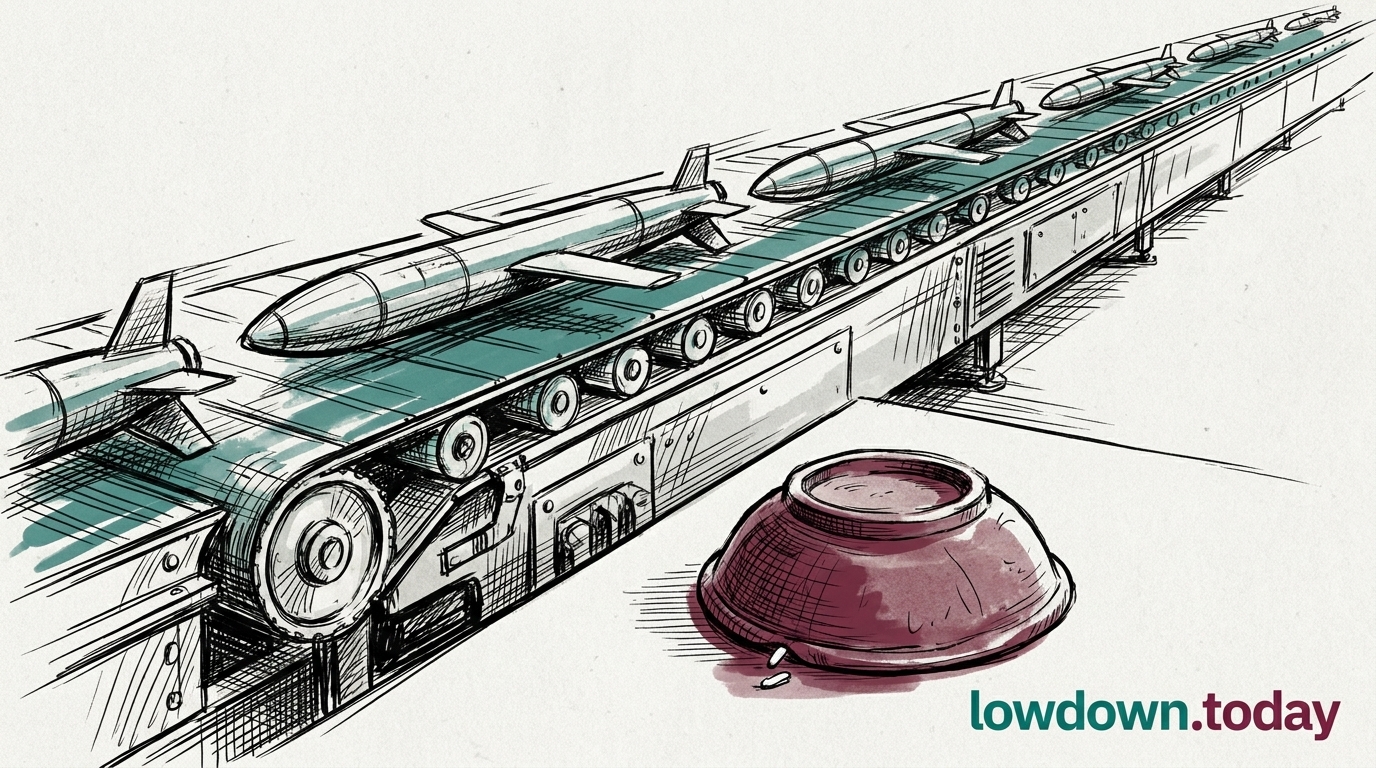
Signed a $22.9bn, seven-year contract with Raytheon on 17 August to raise Tomahawk output from about 60 a year to more than 1,000. The Acting Navy Secretary, quoted via an X post, framed it as the "Arsenal of Freedom" initiative; it replaces the 850 missiles fired by 1 April in about ten months at the new rate.
UK Maritime Trade Operations
UKMTO logged six armed men boarding a tanker 136 nautical miles east of Al Mukalla on 20 August and redirecting it toward Somalia. A vessel steered toward the Somali coast reads as an attempted seizure, a distinct hazard from the stand-off strikes the same lane has seen before.