Skip to content
You can now search across every topic, entity and event.What's new
Iran Conflict 2026
31JUL

Trump won't rule out Iran ground troops

3 min read
09:24UTC

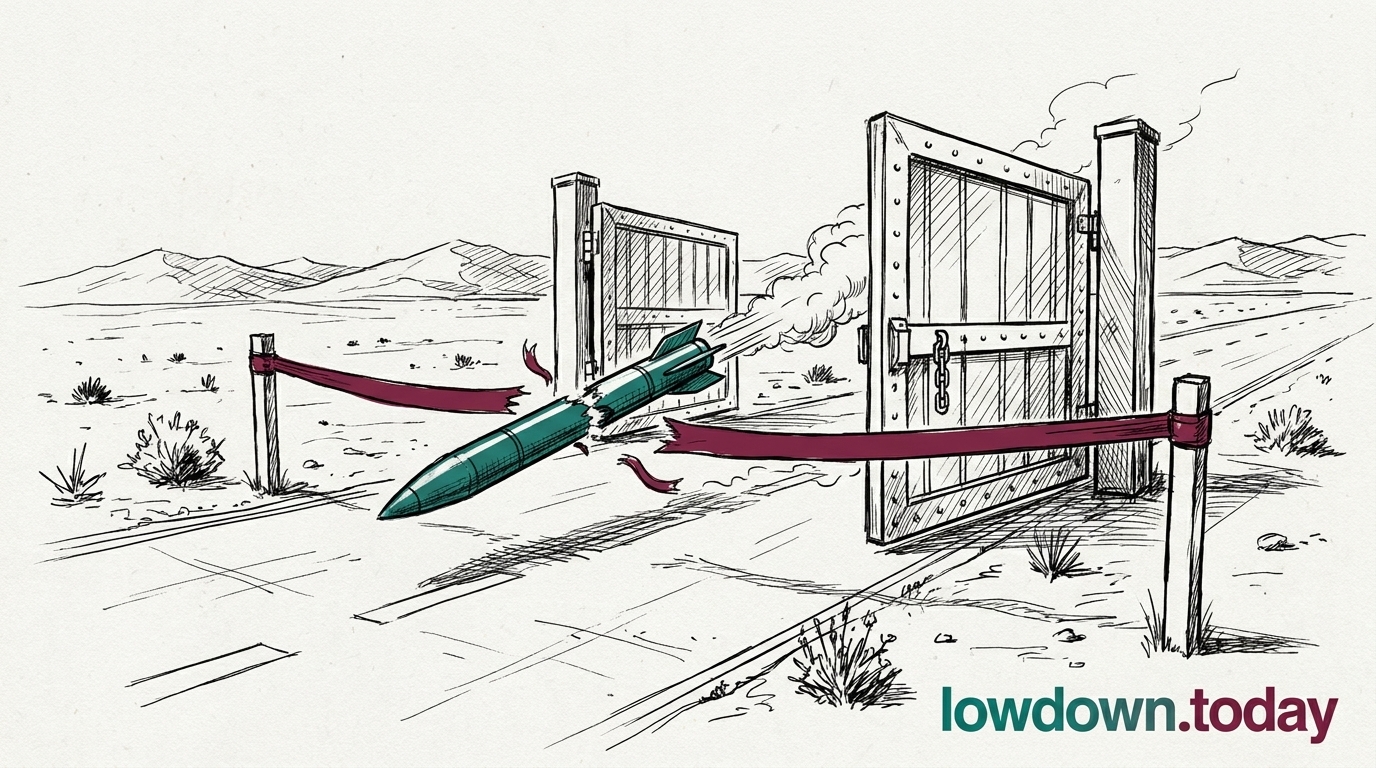
While claiming Iran has been 'demolished,' Trump refused to rule out ground forces for the first time — the gap between the two statements contains the campaign's central strategic problem.

ConflictDeveloping
Key takeaway

Trump's 'demolished' claim is factually accurate for naval and missile forces but entirely false for Iranian ground forces and the IRGC, meaning 'never say never' on troops is less a deliberate contingency signal than an implicit acknowledgement that the air campaign cannot produce political outcomes against intact ground capacity.

President Trump told reporters Thursday that Iran was being "demolished ahead of schedule and at levels people have never seen before," claiming Iran has "no air force, no air defence, no navy." Asked whether ground troops might be deployed, Trump said: "Never say never."

The statement is the first departure from the air-only campaign framing at the presidential level. Defence Secretary Hegseth stated on Day 3 that this was "not a regime change war" . CENTCOM was subsequently directed to "dismantle the Iranian regime's security apparatus" — a war aim encompassing the IRGC, Basij, MOIS, and internal security forces that maintain the current government's domestic control . Trump's formulation sits between these two positions: not committing to ground forces, but explicitly refusing to rule them out.

The gap between "demolished" and "never say never" contains the campaign's central problem. More than 30 Iranian naval vessels have been destroyed and missile launches are down 90% from Day 1. Iran's conventional military — the surface fleet, air defences, fixed Ballistic missile launchers that took three decades to build — has been degraded at a pace not seen since the destruction of Iraq's armed forces in 2003. But conventional military destruction and political outcomes are different things. The United States destroyed Iraq's conventional forces in three weeks; the political consequences lasted two decades.

Iran's remaining military capacity is precisely what air power struggles to eliminate: the IRGC's asymmetric warfare infrastructure, proxy networks across four countries, and the dispersed Mosaic Defence units that have devolved launch authority to 31 provincial commanders . The conventional capabilities destroyed this week were three decades of attempted modernisation layered on top of the IRGC's original design — an organisation built during the Iran-Iraq War for exactly the kind of distributed, attritional warfare that a ground campaign would face. Trump's "never say never" acknowledges, perhaps inadvertently, that destroying what can be seen from the air does not guarantee the political result Washington wants.


Deep Analysis

In plain English

Trump told reporters Iran has no air force, no air defences, and no navy — which is largely accurate for those specific capabilities after a week of strikes. What he did not mention is that the IRGC — Iran's elite military-political force of roughly 125,000 — and the regular army's ground divisions were never targeted and remain entirely intact. When Trump says 'never say never' about ground troops, he is contradicting his own Defence Secretary, who said three days earlier this was 'not a regime change war.' A ground war in Iran — a country of 83 million people with difficult mountain terrain and a sophisticated irregular warfare doctrine — would be categorically larger than Iraq or Afghanistan, requiring forces the US does not currently have positioned in the region.

Deep Analysis
Synthesis

Trump's simultaneous 'demolished' victory declaration and ground-troops non-denial reveals the fundamental strategic tension: the air campaign was designed to coerce behavioural change, but Iranian leadership is dispersed, succession-ambiguous, and the foreign minister is now refusing talks — none of which are the responses of a coerced adversary. The administration is publicly claiming success while the political objective recedes, a dynamic that historically produces escalation decisions rather than graceful exit.

Root Causes

The air-only campaign was premised on achieving political outcomes through kinetic degradation of Iran's conventional military; but the campaign's actual targeting — leadership infrastructure, succession arrangements, missile forces, naval assets — is structurally a regime-change campaign, creating an incoherence between Hegseth's stated 'not regime change' framing and the operational logic that 'never say never' now exposes.

Escalation

The gap between Trump's 'demolished' public framing and the intact state of Iranian ground forces creates a domestic political self-trap: if Iran demonstrates continued capability through proxies, cyber operations, or direct action, Trump faces pressure to escalate to validate the 'demolished' claim — a logic that makes ground deployment more likely the more Iran is seen to be acting, regardless of whether the action is militarily significant.

What could happen next?
  • Risk

    Trump's 'demolished' public framing creates domestic political pressure to escalate if Iran's residual capabilities produce further US casualties or allied strikes, regardless of whether ground deployment is militarily rational.

    Short term · Assessed
  • Consequence

    Hegseth's Day 3 'not a regime change war' framing is now publicly contradicted at presidential level, degrading the coherence of US strategic communication to allies and adversaries simultaneously.

    Immediate · Assessed
  • Precedent

    A presidential 'never say never' on ground troops, once stated publicly, is nearly impossible to walk back without signalling weakness — it is now a fixed input in Iran's threat calculus and ally planning assumptions.

    Immediate · Assessed
  • Risk

    A ground force deployment without Congressional authorisation would face immediate War Powers Resolution challenge, creating a constitutional crisis concurrent with active combat operations.

    Short term · Assessed
First Reported In

Update #23 · Iran loses half its navy; China eyes Hormuz

Al Jazeera· 6 Mar 2026
Read original
Causes and effects
This Event
Trump won't rule out Iran ground troops
Trump's refusal to rule out ground troops is the first crack in the air-only campaign framing at the presidential level. It acknowledges implicitly that destroying Iran's conventional military may not produce the political outcome Washington seeks — the same gap between military victory and political resolution that defined the 2003 Iraq campaign.
Different Perspectives
Shipping and insurance underwriters
Underwriters can price Houthi strikes because the group announces its targets, but an unclaimed drone at Damietta and a mandatory Iranian insurance scheme both deny them a pattern to price against. War-risk premiums are increasingly being set by the absence of a claimant, not the scale of the damage.
Jordan
Jordan
Azraq absorbed its fourth Iranian strike in seven weeks, again drawing no direct Jordanian retaliation, only an American one. Amman's exposure, hosting US basing without the Patriot density of Gulf allies, has not changed even as the war around it widens.
Houthi movement
Houthi movement
The Houthis' 20 July blockade of Saudi-linked shipping is the injury Riyadh's new 43-nation coalition directly answers, yet the group itself was never asked to join and remains outside every proposal on the table. Sanaa-aligned commentators call the coalition a paper reassurance for insurers rather than a deployable force.
Egypt's Cabinet
Egypt's Cabinet
Egypt confirmed the Damietta blaze was an attack, not an accident, on soil the war had never touched before. Cairo now faces an unclaimed threat to a facility supplying roughly 7% of its domestic gas, with no author to hold accountable and no pattern yet to defend against.
Oman
Oman
Muscat is running the only channel Iran will use, a voluntary Hormuz fee modelled on Malacca, but stayed out of Saudi Arabia's new naval coalition entirely. Oman's mediating leverage depends on treating Hormuz as shared and non-exclusive, the opposite of what Tehran is now demanding of it.
Iraq's Prime Minister
Al-Zaidi cancelled his first official Riyadh visit and convened the Coordination Framework, the coalition that keeps him in power and whose factions sit inside the PMF that Saudi jets just struck. He is caught between a five-year Saudi investment relationship and armed groups inside his own state he does not fully control.



