Skip to content
You can now search across every topic, entity and event.What's new
Iran Conflict 2026
28JUL

48 days of war, zero Iran executive instruments

3 min read
09:28UTC

A Lowdown fetch of the White House presidential-actions page on 17 April confirmed zero Iran-related executive orders, proclamations or memoranda across 48 days of war.

ConflictAssessed
Key takeaway

Forty-eight days into the war, this president has signed nothing on Iran.

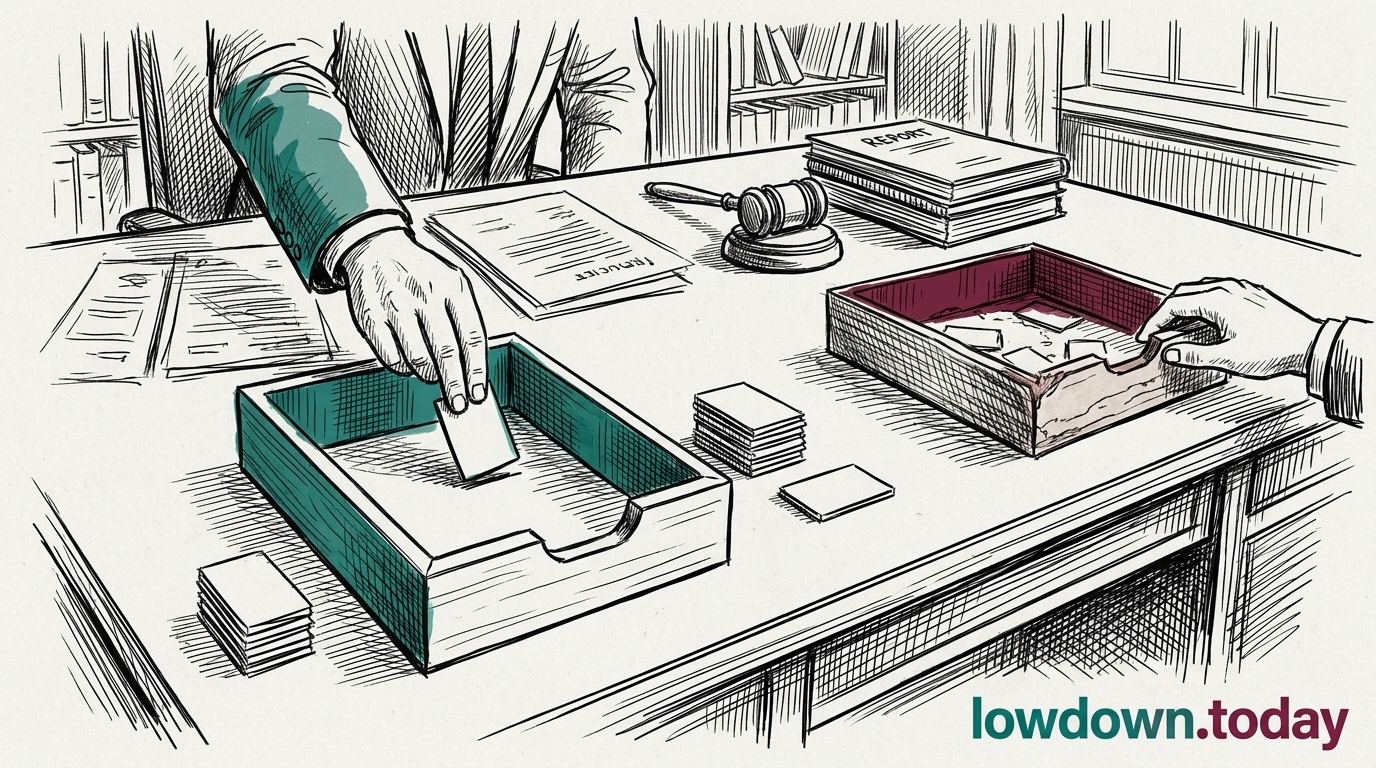
A direct fetch of The White House presidential-actions index on 17 April returned no Iran-related executive orders, proclamations or memoranda. The most recent signed instruments on file, dated 15 April, were Enbridge Pipeline permits for US-Canada cross-border infrastructure. Forty-eight days into a war with active strike operations, a naval blockade, a sanctions expiry, a ceasefire track and a War Powers clock running, the executive index shows nothing with Iran's name on it. This confirms and extends the day-45 finding .

Historical benchmarks make the gap visible. The 2001 Authorization for Use of Military Force passed on 14 September, three days after the attacks it covered. The 2002 Iraq AUMF was signed 16 October. The Tonkin Gulf Resolution cleared Congress within a week of the alleged incident. Every prior US wartime administration produced signed paper inside days. The current administration has run past every one of those markers without producing an Iran instrument.

The counter-argument that wartime tempo squeezes out paperwork collapses on inspection. Enbridge permits and an earlier domestic budget sequestration order show signed documents are being issued on other matters during this same 48-day window . Bandwidth is demonstrably available; the silence is topic-specific, not structural. The decision not to sign Iran instruments reads as active, not passive.

That distinction matters because signed instruments carry legal durability that posts and spokesperson statements do not. A Truth Social post can be deleted; a State Department readout can be walked back; a signed memorandum enters the institutional record and becomes a target for litigation, oversight and foreign-policy continuity. Its absence is not neutral; it reads as a working method. The four-deadline stack converging in the next 12 days, GL-U lapse, Iran ceasefire expiry, Lebanon truce end and WPR 60-day mark, will test what that method can carry when it meets institutions that respond to paper rather than posts.

Deep Analysis

In plain English

When a US president starts a war, they normally sign official documents , executive orders, emergency declarations, official memos , that go into the public record. These create legal obligations and can be reviewed by courts and Congress. Over 48 days of striking Iran, President Trump has signed none. Every ceasefire, blockade, and ultimatum exists only as social media posts. That matters because it means there is no official legal record of what the US committed to, and nothing a court or Congress can directly compel the administration to honour.

Deep Analysis
Root Causes

The instrument gap reflects a structural feature of Trump's governing style: policy announcements via Truth Social rather than the Federal Register preserve maximum optionality by avoiding the APA notice-and-comment process, the Congressional Review Act, and judicial standing for challengers.

The Iran war's sensitivity , combined with the WPR 60-day clock , creates an additional incentive to avoid instruments: a signed executive order authorising offensive military operations would almost certainly be characterised as the triggering action that started the WPR clock, potentially creating a cleaner legal case for Congress.

The topic-specific silence (multiple non-Iran instruments were signed in the same period) confirms this is deliberate, not administrative lag.

Escalation

The instrument gap raises escalation risk indirectly: without signed authorisation, there is no signed limitation. CENTCOM has no formal constraint on operational scope beyond the President's social-media posts, which have contradicted each other multiple times during the conflict.

What could happen next?
  • Risk

    Zero executive instruments means the WPR 60-day clock's 29 April expiry creates no automatic operational constraint; the administration can argue the clock never started because there is no triggering signed instrument.

    Short term · Medium
  • Precedent

    A 48-day air campaign with zero executive instruments, if unchallenged, sets a precedent that future administrations can conduct extended offensive operations using only social-media posts as policy vehicles.

    Long term · High
  • Consequence

    Allied governments relying on US ceasefire or withdrawal commitments have no signed document to cite in diplomatic negotiations; every US commitment is one Truth Social post away from reversal.

    Immediate · High
First Reported In

Update #71 · Netanyahu learned from the media

The White House· 17 Apr 2026
Read original
Different Perspectives
Iran's Supreme Leader's office and Iranian households
A letter published through state media named Lebanon's territorial integrity and an end to Israeli operations there as the war's ending condition; the same week, spokesperson Mohajerani cut the subsidised petrol ration from 70 to 50 litres a month. Iranian agencies still disagree on who inside the office signed the letter.
Oman
Oman
Muscat proposed a voluntary-funded coalition to police Hormuz, the corridor its own coastline gives it standing to manage, while Iran wants control and toll rights over shipping and Washington insists on free navigation. Oman's remit stops at the strait; it has no comparable claim over Iraq, the Caspian, or Lebanon.
Kyiv
Kyiv
President Volodymyr Zelenskyy confirmed the Caspian strike on an Iranian vessel carrying military cargo from Russia's Astrakhan region, opening a front that ties Iran's war to its supply relationship with Moscow rather than to anything the Gulf mediators are discussing.
Riyadh
Riyadh
Maj Gen Turki Al Malki named Iraq as the launch point for drones intercepted over the Eastern Province and Riyadh, the first time this war has reached Saudi Arabia from that direction rather than from Yemen. Nothing landed, but a second launch geography aimed at Saudi oil now exists alongside the Houthi front.
Baghdad
Baghdad
Iraq's Foreign Ministry summoned its own ambassador in Riyadh after Saudi Arabia's Defence Ministry said the drones came from Iraqi territory, while the same day drones struck Iranian-Kurdish opposition camps inside Iraq. Baghdad is disowning attacks it did not launch from territory it does not fully control.
The Pentagon and Congress
Acting press secretary Joel Valdez attributed the toll's reversal to site anomalies, the same explanation the department gave for the opposite cut on 24 July; Representative Thomas Massie called the category change an absurd ruse designed to reset the war's legal clock. Neither side agrees on which explanation, or which war, is real.