Skip to content
You can now search across every topic, entity and event.What's new
Iran Conflict 2026
23JUL

Hegseth tells SASC ceasefire pauses WPR clock

3 min read
19:27UTC

Pete Hegseth told the Senate Armed Services Committee on 30 April 2026 that the War Powers Resolution 60-day clock is paused by the ceasefire, a theory Tim Kaine rejected from the dais.

ConflictDeveloping
Key takeaway

Hegseth's ceasefire-pauses-clock theory is incompatible with the next day's 'not at war' claim, splitting the administration's WPR position.

Pete Hegseth, the US Secretary of Defense, told the Senate Armed Services Committee (SASC) on Thursday 30 April 2026 that "we are in a ceasefire right now, which our understanding means the 60-day clock pauses or stops in a ceasefire" 1. The 60-day clock is the WPR mechanism, the standard congressional check on undeclared hostilities. Tim Kaine (D-VA) rejected the theory directly: "I do not believe the statute would support that."

This was the first time The Administration formally argued a clock-pause legal theory before a congressional committee. Twenty-four hours later, the same administration moved past it to a stronger and incompatible position, that the United States is not at war at all captures the procedural context within which the legal theories were aired. A paused clock can resume; a clock that never ran cannot. Hegseth and the 1 May spokesperson now sit on opposite sides of a definitional split that the same congressional record captures.

The political backdrop matters. Lisa Murkowski's drafted Iran AUMF missed its 28 April filing target ; Murkowski has now set the week of 11 May as her new target, conditional on no White House plan in the interim. Hegseth's testimony was The Administration's last chance to offer a unified legal theory before the WPR deadline expired; it offered two.

Deep Analysis

In plain English

When the US started bombing Iran on 28 February 2026, a legal timer started. Under the War Powers Resolution of 1973, the president has 60 days to either get congressional approval for the war or start pulling troops out. That timer ran out on 1 May 2026. Defence Secretary Pete Hegseth appeared before the Senate Armed Services Committee on 30 April, the day before the deadline, and argued that a ceasefire between the US and Iran had paused the timer, the way pausing a stopwatch works. Senator Tim Kaine pushed back immediately, saying the law does not say anything about ceasefires pausing anything. The problem is that the very next day, the White House said something different: that the US is 'not at war' with Iran at all, meaning the timer never started in the first place. These two arguments contradict each other. Both are now officially on record, which makes it very hard to know what the administration's legal position actually is.

Deep Analysis
Root Causes

The ceasefire-pause theory emerged because the administration committed to a ceasefire narrative without legal preparation for how that ceasefire intersected with the WPR clock. The February-March SNSC (Iranian Security Council) ceasefire discussions were conducted as diplomatic communication; the legal team did not construct a WPR tolling argument at the time.

Hegseth's SASC appearance on 30 April 2026 produced the first attempt to construct a WPR tolling argument, entered retroactively into the congressional record without prior OLC vetting.

A second structural cause: the WPR's 1973 legislative history contains no discussion of ceasefire scenarios because the statute was designed for the Vietnam model, undeclared war with no ceasefire. The gap is genuine; no prior administration has litigated it because no prior administration faced an active ceasefire during an ongoing unauthorised war.

What could happen next?
  • Precedent

    Two mutually incompatible executive branch legal positions on the WPR are now entered into the congressional record within 24 hours, creating a precedent confusion that complicates any future OLC analysis.

  • Risk

    Senator Kaine's direct rejection of the ceasefire-pause theory on the congressional record provides standing for potential future legal challenges if any senator pursues them.

First Reported In

Update #85 · "Not at war": three claims, no treaty

Spectrum News· 1 May 2026
Read original
Different Perspectives
India
India
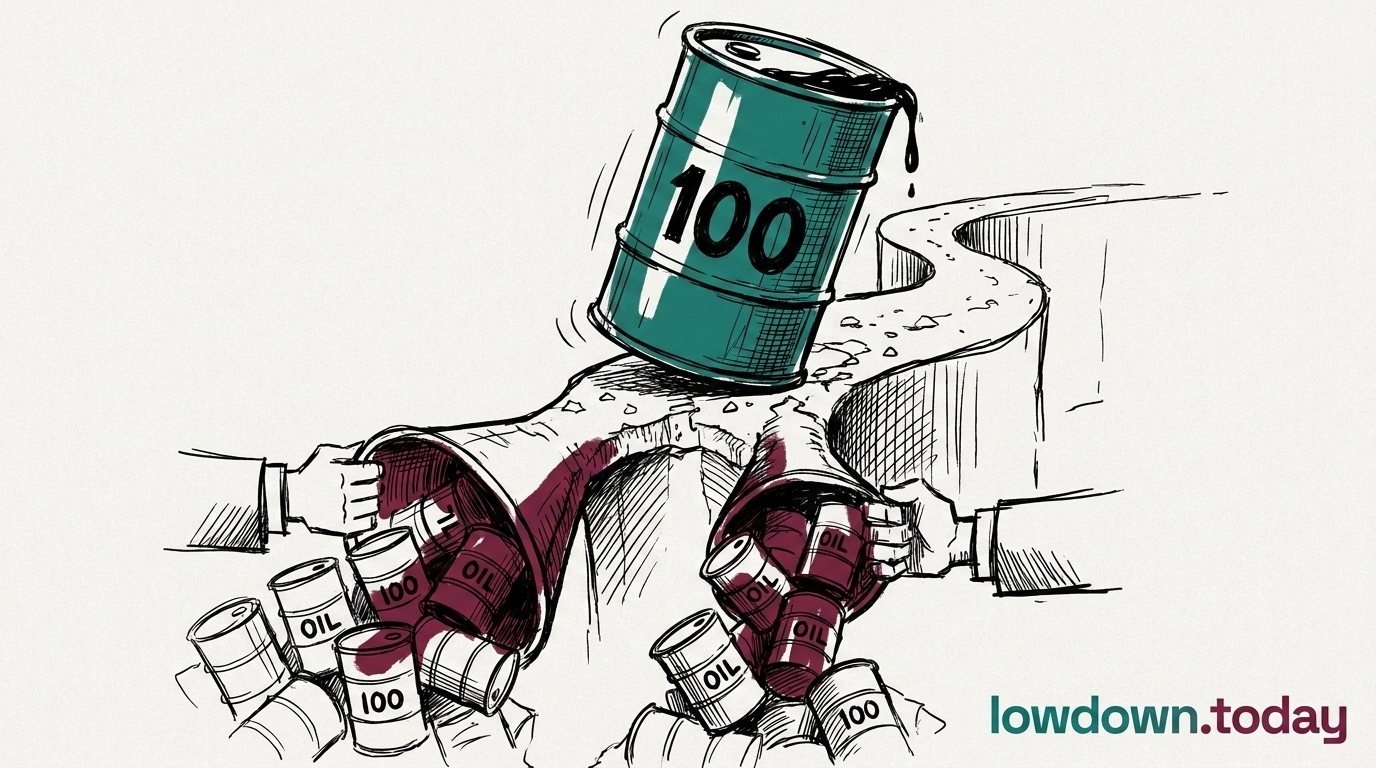
India buys more Saudi crude than any other country and has 2.5 million nationals working in the kingdom, so a $100 Brent and a live strike on Saudi tankers reach New Delhi through both fuel bills and remittance risk. Neither channel has an alternative route the way Saudi Arabia's own pipeline does.
Qatar
Qatar
Qatar co-authored the four-mediator ten-day ceasefire proposal alongside Egypt, Pakistan and Oman, centred on resuming Hormuz navigation, while separately pursuing its dated compensation claim against Iran at the UN Security Council filed on 21 July. Doha is mediating and litigating in the same week.
Israel
Israel
Israeli intelligence, reported by the Wall Street Journal, assesses Iran moved thousands of centrifuges and part of its roughly 440kg enriched-uranium stock into Pickaxe Mountain after the June 2025 strikes on its three main nuclear sites. Some of the US refuelling aircraft now deploying to the region are bound for Israeli bases and Ramon Airport.
Houthis
Houthis
Yahya Saree announced the missile and drone strikes on the Encelia and Layla on 22 July as enforcement of the embargo his forces had declared by radio warning alone two days earlier. Six vessels already turned back on the broadcast; the strike shows Houthi forces will use weapons once warnings stop working.
Saudi Arabia
Saudi Arabia
Saudi Arabia's state news agency confirmed only a fire on the Encelia's bow, with the crew safe; the Layla strike remains unconfirmed by Riyadh. The kingdom built its Petroline pipeline specifically to bypass Hormuz through the Red Sea, so the tanker fire lands on the route Riyadh had already spent billions escaping.
United States
United States
Washington is weighing both ten-day proposals but wants a longer truce than either offers, and moved F-16 and F-35 jets plus refuelling aircraft into the region while it decides. That deployment, not Trump's Pickaxe Mountain remarks, is the measurable US action, buying options for the day talks fail rather than betting on them.