Skip to content
You can now search across every topic, entity and event.What's new
Iran Conflict 2026
21JUN

IRGC claims mines shut Hormuz; US denies

2 min read
17:51UTC

The IRGC claimed on 18 July that two tankers struck mines and Hormuz is closed; CENTCOM called the claim false within hours.

ConflictDeveloping
Key takeaway

Iran says mines closed Hormuz on 18 July; CENTCOM calls it false, with no independent source yet arbitrating.

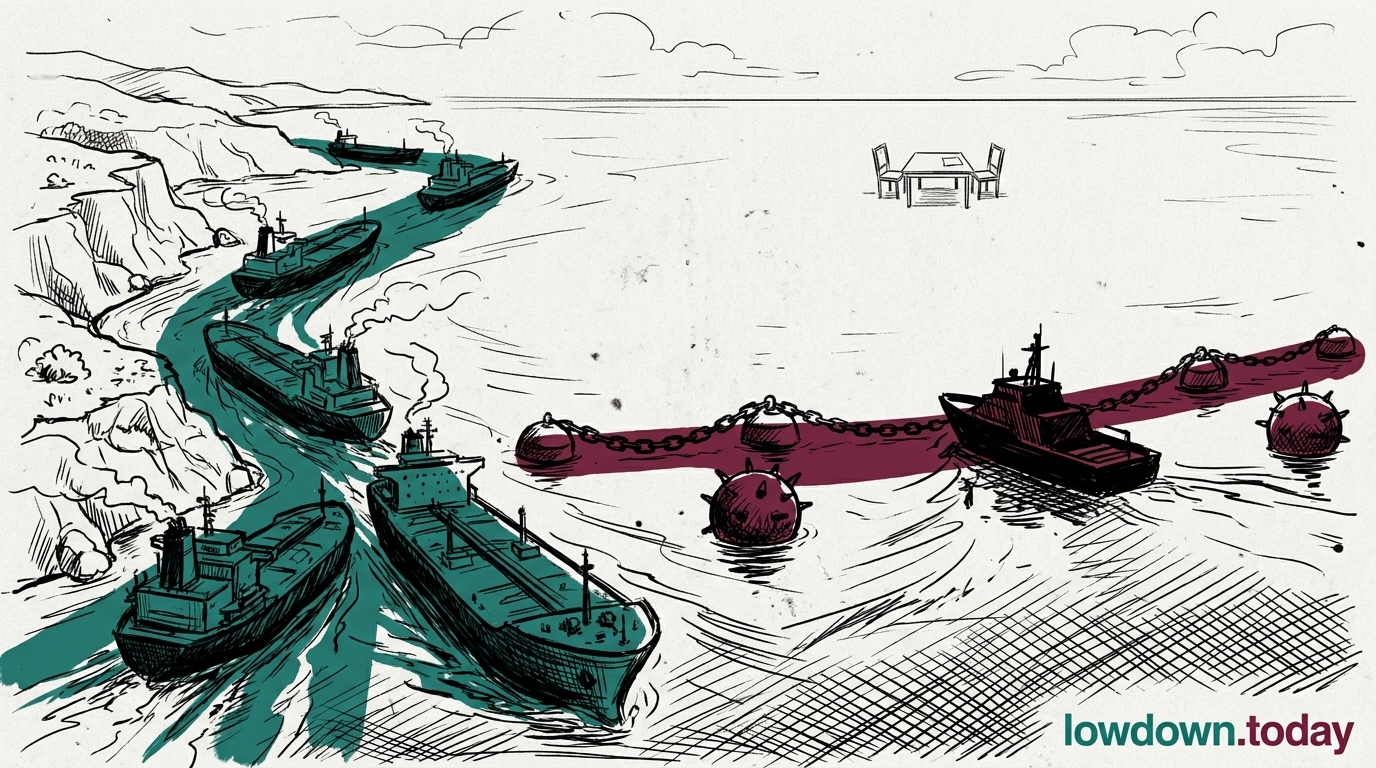
The IRGC claimed on 18 July that two tankers struck mines in the Strait of Hormuz and declared the strait completely closed; CENTCOM called the claim false within hours. 1

No independent maritime source had arbitrated the competing accounts as of 18 July. The IRGC (Islamic Revolutionary Guard Corps) is Iran's ideological military force and has controlled the Hormuz closure messaging throughout the war; CENTCOM (US Central Command) runs the strikes and the blockade. One says the world's busiest oil chokepoint is shut by mines; the other says nothing of the sort happened.

For the third time this month, a declared Iranian closure meets a flat CENTCOM denial with no neutral party to settle it. On 12 July the IRGC Navy struck the container ship GFS Galaxy and declared Hormuz closed, only for CENTCOM to insist the strait stayed open to traffic . CENTCOM has denied each declared closure in turn, and no neutral maritime authority has confirmed one yet.

The stakes turn on verification. A mined strait would be a genuine escalation, closing a corridor that carries about a fifth of the world's seaborne oil; an unverified claim is cheap leverage that costs Iran nothing to assert. Until an independent maritime authority confirms a mine strike, the closure exists only in IRGC statements, and CENTCOM's denial is the only counter-weight on the record.


Deep Analysis

In plain English

The Strait of Hormuz is the narrow waterway between Iran and Oman that a large share of the world's oil tankers pass through. Iran's IRGC, the hardline paramilitary force that has led much of the war effort, said on 18 July that two tankers had hit mines there and that the strait was now completely shut. CENTCOM, the US military command in the region, said within hours that this was false. Neither side has offered outside proof yet, so nobody independent has confirmed what, if anything, actually happened.

What could happen next?
  • Risk

    A pattern of unverified closure claims risks eroding the credibility of future IRGC statements even in a case where an actual mining incident occurs.

First Reported In

Update #155 · US bombing moves inland as blockade hardens

Al Jazeera· 18 Jul 2026
Read original
Different Perspectives
Hengaw
Hengaw
The Norway-based monitoring group reported the Urmia executions of Omid Behzad and Pouria Safvat, the only source to do so, consistent with its documented pattern of recording far more executions than the Iranian state acknowledges. Iran's government has not confirmed either execution.
Shipping and insurance underwriters
War-risk premiums price the Houthi campaign because the group announces its targets in advance, but a reopening Trump has promised without a published text gives underwriters no benchmark to reprice Hormuz cover against. Insurers want a text before they move rates, not a promise.
Houthi movement
Houthi movement
Spokesman Yahya Saree claimed strikes on two tankers in the Red Sea and Gulf of Aden on 5 August, only one of which UKMTO could confirm. The group's campaign against shipping continues on its own schedule, independent of any Hormuz arrangement further north.
Oman
Oman
Muscat has brokered the coordinates both Tehran and Washington's wire sources now describe differently, but has published no account of its own. Oman's position depends on treating Hormuz as a shared route, which is not what Iran is currently describing.
United States Central Command
CENTCOM raised its interdiction tally from 35 to 44 redirected vessels and disclosed its first boardings on 3 August, the day before Trump promised a reopening. The command's own enforcement record does not yet reflect the release the President has described.
Iran's Foreign Ministry
Spokesman Esmaeil Baghaei described the agreed Hormuz coordinates as a wholly new corridor under Iranian management, not a split of the existing route, days after his own deputy rejected Oman's lane proposal. Tehran wants the arrangement read as a change of ownership, not a compromise on access.



