Skip to content
You can now search across every topic, entity and event.What's new
Iran Conflict 2026
14JUN

Murkowski holds AUMF for a paper plan

3 min read
11:42UTC

Senator Lisa Murkowski's Iran Authorisation for Use of Military Force remained unfiled on Monday 11 May as the Senate returned from recess. Her condition for filing, a credible White House plan with defined objectives and exit criteria, stayed unmet by Trump's verbal escalation.

ConflictDeveloping
Key takeaway

Murkowski holds her Iran AUMF for a written White House plan; Trump's verbal week raises her leverage, not lowers it.

Alaska Republican Lisa Murkowski's Iran Authorisation for Use of Military Force (AUMF) remained unfiled on Monday 11 May as the US Senate returned from a week of recess. Her condition for filing, set on the floor on 30 April, was a credible White House plan with defined objectives, success metrics, exit criteria and congressional reporting. That paper threshold stayed unmet across the recess and into Monday's reopening.

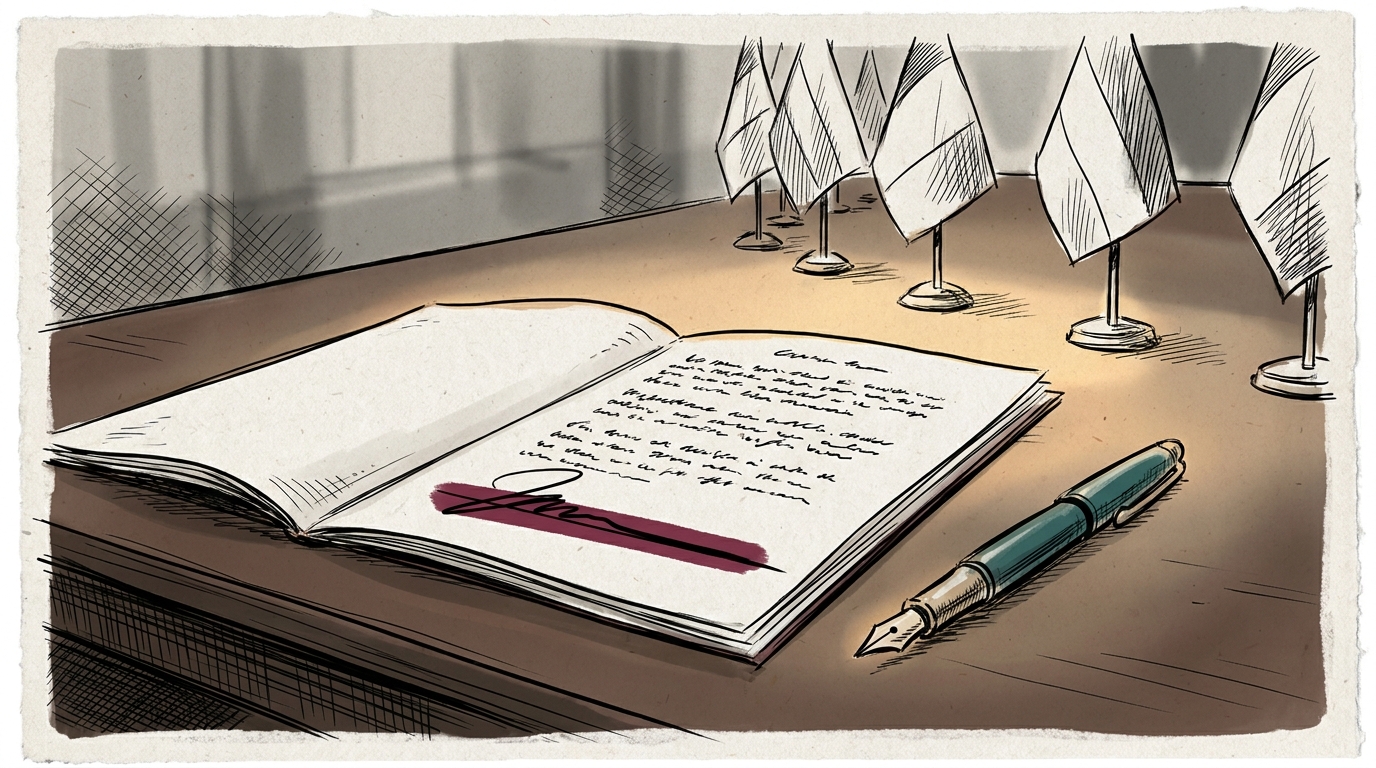
Donald Trump's Oval Office statements on Monday (the ceasefire on life support, three Axios-leaked military options) do not satisfy a paper requirement; they extend the pattern Murkowski cited when she declined to file ahead of the 9 May deadline . She had flagged the same gap between Truth Social posts and presidential signatures in her floor remarks on the 8-9 May run . The verbal track makes her bar harder to clear, not easier: a credible plan requires a written instrument and a documented decision chain that the presidential-actions index has not produced in 74 days.

The legislative leverage runs the other way to most readings. If Trump signs nothing during the 13-15 May Beijing trip, Murkowski returns to a Senate that has watched a full week of verbal escalation against an empty paper trail, and her credible-plan demand carries more weight, not less. A signed Friday strike directive cuts the other way: an order arriving without prior congressional authorisation is the constitutional question Murkowski wanted to avoid, and she would lose the procedural lever to force a debate.

The institutional logic favours holding. Marco Rubio's closure of EPIC FURY on 5 May removed the executive's stated justification for further action; the absence of a follow-on signed instrument means the Senate cannot debate something that does not exist on paper. Murkowski's bar is procedural rather than political, and the longer the paper track stays empty, the more procedural ground she gains.


Deep Analysis

In plain English

In the United States, major military actions are supposed to be authorised by Congress. Senator Lisa Murkowski has written a bill called an Authorisation for Use of Military Force; an AUMF; that would give the Iran war a proper legal basis. But she has not filed it yet. She said she will only do so if the White House gives Congress a clear written plan: what the goals are, how success will be measured, how Congress will be kept informed, and what the exit plan is. So far the White House has not provided that plan. Trump's tough statements on 11 May; war on 'life support', military options under review; are verbal, not written. Murkowski's four conditions require paper documentation, not press quotes. Until the White House produces that document, the AUMF stays unfiled.

Deep Analysis
Root Causes

Murkowski's four conditions; defined objectives, named success metrics, advance notice of objective changes, and an exit criterion; directly address the structural failure of the 2001 AUMF, which contained none of those elements and has been applied to 42 countries over 24 years.

The White House's verbal-only track creates a specific enabling condition for Murkowski's hold: without a signed instrument, there is no executive document to which the congressional conditions can be attached. The administration cannot meet her conditions without producing the paper it has deliberately avoided for 74 days.

Republican co-sponsor Todd Young remaining on the bill signals the hold is bipartisan within the Senate caucus, reducing the risk that Murkowski can be isolated as a solo obstructionist before the summit returns.

What could happen next?
  • Consequence

    Each day Trump returns from Beijing without a signed Iran instrument, Murkowski's four-condition AUMF bar becomes harder to clear: the administration has demonstrated it can operate without the bill, reducing its incentive to produce the required paper.

    Short term · 0.8
  • Precedent

    Murkowski's four-condition hold is the most operationally specific AUMF pre-condition in US history. If it succeeds; if the White House produces a strategy document; it establishes a template for future congressional oversight of undeclared wars.

    Long term · 0.6
  • Risk

    If Murkowski files without conditions being met; under pressure from Republican leadership ahead of 2026 mid-terms; the resulting AUMF will have the same structural indefiniteness as the 2001 AUMF, authorising force without geographic or temporal limits.

    Medium term · 0.65
First Reported In

Update #95 · OFAC opens the Hong Kong door

Al Jazeera· 12 May 2026
Read original
Causes and effects
This Event
Murkowski holds AUMF for a paper plan
Verbal escalation makes the credible-plan threshold harder to clear, not easier; if Trump signs nothing during the Beijing trip, Murkowski's leverage rises on the Senate's return the following week.
Different Perspectives
Qatar (mediator)
Qatar (mediator)
Qatari negotiators flew to Tehran on Sunday morning to close remaining gaps between the parties, operating as the primary shuttle channel. Qatar's role is to bridge the civilian-track gap the IRGC veto has left.
IAEA / Rafael Grossi
Grossi replied to Araghchi's 13 June protection-of-materials letter the same day, citing Iran's NPT Safeguards Agreement obligation to declare any nuclear material transfer. With 97 days of lost inspector access and approximately 240 kg unaccounted, Grossi has treaty text and no inspectors on the ground to enforce it.
United Arab Emirates
The UAE state oil company assessed full Hormuz flows will not resume until 2027 even with a fast deal, citing demining, inspection, and insurance timelines. The UAE ambassador to Washington said a simple ceasefire is not enough.
Islamic Revolutionary Guard Corps (IRGC)
The IRGC ran naval exercises in Hormuz during Geneva talks and its political deputy declared Iran was negotiating from a position of strength. The corps has not endorsed the MoU; by amplifying Mashhad protests through Fars, it is framing any deal as conditions it imposed rather than a concession it accepted.
Iran Foreign Ministry / Araghchi
Araghchi's dilute-in-Iran red line was met by the US concession, but his foreign ministry spokesman said Tehran had not taken a final decision and a signing might come in days, not Sunday. Araghchi separately wrote to the IAEA pledging to protect nuclear materials as dilution negotiations advanced.
White House / US negotiating team
Washington accepted dilution inside Iran rather than ship-out, its first substantive material concession in 106 days, the New York Times reported. With the White House register blank and the ceremony slipped a third weekend, the administration has moved its negotiating position without yet producing a document.



