Skip to content
Briefings are running a touch slower this week while we rebuild the foundations.See roadmap
Iran Conflict 2026
10JUN

CIA Deception Enabled Ground Rescue Inside Iran

3 min read
09:46UTC

Hundreds of US special forces fought IRGC troops on Iranian soil to retrieve a downed colonel. Washington calls it a rescue, not an incursion.

ConflictAssessed
Key takeaway

US forces fought inside Iran and nobody in Washington called it a ground war.

CENTCOM confirmed on 5 April that the F-15E weapons system officer shot down over western Iran two days earlier has been rescued. The colonel, injured but alive, evaded IRGC search teams for roughly 36 hours in the mountains of southern Isfahan province. The CIA ran a deception campaign inside Iran, feeding false intelligence about the airman's location to confuse IRGC units closing on his position. 1

Hundreds of US special operations forces then deployed on Iranian soil. They established a temporary forward base. USAF jets struck IRGC units approaching the colonel. Two MC-130J special operations aircraft were immobilised at the base and deliberately destroyed before American forces withdrew. A senior US military official called it "one of the most challenging and complex missions in the history of US special operations." The A-10 crash during the initial search and the helicopter crews wounded in the same effort were preludes to this larger ground operation.

Donald Trump confirmed "fierce firefights" inside Iran on Truth Social. The IRGC, needing to explain two wrecked American aircraft on its territory, claimed it had shot down a US drone. The claim does not account for the wreckage type. Iran now holds physical evidence of American ground operations on its soil, evidence it has so far chosen to bury behind a fiction.

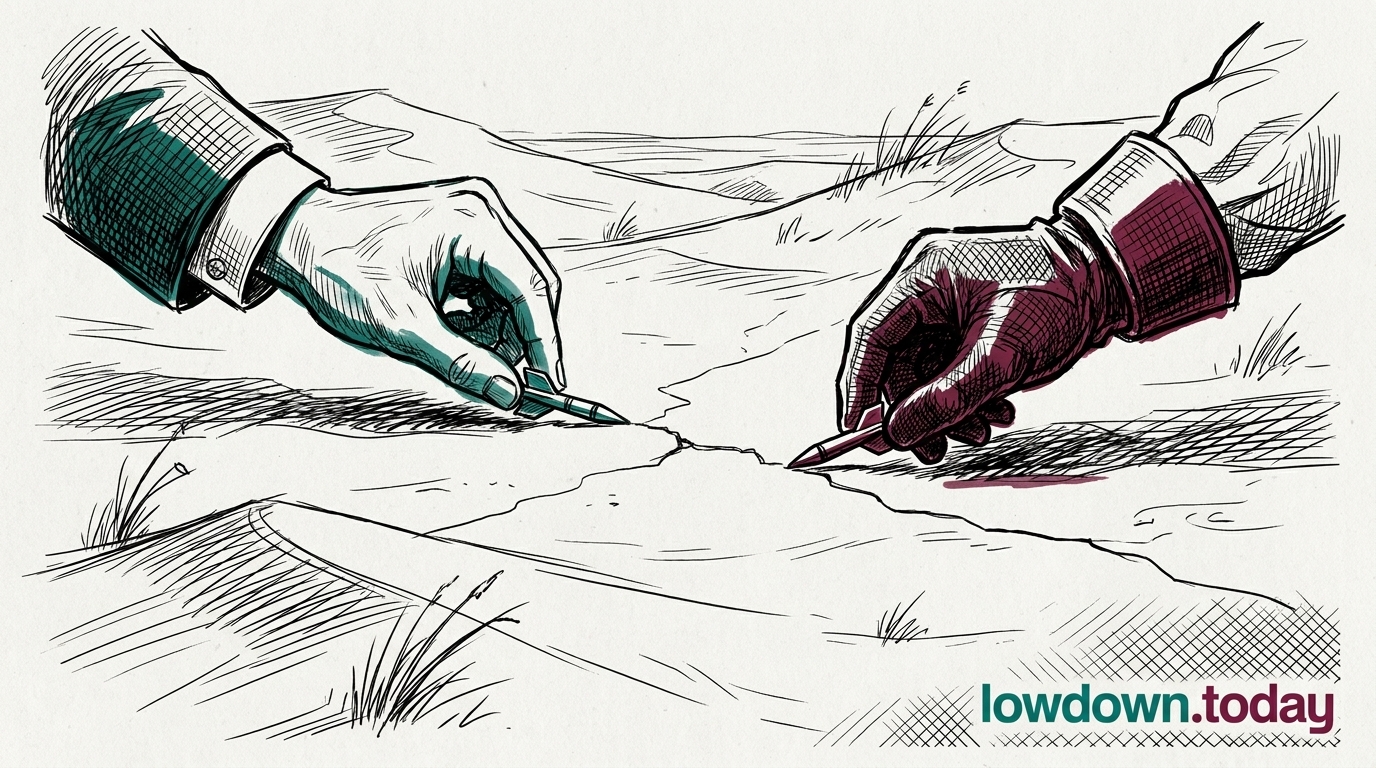
This was a forward base inside a sovereign state, direct combat with its military, and deliberate destruction of US equipment to prevent capture. CENTCOM has not used the word "incursion." Trump's March declaration that he "rejects ground troops" is operationally contradicted by what happened in Isfahan. The counter-argument is narrow: combat search and rescue is a distinct legal category, and the forces withdrew. Whether a temporary base with firefights qualifies as rescue rather than incursion is a question no official has answered.

Deep Analysis

In plain English

An American military pilot was shot down over Iran. The US sent hundreds of soldiers into Iran to rescue him. They set up a temporary base, fought Iranian troops, and destroyed two of their own aircraft to stop Iran from capturing them. The CIA spread false information to confuse Iranian search teams while this was happening. When it was over, the US called it a rescue mission. By most definitions, it was also a ground combat operation inside a country the US has not invaded.

Deep Analysis
Root Causes

The rescue required a ground operation because Iran's terrain and IRGC search density made aerial extraction impossible without suppressing enemy forces. The MC-130J destruction reflects a standing US protocol for denial of sensitive special operations aircraft: the same protocol governed the stealth helicopter destroyed in the bin Laden raid at Abbottabad in 2011.

The CIA deception campaign inside Iran is the structural departure from historical CSAR precedent. Running active disinformation targeting a sovereign military's internal communications goes beyond rescue into covert action under US law. The legal distinction between rescue and covert action determines whether the War Powers Resolution clock applies to the operation.

Escalation

The operation succeeded without acknowledged US casualties, which reduces immediate pressure for further escalation. Iran's IRGC cannot credibly publicise the MC-130J wreckage without admitting US forces operated on Iranian soil, limiting Tehran's retaliatory narrative options. The primary escalation risk is Iranian special operations retaliation against US personnel in Iraq, Syria, or the Gulf, using the Isfahan precedent as justification.

What could happen next?
  • Precedent

    US ground combat inside Iran has occurred under a rescue framing, setting an operational precedent for future JSOC missions without a formal ground war declaration.

    Long term · Assessed
  • Risk

    Iran may retaliate via proxy special operations against US personnel in Iraq or the Gulf, citing the Isfahan precedent.

    Short term · Suggested
  • Consequence

    The War Powers Resolution notification clock may apply if Congress presses CENTCOM to characterise the Isfahan operation as ground combat rather than CSAR.

    Immediate · Suggested
First Reported In

Update #59 · Day 37: A Ground War Inside Iran That Nobody Will Name

Al Jazeera· 5 Apr 2026
Read original
Causes and effects
This Event
CIA Deception Enabled Ground Rescue Inside Iran
The largest US ground operation inside Iran since 1980 sets a precedent the Pentagon has not acknowledged and the IRGC cannot credibly refute.
Different Perspectives
Oil markets / Lloyd's underwriters
Futures markets priced CENTCOM's strikes-complete statement as a de-escalation signal and pushed Brent down 1.7 per cent to $94.71, even as the IRGC declared Hormuz closed. Lloyd's war-risk premiums held elevated because institutional de-listing requires a UN Security Council resolution that Russia and China have just shown they will block.
Pakistan (mediator)
Pakistan (mediator)
Interior minister Mohsin Naqvi carried dual civilian and military letters to Mojtaba Khamenei in Tehran on 6-7 June with no public response. The IRGC's Hormuz closure on 11 June shows the corps is acting independently of the channel Pakistan is using, making the mediation structurally unable to produce a binding commitment without direct IRGC access.
Russia and China
Russia and China
Russia and China voted against GOV/2026/40 at the IAEA Board, following through on the blocking position coordinated with Grossi in Geneva on 5 June; both states continue to oppose Western institutional pressure on Iran at every multilateral venue.
E3 and IAEA (UK, France, Germany)
The E3 co-sponsored IAEA resolution GOV/2026/40, adopted 21-3-10 on 10 June, demanding Iran disclose 440.9 kg of unaccounted HEU and admit inspectors to four denied facilities. The 10 abstentions and Russia-China noes leave any Security Council referral without a viable enforcement path.
IRGC / Iran military command
The corps declared Hormuz closed to all traffic on 11 June and claimed two vessels struck, overriding the MoU its own civilian negotiators were pursuing through Pakistan. The closure order used the Persian Gulf Strait Authority apparatus to convert a toll mechanism into a military prohibition.
Trump administration / CENTCOM
CENTCOM completed a second day of strikes on Tehran, Sirik and Minab, rejected the IRGC Hormuz closure as inconsistent with observed transit, and said strikes were complete. Hegseth framed the bombing explicitly as the negotiation: the method is coercive deal-making with no stated pause threshold.