Skip to content
Briefings are running a touch slower this week while we rebuild the foundations.See roadmap
Iran Conflict 2026
8JUN

Trump: war nearly won; no ceasefire

3 min read
09:58UTC

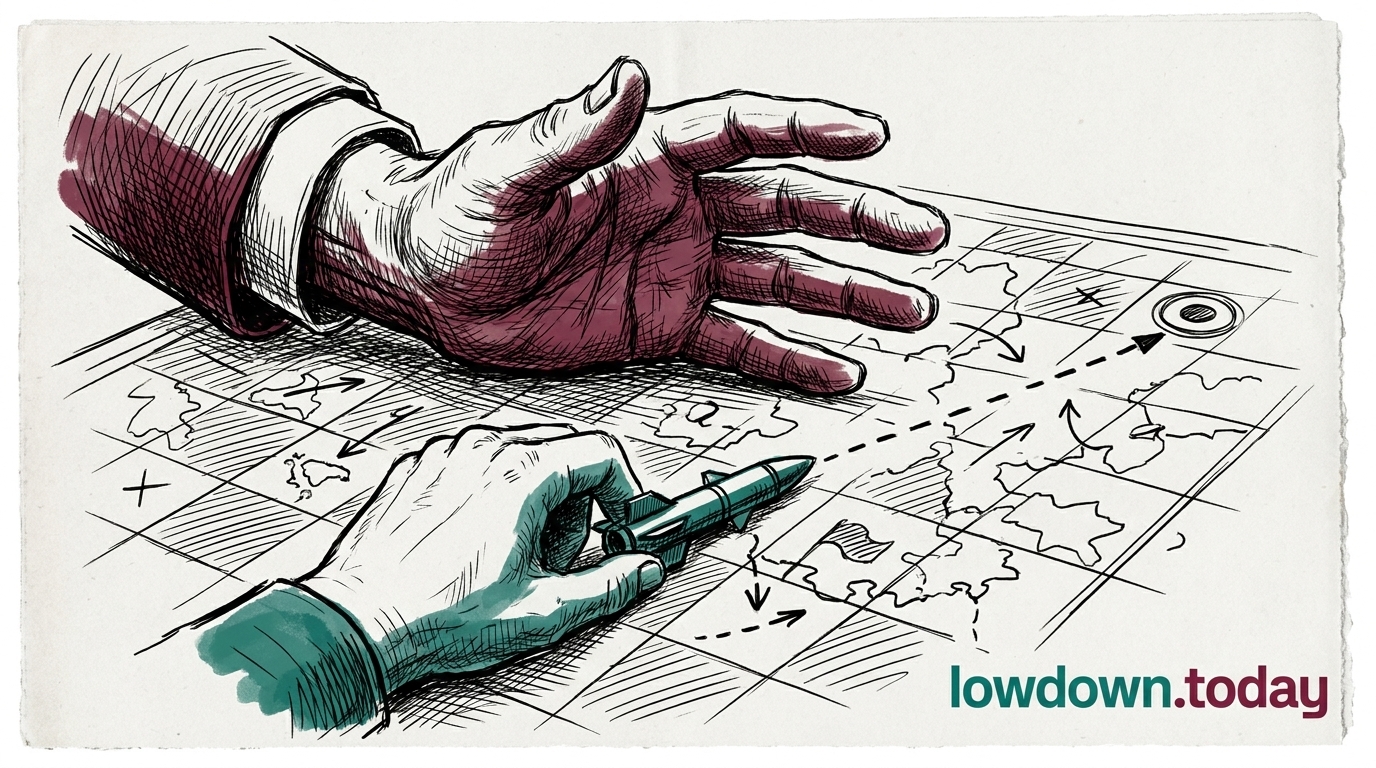
The president listed four objectives he says are close to achieved and dismissed the idea of stopping — on the same day his Pentagon shipped Marines toward the Gulf and drew up ground-invasion plans.

ConflictDeveloping
Key takeaway

Trump's four war aims are internally contradictory and structurally incompatible with a near-term wind-down.

Trump posted on Truth Social on Thursday that the United States is "getting very close to meeting our objectives as we consider winding down our great Military efforts in the Middle East." He listed four aims: degrading Iran's missile capacity, eliminating its navy and air force, preventing nuclear weapons, and protecting allies. He rejected a ceasefire in terms that left no diplomatic room: "You don't do a ceasefire when you're literally obliterating the other side."

The statement arrived on the same day his Pentagon shipped 2,200 Marines toward The Gulf and drew up plans for ground forces on Iranian soil 1. NBC News reported last week that military officials include off-ramp options alongside escalation options in Trump's daily war briefings; he has not exercised any . The $200 billion war-funding request faces bipartisan opposition with no visible path through Congress . Heritage Foundation president Kevin Roberts called intra-party Republican tensions over the spending "good" — the populist right's fiscal hawkishness, once reserved for social programmes, now extends to military expenditure.

Each of the four stated objectives faces a gap between the president's claims and available evidence. IAEA Director General Rafael Grossi assessed that military strikes cannot eliminate Iran's enrichment capacity . Iran holds 440 kilograms of 60%-enriched uranium — enough, if enriched further, for approximately ten weapons. The IRGC's 66th wave of attacks on Thursday, deploying what it called "super-heavy multi-warhead" Qadr missiles, contradicts the claim of degraded missile capacity. DNI Tulsi Gabbard told the Senate Intelligence Committee the Iranian government "appears to be intact but largely degraded" — language that stops well short of mission-accomplished.

The ceasefire rejection places Trump alongside Iran's Foreign Minister Araghchi, who told The National four days earlier: "We don't believe in a ceasefire. We believe in ending the war on all fronts" . Both governments are publicly committed to continuation. The difference is that Trump frames it as the final phase of a victorious campaign. The operational picture — Marines deploying, Airborne divisions on alert, oil at $112, every named ally refusing to send warships — describes a war that is expanding, not concluding.

Deep Analysis

In plain English

Trump is publicly saying the war is nearly over while the military is simultaneously deploying more troops and he is rejecting any ceasefire. The four goals he listed — degrading missiles, eliminating Iran's entire navy and air force, preventing nuclear weapons, protecting allies — are each enormous military objectives that historically require sustained campaigns of months or years. 'Eliminating' a nation's entire air force and navy means destroying every aircraft, base, vessel, and supporting infrastructure. 'Preventing nuclear weapons' requires verified dismantlement or permanent military presence. Claiming these are nearly achieved whilst deploying additional forces and planning ground operations indicates that the public messaging and the actual military planning are running on entirely separate timelines. If the war does not end quickly, Trump's own words become a credibility liability — both domestically and with allies he has been pressuring to join.

Deep Analysis
Synthesis

Trump's four objectives function as a war-termination trap of his own construction: each is defined in terms Iran cannot concede without regime collapse, and which the US cannot verify without on-the-ground presence. This means the stated objectives are structurally incompatible with the 'winding down' narrative — revealing that no post-war political settlement framework has been developed, which is itself a strategic vulnerability Iran's negotiating posture will exploit if talks ever begin.

Root Causes

The 'winding down' narrative serves a specific domestic political function: managing Republican fiscal hawks resisting the $200 billion supplemental and sustaining public support as war costs accumulate. This reflects a structural US executive-branch dynamic in which war-termination rhetoric is deployed to manage political costs without constraining military options — a pattern the War Powers Resolution was designed to address but has consistently failed to enforce.

Escalation

The four objectives are structurally maximalist. 'Eliminating Iran's navy and air force' and 'preventing nuclear weapons' cannot be achieved through an air campaign alone — they require prolonged military presence or a negotiated framework with intrusive verification. Neither exists. Rejecting ceasefire whilst deploying additional forces is the operational signature of a campaign seeking unconditional outcomes, not wind-down.

What could happen next?
  • Risk

    If military operations continue beyond 60 days while Trump maintains the 'winding down' narrative, the credibility gap becomes exploitable by domestic opponents and adversaries simultaneously.

    Short term · Assessed
  • Consequence

    Rejection of ceasefire forecloses the diplomatic off-ramp most likely to stabilise oil markets before Goldman Sachs's $147.50 threshold is tested.

    Short term · Assessed
  • Meaning

    The four objectives as stated require either Iranian capitulation or permanent US military presence — neither of which constitutes a 'wind-down' by any conventional strategic definition.

    Medium term · Assessed
  • Precedent

    A presidential victory declaration preceding further escalation would be the most direct parallel to the Nixon 1972 pattern since the Vietnam era.

    Immediate · Suggested
First Reported In

Update #43 · Trump floats wind-down, deploys 2,200 more

Axios· 21 Mar 2026
Read original
Different Perspectives
Bahrain / Gulf partners
Bahrain's PAC-3 interceptor magazine sits at 87% depletion after absorbing IRGC salvos aimed at US bases; no resupply is scheduled before 2027, concentrating the intercept burden on US assets and Israeli Iron Dome and Arrow-3.
IAEA / Vienna process
IAEA officials cited proliferation concerns over 440.9 kg of HEU unaccounted for after 97 days without inspector access; the Board session that opened 8 June cannot retroactively close the evidentiary gap its own resolution documents.
China
China
China absorbed the Shanghai Qianye designation by OFAC and opposes censure at the IAEA Board, arguing the verification gap was created by strikes rather than Iranian non-compliance, a framing it shares with Russia to protect the non-Western bloc's Board votes.
Russia
Russia
Putin reaffirmed at SPIEF on 6 June his offer to hold Iran's uranium stockpile as custodian, a proposal the IAEA's 97-day verification gap now renders undeliverable: no one can transfer or confirm a stockpile that has not been inspected.
United States / Trump administration
Trump publicly asked Netanyahu not to retaliate and described a deal as 95% done; Rubio then acknowledged enrichment terms could take months. The 24-hour gap between the request and the Mahshahr strike removes the credible-restraint argument from US diplomatic leverage with Tehran.
Israel / Netanyahu government
Netanyahu struck the Mahshahr complex and missile sites inside Iran within 24 hours of Trump's public no-retaliation request, a second kinetic override of US counsel that confirms Israel will not allow Tehran to dictate the terms of the exchange.