Skip to content
Briefings are running a touch slower this week while we rebuild the foundations.See roadmap
Iran Conflict 2026
6JUN

Iran hits Kuwait airport for fourth time

1 min read
12:17UTC

Non-belligerent Gulf states absorb daily attacks; Kuwait's airport hit for the fourth time in 26 days.

ConflictAssessed
Key takeaway

Iran's four-country strike campaign makes non-belligerent status irrelevant for states hosting US forces.

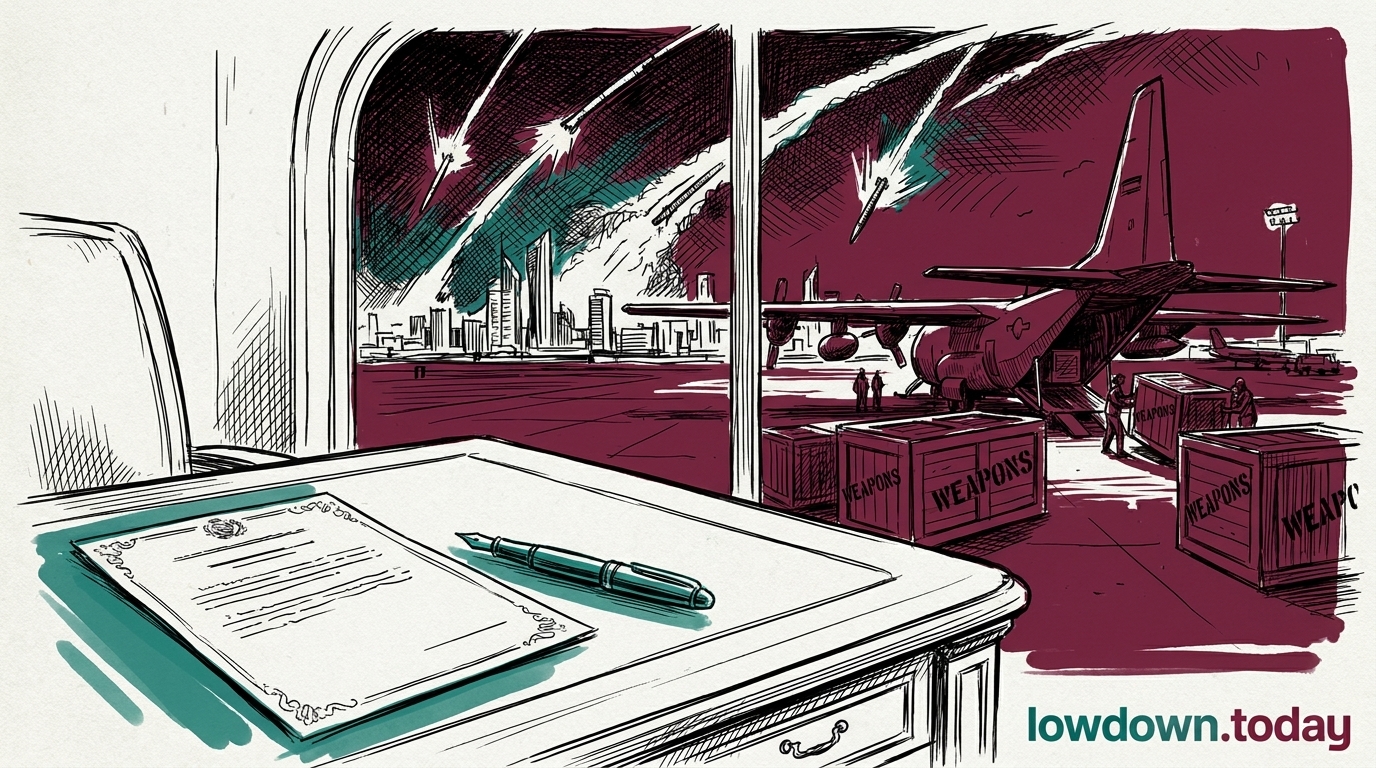
Iranian drones struck a fuel tank at Kuwait International Airport on Tuesday, the fourth attack on the airport since 28 February 1. The Kuwait National Guard intercepted six more drones. No casualties were reported. Kuwait Airways is routing passengers through Saudi Arabia.

Saudi Arabia intercepted 32 drones and one ballistic missile over the Eastern Province in 11 hours. In Bahrain, an Iranian attack killed a Moroccan civilian working with the UAE armed forces 2. None of these countries is a formal belligerent. All host US military forces.

The Islamic Revolutionary Guard Corps (IRGC) resumed hourly barrages against Israeli cities the same day . The IRGC's four-country campaign, now in its 26th day, has struck energy infrastructure, airports, and military bases across Kuwait, Saudi Arabia, Bahrain, and Israel. Kuwait's airport has been hit four times in 26 days for hosting American aircraft.

Deep Analysis

In plain English

Iran is attacking airports and oil sites in countries that are not part of the war, because those countries host US military bases. Kuwait's main airport has been hit four times in a month. These countries did not choose to fight but are absorbing the consequences.

What could happen next?
  • Consequence

    Gulf states may restrict US basing to reduce exposure

First Reported In

Update #48 · Iran rejects ceasefire; Kharg fortified

Al Jazeera· 26 Mar 2026
Read original
Causes and effects
This Event
Iran hits Kuwait airport for fourth time
Iran's campaign against neutral Gulf states' civilian infrastructure normalises a pattern where non-combatant status provides no protection.
Different Perspectives
Israel
Israel
The IDF struck a Lebanese army unit on 6 June, killing a colonel, and privately told Moscow that shelling near Bushehr was accidental, per Putin's SPIEF disclosure. Israel is advancing in Lebanon past an unenforced ceasefire text while maintaining a back-channel to Russia on nuclear-site deconfliction.
Lebanon
Lebanon
President Aoun told CNN on 5 June that Iran uses Lebanon as a bargaining chip and urged Hezbollah toward diplomacy; on 6 June an IDF strike killed a Lebanese army colonel on the Khardali-Nabatieh road. The Lebanese state is publicly rejecting Iranian tutelage while the army sustains casualties from Israeli fire and the Washington framework remains unenforced.
Bahrain
Bahrain
Bahrain's US Fifth Fleet headquarters was among the targets in the 5-6 June two-country salvo; its PAC-3 magazine stands at 87 per cent depletion with an 18-month resupply gap and no comparable arms sale has been announced. The state is defending a critical US regional command on a thinning interceptor stock.
Kuwait
Kuwait
Kuwait received a $1.98bn US counter-drone sale approval on the same day IRGC missiles targeted its bases; it expelled two Iranian diplomats on 4 June and filed a formal protest. The arms approval gives Kuwait a future capability but leaves a 6-18 month delivery gap that the salvo tempo is already pressing.
Russia
Russia
Putin reaffirmed Russia's offer to hold Iran's 440.9 kg HEU at SPIEF on 6 June, said Russia is not arming Iran, and disclosed that both the US and Israel privately told Moscow that shelling near Bushehr was accidental. The restatement casts Moscow as the only remaining mediator both sides call, a position serving Russian interests whatever the nuclear file produces.
Iran
Iran
The IRGC, per Iranian state media, fired seven ballistic missiles at US bases in Kuwait and Bahrain, the largest two-country salvo of the war, and framed the launches as lawful retaliation; Foreign Minister Araghchi rejected Aoun's bargaining-chip accusation and Velayati warned Beirut against diplomatic naivety. Tehran has sent no HEU counter-proposal since Araghchi confirmed no progress on 4 June.