Skip to content
You can now search across every topic, entity and event.What's new
European Oil Markets
4JUN

Brent $106 on summit Day 1; buffers near exhaustion

3 min read
10:20UTC

Brent crude settled at $106.0 on 14 May, down $1.05 from the prior close but still $5-7 above the post-ceasefire equilibrium analysts modelled in March; OilPrice analysts warned global crude buffers may run dry before the Strait of Hormuz reopens.

EconomicDeveloping
Key takeaway

Brent priced a holding pattern; buffer exhaustion before Hormuz reopens forces faster diplomacy than verbal summitry can deliver.

Brent Crude settled at $106.0 per barrel on 14 May, down $1.05 from the 13 May close of $107.05, extending a two-day decline from $107.77 on 12 May 1. Brent at $106 sits $5-7 above what analysts modelled as the post-ceasefire equilibrium in March, a structural conflict premium the summit's verbal opening did not shift.

OilPrice.com analysts warned on 14 May that global crude buffers may be exhausted before the Strait of Hormuz reopens, independently corroborating Aramco chief Amin Nasser's warning that oil markets will not normalise until 2027 if the blockade extends past mid-June . The corroboration is structural: two independent analytical sources pointing to the same timeline without coordination 2.

The infrastructure numbers carry that warning. Fujairah crude throughput reached 1.62 million barrels per day, approaching the ADCOP pipeline's 2 million bpd design ceiling. The US Strategic Petroleum Reserve fell below 350 million barrels, its lowest level since 1983. Both the bypass route and the emergency stockpile are near their limits simultaneously, a condition Nasser's 2027 projection assumed would materialise before diplomatic movement accelerated.

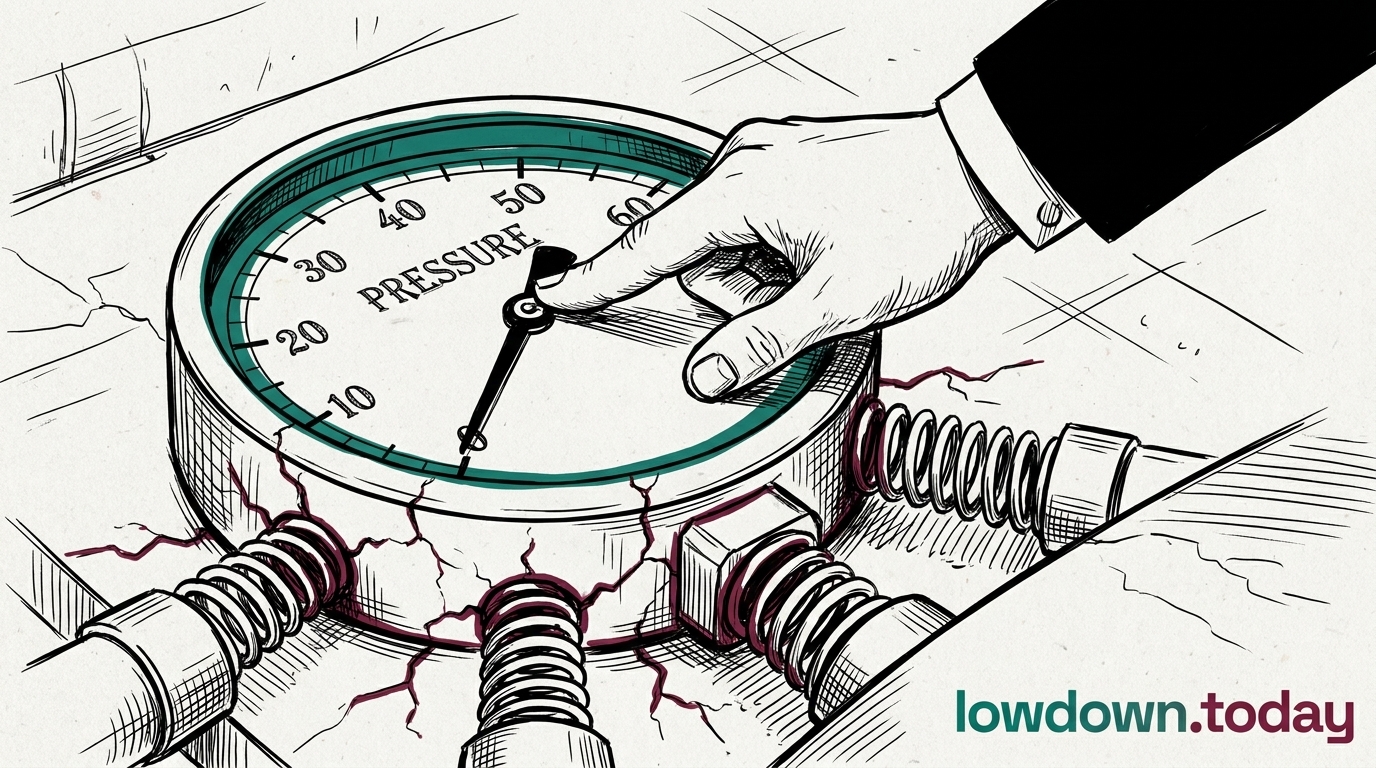
The market's flat-to-down read on summit Day 1 is the verdict that matters most for the diplomatic timeline. If buffers exhaust before Hormuz reopens, the price signal will force faster movement than the summit's current verbal register supports. Brent at $106 is not pricing a deal; it is pricing patience at the margin of structural constraint.


Deep Analysis

In plain English

Oil prices should normally fall when diplomats hold a summit. On 14 May they barely moved: Brent fell by about a dollar, but stayed well above where it was before the Iran war started. The reason is that traders are not pricing in a deal; they are pricing in a long blockade. Two things that would need to be in place for oil to fall more are: a reopened Strait of Hormuz and insurers agreeing to cover ships again. Neither has happened, and neither can happen until something gets signed.

Deep Analysis
Root Causes

Two independent infrastructure constraints have converged simultaneously: Fujairah crude throughput at 1.62 million bpd is approaching the ADCOP 2 million bpd design ceiling, meaning the bypass route is near saturation. The US SPR below 350 million barrels is near its lowest level since 1983, meaning the emergency buffer is simultaneously near depletion. Neither constraint existed at this level in prior Gulf disruption cycles.

The premium floor persists because P&I war-risk insurers cannot price the strait open until they have written rules of engagement covering both the US blockade and the European coalition mission . Written rules do not exist for either. No insurance-market reopening can precede written operational rules.

What could happen next?
  • Risk

    If Fujairah reaches the ADCOP 2 million bpd ceiling before Hormuz reopens, the bypass route saturates and crude with no Hormuz access and no bypass route has no market exit, forcing production cuts at Iranian-adjacent fields.

  • Consequence

    P&I war-risk insurance cannot reopen without written rules of engagement for both the US blockade and the European coalition mission; any ceasefire that lacks those written rules leaves the Brent premium structurally intact even after hostilities pause.

First Reported In

Update #97 · Chips for Beijing, no paper for Iran

OilPrice.com· 14 May 2026
Read original
Different Perspectives
Kuwait
Kuwait
Kuwait absorbed the Iranian strike that knocked generating units offline at a combined power-and-desalination plant on 17 July, the event that finally moved freight and insurance in lockstep with Brent. The strike hit essential civilian infrastructure, not a trading desk's benchmark.
Asian buyers (Singapore)
Singapore's middle distillates rose 12% month-to-date to 8.91m barrels and fuel oil passed 19m barrels on a 105% net-import surge, buyers retaining barrels as the East-West arbitrage window narrows. Cargoes are being stockpiled ahead of further Hormuz-driven freight repricing rather than released west.
Austria (Coreper holdout)
Vienna is blocking the same package over roughly EUR 2bn of frozen Russian assets earmarked for Raiffeisen, a domestic banking dispute with no connection to the oil cap racing toward its 23 July expiry. The linkage forces the whole package to wait on a bilateral compensation fight.
Greece (Coreper holdout)
Athens is holding the 21st sanctions package at the 22 July Coreper vote over Russian LNG re-export rights, a condition unrelated to the oil price cap itself, leaving the $44.10 freeze one day from expiry without a deal. Greece's own tanker registry gives it a direct stake in how any shadow-fleet measures are drafted.
Marine underwriters (Gulf war-risk)
Hull war-risk cover for Hormuz transits widened to a 3-10% band on 17 July with 5% the emerging norm, up from a 3-4% baseline set in late June, the first repricing in six weeks to track a flat-price move rather than lag it. Cover resets on actuarial evidence of loss, not on diplomatic or price signals.
Money managers (CFTC-tracked)
The CFTC's week-to-14-July snapshot, released 17 July, showed WTI managed-money net long collapsing 69% to 19,783 contracts and a standalone 60,141-contract net short on Brent Last Day (NYMEX). Both readings predate the Kuwait strike and the 20 July escalation, so any covering since is not yet visible in public data.