Skip to content
You can now search across every topic, entity and event.What's new
European Oil Markets
31JUL

Gas prices a strait nobody can verify

3 min read
09:33UTC

TTF settled at EUR 59.135/MWh on Monday, 7.5% above its 15 July close, while the IRGC says the Strait of Hormuz is shut and CENTCOM says vessels are still transiting.

EconomicDeveloping
Key takeaway

TTF has added 7.5% in three sessions on a Hormuz closure claim CENTCOM denies and AIS contradicts.

TTF, the Dutch Title Transfer Facility contract that prices most of Europe's wholesale gas, settled at EUR 59.135/MWh on Monday 20 July, up from EUR 57.395 on Friday 17 July and EUR 54.995 on 15 July 1. Three sessions, 7.5%, and no fresh supply loss inside the window to account for it.

The one confirmed physical constraint predates the move. QatarEnergy held the Ras Laffan LNG complex at minimum output on 9 July and extended force majeure to Asian buyers into August . That loss has sat in the curve since. What has moved since Friday is risk premium stacked on a constraint the market had already absorbed, not a repricing of anything newly lost.

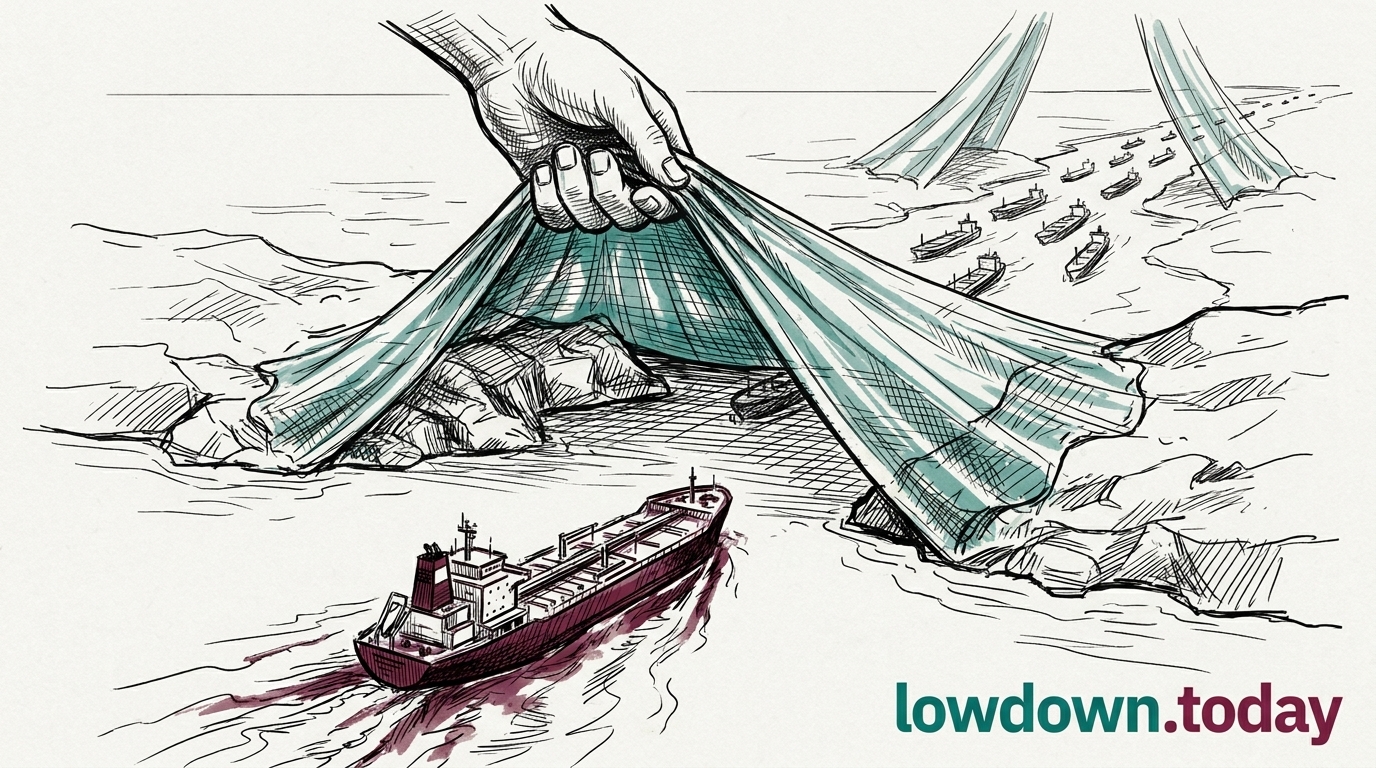
Vessel tracking at the Strait of Hormuz shows severe curtailment rather than closure. IMF PortWatch, the IMF platform that reads shipping activity off AIS transponders, put 479 vessels anchored regionally on 20 July, with 36 running dark and 123 broadcasting inside the strait 2. The IRGC, Iran's Islamic Revolutionary Guard Corps, says it has closed the waterway and destroyed two tankers attempting a southern route, naming no vessel, flag or owner; Chinese state broadcaster CGTN relayed the claim 3. CENTCOM, the US military command responsible for the Gulf, says vessels are still transiting and that no closure is in effect 4.

Price the gap, not the headline. A benchmark carrying EUR 4.14 of three-session gain on a contested closure holds a fast reversal inside it, and the trigger is any independent count confirming transits at scale. What the desk is paying for is the absence of that count rather than the content of one, which is a thinner thing to own than a cargo that failed to arrive.


Deep Analysis

In plain English

The Strait of Hormuz is the narrow sea passage between Iran and the Arabian peninsula that a large share of the world's oil and gas tankers must pass through. Iran's military says it has closed the strait and sunk two ships; the US military says that is not true and vessels are still moving. Neither side has produced hard proof, such as a ship's name or flag. TTF, the European price benchmark for wholesale gas, settled at EUR 59.135 per megawatt hour on 20 July as traders priced in the risk that the standoff turns into a real supply loss, even though satellite ship-tracking data still shows more than 100 vessels moving through the strait.

Deep Analysis
Root Causes

The dispute is unresolvable in real time because the two claims rest on different evidence standards. Iran's tanker-destruction claim carries no vessel name, flag or owner and was relayed only by state broadcaster CGTN, while CENTCOM's denial is a verbal assertion with no published vessel list either. Neither side has put forward AIS-checkable detail, leaving traders to price the gap itself.

The move also lands on a supply base already discounted rather than fresh. QatarEnergy has held Ras Laffan at minimum output and extended force majeure into August since the 7 July strike on the Al Rekayyat. Today's premium is compounding on a constraint the market has been pricing for nearly two weeks, not reacting to a new physical loss.

Escalation

Direction is genuinely contested rather than one-way: Iran's rhetoric has hardened to an explicit closure claim, but the AIS data (123 broadcasting, only 36 dark) shows traffic still moving at a scale inconsistent with a sealed strait. The claim and the tracked reality are diverging, not converging.

What could happen next?
  • Risk

    If IRGC action escalates from claimed to AIS-verified vessel losses, TTF could reprice sharply higher from EUR 59.135/MWh, given the current move already embeds an unconfirmed-claim premium rather than a documented physical loss.

  • Meaning

    The gap between Iran's closure claim and the 123-vessel broadcasting count shows the market is currently pricing uncertainty about verification, not a measured cut to physical flow.

First Reported In

Update #28 · Hormuz premium inverts the German spark spread

ICE via Investing.com· 20 Jul 2026
Read original
Different Perspectives
Sanctions compliance officer reviewing a Lukoil International GmbH bid
OFAC's amended FAQ 1224 gives a compliance desk its first published standard: full severance from Lukoil and a US-jurisdiction blocked account for sale proceeds. The conditions name neither ISAB nor Italy, so a Priolo Gargallo-linked bid answers a different question than a Neftochim Burgas or Petrotel Ploiesti one.
Managed-money funds on Brent Last Day
CFTC data for the week to 21 July showed managed money flipping 74,400 contracts to a net long of 15,665 against 1,410 short on the Brent Last Day contract, code 06765T. A fund that held that short through July has now covered it, and the spent short base raises the bar for the next leg higher.
Saudi crude exporters
Saudi-linked tanker transits through Bab el-Mandeb fell to about 7.5 a day after the 24 July underwriting withdrawal, pushing more barrels onto the longer route round the Cape or through the Yanbu terminal. Every diverted barrel ties up a ship for longer, and a fleet that turns slower charges more.
Tanker owners on the Bab el-Mandeb route
Lloyd's-market syndicates withdrew war-risk cover from Saudi-linked hulls on 24 July, leaving owners of that class of vessel to sail Bab el-Mandeb uninsured or not at all. Tanker transits on the route fell to roughly 7.5 a day, and cover, once withdrawn, does not return on a shipowner's timetable.
Eni
Eni
Eni's board approved second-quarter results on 29 July, swinging refining EBIT to a EUR0.08bn profit from a year-earlier loss even as group profit doubled, and named Red Sea freight cost as a cap on that improvement. A refiner absorbing higher shipping costs on Saudi-linked crude while its numbers improve treats the freight line as a drag, not a crisis.
Asian buyers (India, Japan, China, South Korea)
Asian refiners are absorbing 62% of Yanbu's 3.75m b/d flow, the bulk of Saudi Arabia's rerouted crude now clearing east rather than into the Atlantic basin. That destination split leaves Asian buyers more exposed to any single Yanbu-specific disruption than under the kingdom's normal multi-terminal export pattern.



