Skip to content
You can now search across every topic, entity and event.What's new
European Oil Markets
23JUL

Brent at $92 as premiums idle tankers

3 min read
19:27UTC

Brent reached $92.09 on Wednesday morning, a fourth straight daily gain, while war-risk premiums of 3% to 10% of hull value keep legal cargo sitting where it is.

EconomicDeveloping
Key takeaway

Gulf cargo stays put because of what it costs to insure, not because of what blocks it.

Brent crude traded at $92.09 at 01:30 GMT on Wednesday 22 July, up 1.2% and its highest since 11 June, a fourth consecutive daily gain 1.

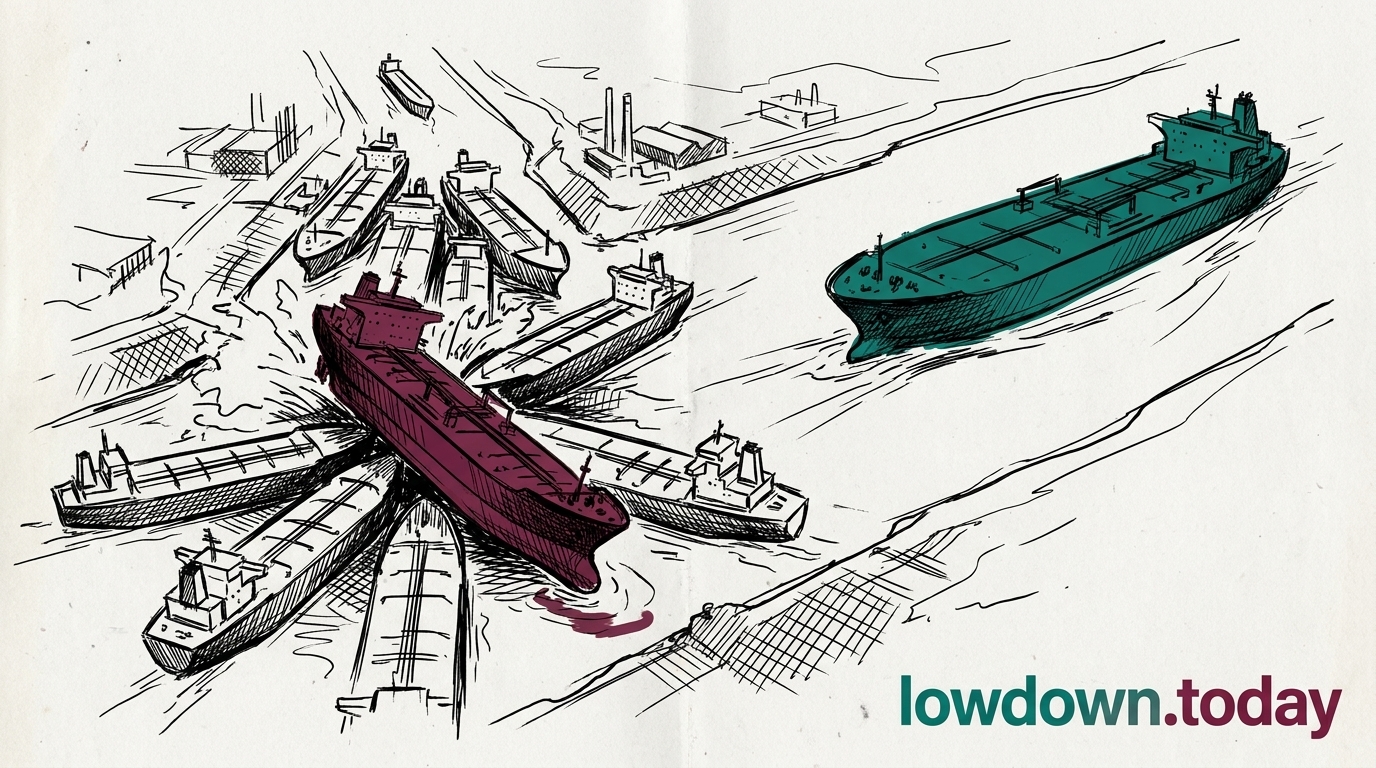
War-risk premiums for a Strait of Hormuz transit now run at 3% to 10% of a vessel's hull value, against 0.25% before the war 2. On a $100 million tanker that is $3m to $10m a voyage where it used to be about $250,000. The largest vessels are quoted $10m to $14m, and the charge falls on the charterer rather than the owner.

Whoever books the ship pays that premium up front and adds it to the delivered cost of the barrels. A buyer with any alternative supplier declines the cargo, and the charter is never fixed. So a legal, licensed, fully insurable parcel of crude sits where it is, because nobody at either end of the voyage will carry a $10 million charge the barrels cannot recover. The Lloyd's Market Association is explicit that cover remains available: what suppresses transits is price and crew willingness, not capacity 3. Underwriting resets slowly, and crews have longer memories than markets.

CENTCOM (US Central Command) frames the same water differently. Its 21 July statement says US forces have facilitated the transit of roughly 900 commercial vessels and 450 million barrels of crude "since early May", redirected eight vessels and disabled one 4. No date window is attached to the 900-vessel figure, so it cannot be set against the 66% weekly fall in transits recorded on 21 July . The two counts cover different things over different periods.

In a note dated 20 July, Daan Struyven of Goldman Sachs set out an upside case of Brent above $120 by the fourth quarter, conditional on Hormuz disruption persisting and Persian Gulf flows staying below roughly 45% of pre-war levels 5. Goldman's base case is $80 in the fourth quarter and about $75 in 2027 6. The higher number describes what happens if nothing changes, not what the bank expects.

Deep Analysis

In plain English

Brent crude, the main international oil price benchmark, rose to $92.09 a barrel, its highest level since 11 June and the fourth straight daily rise. Oil often gets more expensive when investors worry that war could disrupt supply, even before that disruption actually happens. A lot of this price rise comes down to insurance, not ships actually being stopped. Sailing through the Gulf now costs shipping companies far more in war-risk insurance than before the war, and that extra cost is passed on. Insurers say enough cover is technically available, it has simply become expensive enough that some owners choose not to sail. Goldman Sachs, a major investment bank, has said oil could go above $120 a barrel later this year, but only if the situation gets significantly worse. Its actual expectation for now is closer to $80.

Deep Analysis
Root Causes

War-risk premiums of 3-10% of hull value, not a shortage of naval capacity or insurance cover, are what is keeping tankers from sailing the Gulf, according to the Lloyd's Market Association. For the largest vessels, insurers are seeking $10-14 million per Hormuz voyage, a cost charged to the charterer rather than the shipowner.

Because that liability sits with charterers and crews rather than a fixed physical bottleneck, the decision to sail is a commercial one made voyage by voyage, which is why price continues climbing even as CENTCOM reports it is still moving substantial volumes through the strait.

What could happen next?
  • Consequence

    If Gulf flows fall and stay below roughly 45% of pre-war levels through Q4, Goldman's contingent $120+ scenario becomes the operative case rather than its $80 base case.

  • Opportunity

    Because the Lloyd's Market Association says insurance capacity remains available, a de-escalation could unwind the price premium quickly, as happened after the 1990 Gulf War spike.

First Reported In

Update #159 · A second strait closes by radio alone

CENTCOM· 22 Jul 2026
Read original
Different Perspectives
US money managers (CFTC-tracked)
US money managers had trimmed WTI net long positioning into July's rally, doubting the Hormuz premium would hold without freight or war-risk confirmation, and the crude stock build reported for the week to 17 July gives that scepticism a fundamentals basis. The 25 July CFTC data will show whether Brent's move above $100 changed their calculus.
Asian distillate buyers (Singapore)
Singapore's distillate holders kept retaining middle-distillate barrels as the East-West arbitrage window narrowed further this week, a pattern that sharpened as Fujairah light distillates hit a record low. Cargoes are being held rather than released west into the tightening Mediterranean market.
Bulgaria
Bulgaria
Bulgaria secured the removal of Lukoil founder Vagit Alekperov and Patriarch Kirill from the 21st package, with President Rumen Radev calling a personal listing 'shooting ourselves in the foot'. Sofia is protecting its position in Lukoil's EUR 3bn compensation claim over the 2023 Neftohim Burgas nationalisation.
Russia
Russia
Russia loses the roughly $14 a barrel of legal headroom the price-cap formula would have released toward $58, even as Urals continues trading below Moscow's $59 budget floor. The shadow-fleet insurance workaround that lets sanctioned crude clear above $44 in practice remains untouched by the freeze itself.
European Union
European Union
The EU adopted its 21st sanctions package on 23 July, freezing the $44 Russia oil cap for 12 months rather than letting the formula drift it toward $58, and listed shadow-fleet support vessels for the first time. The package cleared only after three failed Coreper votes.
Marine war-risk underwriters (Lloyd's-linked syndicates)
War-risk syndicates lifted southern Red Sea hull premiums 150% to about 0.75% of hull value after the 20 July blockade declaration, still a seventh of the roughly 5% Hormuz band. Underwriters reset on realised loss, not declared threat, so the 23 July Encelia and Layla strikes set up the next re-mark.
