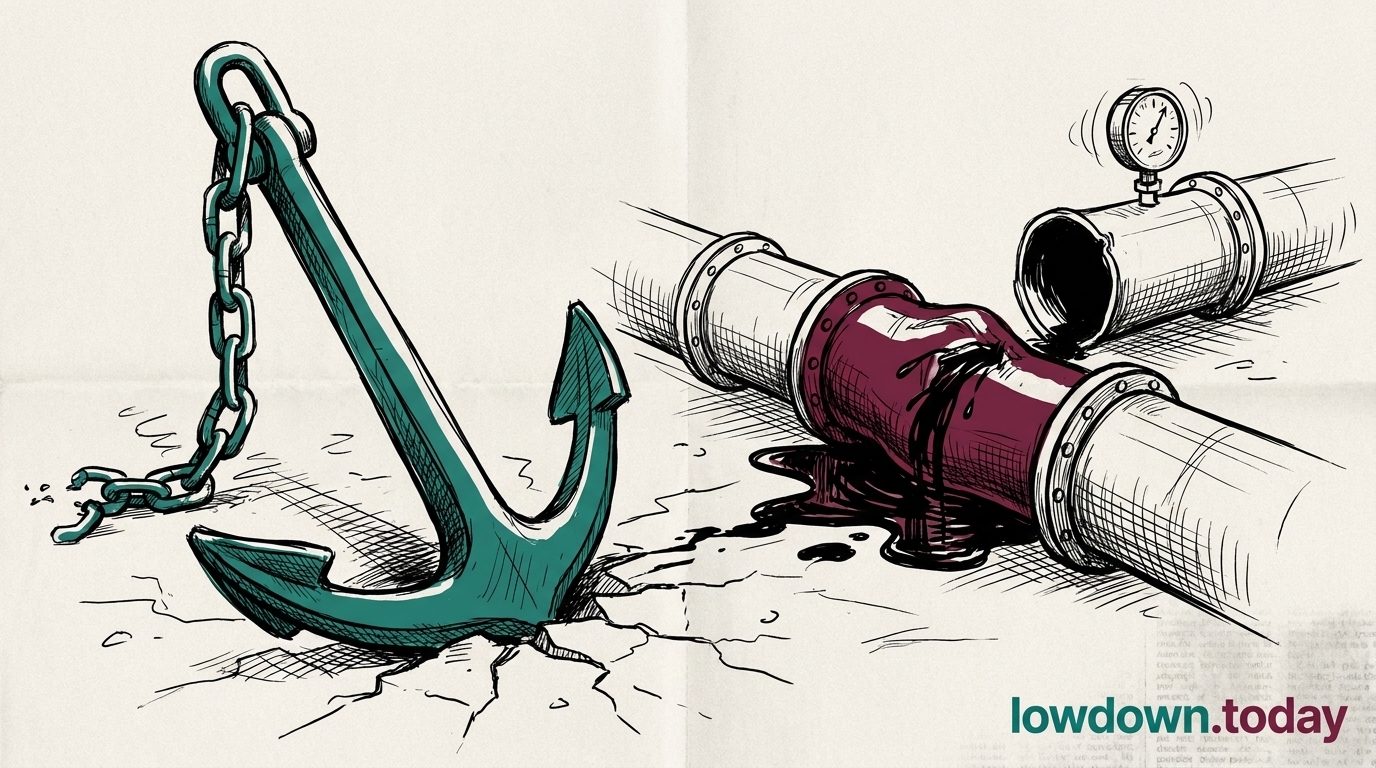
Brent traded near $79.16 and WTI $74.38 by Monday 13 July, the highest Brent since 22 June, after a fourth US strike on Iran in a week and Iran's Strait Authority declared vessels on unauthorised routes forfeit any safe-passage guarantee12. The Strait of Hormuz, the 33km chokepoint carrying roughly a fifth of the world's oil, saw crossings thin to 6-9 vessels a day against a pre-war baseline near 1303. The strike sits with the wider Iran conflict coverage; what it did to the physical balance and the spreads is what decides the P&L here.
The Brent-Dubai EFS, the exchange-for-swaps spread between the two crude grades and a gauge of Atlantic-versus-Gulf demand, stood at $4.24 on 8 July. No dated TD3C VLCC rate or war-risk premium for 10-13 July has printed since. On 22 June the TD3C forward held $181,163/day flat while Brent shed 8%, and war-risk cover sat at 3 to 4% of hull value.
Freight is the desk's cleanest test of whether Hormuz risk is physical or paper. A rate that holds flat while flat price spikes says the tankers are still moving and the premium is on the screen, not on the water. Through 10-13 July it stayed silent, so the highest Brent since 22 June rests on strait-transit fear that the physical market has yet to ratify.




