Skip to content
You can now search across every topic, entity and event.What's new
European Energy Markets
31JUL

Wind-down licence lapses for blocked ships

1 min read
09:44UTC

General License Z, the US Treasury authorisation letting counterparties wind down dealings with vessels blocked on 14 July, lapsed on 17 July alongside General License X1.

EconomicDeveloping
Key takeaway

General License Z lapsed on 17 July, the same day General License X1 expired unrenewed.

General License Z, issued by the US Treasury's Office of Foreign Assets Control (OFAC) to let counterparties wind down dealings with vessels blocked on 14 July, lapsed on 17 July 1. General License X1, which had covered Iranian oil transactions, expired the same day with no renewal .

OFAC issues wind-down licences to open a legal grace period. Each one gives banks, charterers, insurers and port agents a fixed window to settle outstanding obligations with a newly sanctioned party without themselves becoming sanctions violators. Three days is a short window when the counterparties are ships mid-voyage in a war zone whose insurers have already repriced the passage.

With both licences gone, anyone still holding contracts tied to those vessels is exposed with no authorised path to unwind them. The practical effect falls on intermediaries rather than on Tehran: the Greek owner, the Singaporean bunker supplier and the Dubai trading desk now face a choice between breaching a contract and breaching US sanctions, and OFAC has published no successor authorisation.


Deep Analysis

In plain English

The US Treasury had given companies dealing with certain Iran-linked ships a short grace period to wind down their business with them lawfully after those ships were blocked on 14 July. That grace period, called General License Z, ran out on 17 July, the same day a separate licence covering Iranian oil trade also expired with nothing to replace it. Any bank, insurer or shipping company still tied to those vessels now has no officially approved way to end those dealings without risking a sanctions violation.

Deep Analysis
Root Causes

OFAC issues wind-down licences because sanctions designations otherwise take effect instantly, criminalising contracts signed before the designation existed; the licence exists to give banks, insurers and charterers a defined legal window to exit cleanly.

When that window closes without a successor authorisation, as it has here, anyone still holding a contract tied to a blocked vessel has no lawful route to end it, only a choice between breaching the contract or breaching sanctions law.

What could happen next?
  • Consequence

    Intermediaries such as ship owners, bunker suppliers and trading desks now bear the compliance risk of unwinding contracts with no lawful exit route, a burden that falls on third parties rather than on Tehran directly.

First Reported In

Update #156 · First American deaths in Jordan

Al Jazeera· 19 Jul 2026
Read original
Causes and effects
This Event
Wind-down licence lapses for blocked ships
Two escape hatches for lawful disengagement closed on the same day, leaving no authorised route out for exposed counterparties.
Different Perspectives
Spain's LNG terminal operators
Spain's 9,145 GWh terminal inventory is the largest single stock in the EU LNG network, an option value that can reroute cargoes wherever the winter strip pays best rather than a cavern gas obligation tied to a fixed date. That flexibility matters more as Germany's cavern shortfall pushes more of the winter security question onto import infrastructure.
European Commission
European Commission
Brussels holds the bloc to 90% on a flexible window while Germany, holding roughly a quarter of EU storage capacity, tracks toward missing its own lower 80% figure by 21 points. A national shortfall this size in the anchor market matters more to bloc security than the flexible timetable alone can absorb.
French power exporters and CRE
French day-ahead rose in step with Germany but by less, reopening a EUR 7-17 premium that makes northward export flows commercially attractive again after the EUR 43.09 discount evaporated in days. CRE separately authorised RTE and Enedis to buy flexibility locally, betting the coming winter's binding constraint is grid congestion rather than a shortage of firm capacity.
TTF trading desk
TTF trading desk
A visible national shortfall like Germany's 21-point gap is a directional signal, not noise, for a desk holding the summer-winter spread. TTF's flat EUR 58-60 range through this week's German price swings says the market has not yet chosen to reprice refill risk into the front of the curve.
German cavern and CCGT operators
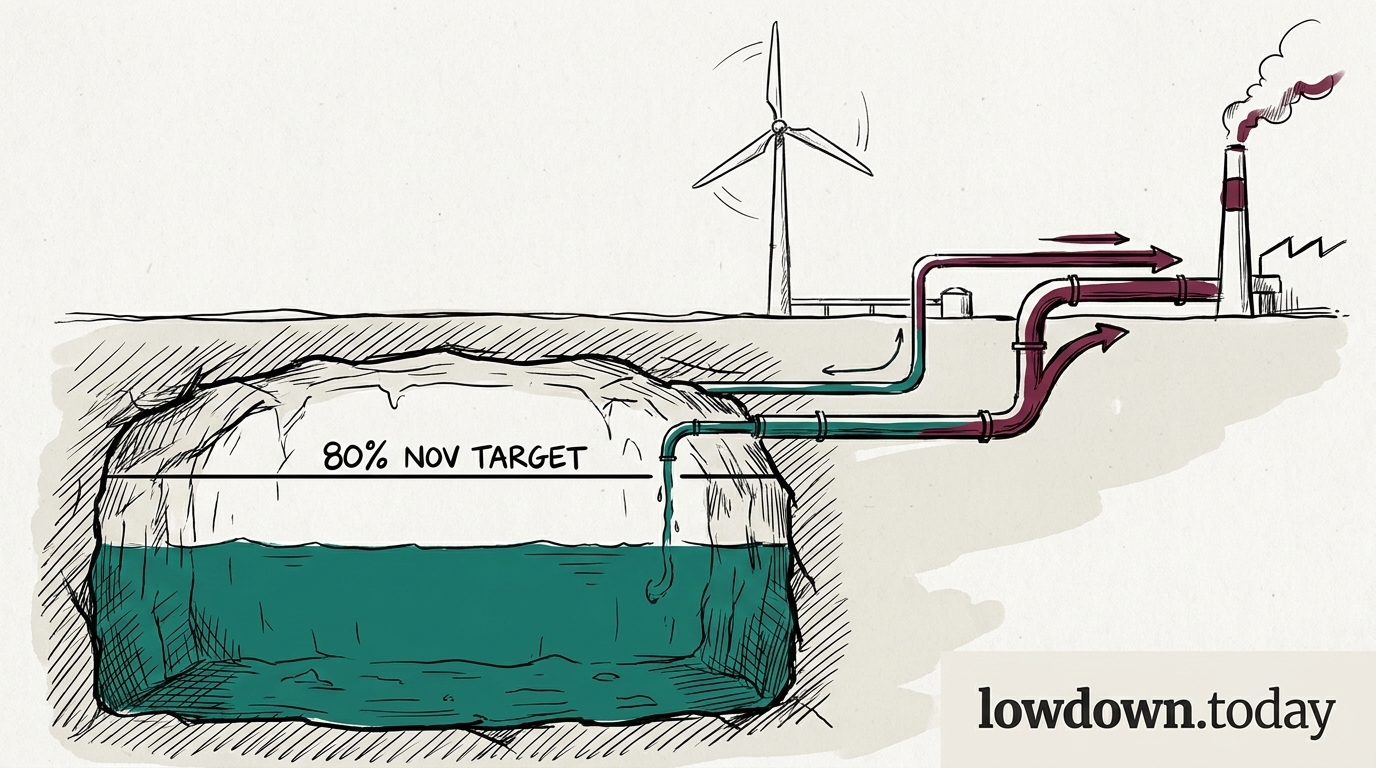
German caverns kept buying prompt gas at TTF near EUR 58-60 through the inversion; the wind collapse to 2.4 GW then flipped the spark spread to plus EUR 29 and put turbines back in the same queue. Every day turbines win that bid, injection at a third of the 877 GWh/day pace needed falls further behind.
Slovakia
Slovakia
Slovakia says it dropped its hold-out on the 21st sanctions package only after Ursula von der Leyen personally signed written gas-price and supply guarantees. The Council of the European Union's own 17,238-character release on the package names neither Slovakia nor any guarantee, leaving Bratislava's account unconfirmed by the institutional record.



