Skip to content
You can now search across every topic, entity and event.What's new
European Energy Markets
31JUL

US pump prices 36% above pre-war

2 min read
09:44UTC

American petrol prices now run 36% above their pre-war level, and the Strategic Petroleum Reserve sits at its lowest since 1983.

EconomicDeveloping
Key takeaway

American pump prices are a third above pre-war levels with the strategic reserve at a 1983 low.

US petrol prices have climbed to 36% above pre-war levels, and the Strategic Petroleum Reserve now sits at its lowest level since 1983, CNN reported on 25 July 1. Brent Crude crossed $100 a barrel on 23 July before easing to $98.38 as mediation reports circulated .

Congress created the reserve after the 1973 oil embargo, and it sits in salt caverns along the Gulf Coast so that a president facing a supply shock can put barrels on the market without asking anyone's permission. Drawing it down to a 1983 level removes that option at the moment a blockade the United States is itself enforcing keeps crude near three figures. Refilling it means buying at those prices, which no administration does willingly in an election cycle.

Pump prices are also the channel through which this war reaches American voters who are not following it. Congressional opposition to the campaign has been measurable and unable to bind the executive; petrol at a third above its pre-war price does not need a roll call to apply pressure. The two constraints now converge on the same building: an air campaign paused for want of munitions, and a fuel price rising because the sea lane that campaign closed has not reopened.


Deep Analysis

In plain English

Petrol prices in the US have climbed to 36% above what they were before the war with Iran started. Normally, when prices spike like this, the government can release oil from its Strategic Petroleum Reserve, a stockpile built for emergencies, to bring prices back down. But that reserve is now at its lowest level since 1983, because it has been drawn down over several years for other reasons. That means the government has much less ability to soften the blow at the pump this time.

Deep Analysis
Root Causes

The Strategic Petroleum Reserve's depletion did not start with this war. Successive administrations drew it down for budget and price-management reasons over the past several years, leaving a reserve sized for a short emergency, not for a Hormuz blockade with a Houthi front now expanding into Saudi Aramco infrastructure directly.

That pre-existing depletion is the structural reason petrol prices are transmitting more directly to the pump now than in earlier oil shocks: the SPR release valve that historically absorbed part of the shock is largely unavailable this time.

What could happen next?
  • Consequence

    With the SPR near its lowest level since 1983, Washington has limited capacity to blunt further petrol-price rises through reserve releases alone.

  • Risk

    Sustained high petrol prices heading into any political negotiation over the war raise domestic pressure on the administration independent of battlefield developments.

First Reported In

Update #162 · Munitions, not Iran, halted US bombing

CNN· 26 Jul 2026
Read original
Causes and effects
This Event
US pump prices 36% above pre-war
The buffer a president reaches for when fuel prices bite is emptier than at any point in four decades.
Different Perspectives
Spain's LNG terminal operators
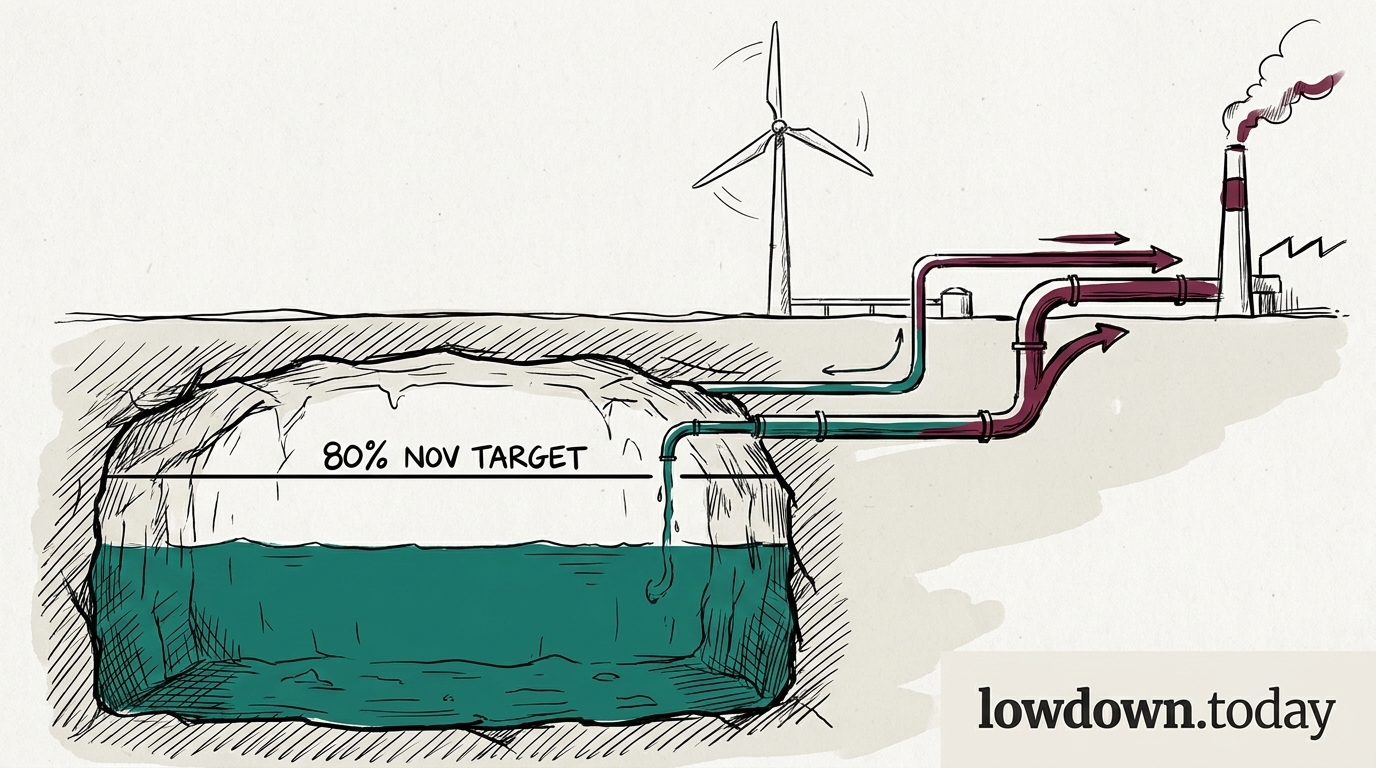
Spain's 9,145 GWh terminal inventory is the largest single stock in the EU LNG network, an option value that can reroute cargoes wherever the winter strip pays best rather than a cavern gas obligation tied to a fixed date. That flexibility matters more as Germany's cavern shortfall pushes more of the winter security question onto import infrastructure.
European Commission
European Commission
Brussels holds the bloc to 90% on a flexible window while Germany, holding roughly a quarter of EU storage capacity, tracks toward missing its own lower 80% figure by 21 points. A national shortfall this size in the anchor market matters more to bloc security than the flexible timetable alone can absorb.
French power exporters and CRE
French day-ahead rose in step with Germany but by less, reopening a EUR 7-17 premium that makes northward export flows commercially attractive again after the EUR 43.09 discount evaporated in days. CRE separately authorised RTE and Enedis to buy flexibility locally, betting the coming winter's binding constraint is grid congestion rather than a shortage of firm capacity.
TTF trading desk
TTF trading desk
A visible national shortfall like Germany's 21-point gap is a directional signal, not noise, for a desk holding the summer-winter spread. TTF's flat EUR 58-60 range through this week's German price swings says the market has not yet chosen to reprice refill risk into the front of the curve.
German cavern and CCGT operators
German caverns kept buying prompt gas at TTF near EUR 58-60 through the inversion; the wind collapse to 2.4 GW then flipped the spark spread to plus EUR 29 and put turbines back in the same queue. Every day turbines win that bid, injection at a third of the 877 GWh/day pace needed falls further behind.
Slovakia
Slovakia
Slovakia says it dropped its hold-out on the 21st sanctions package only after Ursula von der Leyen personally signed written gas-price and supply guarantees. The Council of the European Union's own 17,238-character release on the package names neither Slovakia nor any guarantee, leaving Bratislava's account unconfirmed by the institutional record.



