Skip to content
You can now search across every topic, entity and event.What's new
European Energy Markets
31JUL

Ukraine hits Baltic Fleet at Kronstadt

3 min read
09:44UTC

Ukraine's Unmanned Systems Forces sent more than 400 drones into Russia overnight into 6 June and set fire to the missile corvette Boikyi at Kronstadt, the Baltic Fleet's home base outside St Petersburg.

EconomicDeveloping
Key takeaway

Ukraine hit a Baltic Fleet warship 1,000km inside Russia during Putin's flagship investor forum.

Overnight into 6 June, Ukraine's Unmanned Systems Forces sent more than 400 drones deep into Russia and set fire to the missile corvette Boikyi at Kronstadt, the Baltic Fleet's home base outside St Petersburg 1. It was the first confirmed Ukrainian strike on a Russian warship in the Baltic Sea, around 1,000km from the border. The same wave hit the Petergofskaya oil depot, the Neste terminal at Lomonosov, and a naval arsenal at Bolshaya Izhora. Moscow has not disputed the strike, only its scale.

The strikes landed during the St Petersburg International Economic Forum, the event Putin uses to court foreign investors and project stability. Brovdi, the drone-forces commander, said his units tracked down and set fire to the corvette, the same vessel that had escorted Russia's sanctioned shadow-fleet tankers through the English Channel in 2025. Hitting the flagship economic forum with a naval fire punctures the calm Putin was selling.

Twelve months earlier, Ukraine's Operation Spiderweb of 1 June 2025 destroyed Russian strategic bombers on the ground; the reach has only lengthened since. Kronstadt had been treated by Moscow as an untouchable rear-area base; it now sits inside Ukrainian range, the same assumption of a secure rear that its declining oil revenue had already begun to test . No Russian rear area now reads as safe.


Deep Analysis

In plain English

Ukraine has been attacking Russian military targets far behind the front lines using swarms of cheap, one-way drones. On the night of 5-6 June those drones flew roughly 1,000 kilometres to reach Kronstadt, a fortified naval island 30km west of St Petersburg that houses Russia's Baltic Fleet. The Baltic Fleet is Russia's navy in the Baltic Sea. Boikyi is a Baltic Sea patrol corvette carrying eight Kalibr cruise missiles. Kronstadt was previously considered far beyond Ukraine's reach. It also sent a message to the foreign investors Putin was hosting at his annual SPIEF (St Petersburg International Economic Forum) that the war is not contained to a distant front.

Deep Analysis
Root Causes

Ukraine's Unmanned Systems Forces, established February 2024, industrialised cheap one-way FPV and strike-drone production to a scale that makes 400-unit waves routine.

The 1,000km reach exploits Russia's decision to concentrate the Baltic Fleet at Kronstadt rather than disperse it, a Cold War-era basing posture that assumed no adversary could strike that deep. Ukraine's maritime-drone doctrine, developed after Russia withdrew from the Black Sea grain corridor in 2023, has progressively extended from the Black Sea coast northward to Baltic waters.

Escalation

The Baltic strike crosses a geographic threshold Russia had not previously defended against. Moscow's non-denial is unusual and suggests it has no air-defence answer to a 400-drone wave at that range. The risk of Russian retaliation against Baltic state ports or infrastructure routing Ukrainian weapons is real but unconfirmed; no escalatory Russian response had been declared by 9 June.

What could happen next?
  • Consequence

    Russia must now defend its Baltic Fleet and St Petersburg logistics against drone strikes, diverting air-defence assets from other theatres.

    Short term · Assessed
  • Risk

    Russian retaliatory strikes on Baltic Sea shipping lanes or Finnish/Estonian port infrastructure cannot be ruled out if Ukraine repeats the Kronstadt attack.

    Medium term · Suggested
  • Precedent

    Ukraine has established that it can strike Baltic Sea naval assets; NATO's Baltic flank planning must now account for Russian escalation in that theatre.

    Long term · Assessed
First Reported In

Update #19 · Ukraine burns the Baltic Fleet at Kronstadt

Kyiv Independent· 9 Jun 2026
Read original
Different Perspectives
Spain's LNG terminal operators
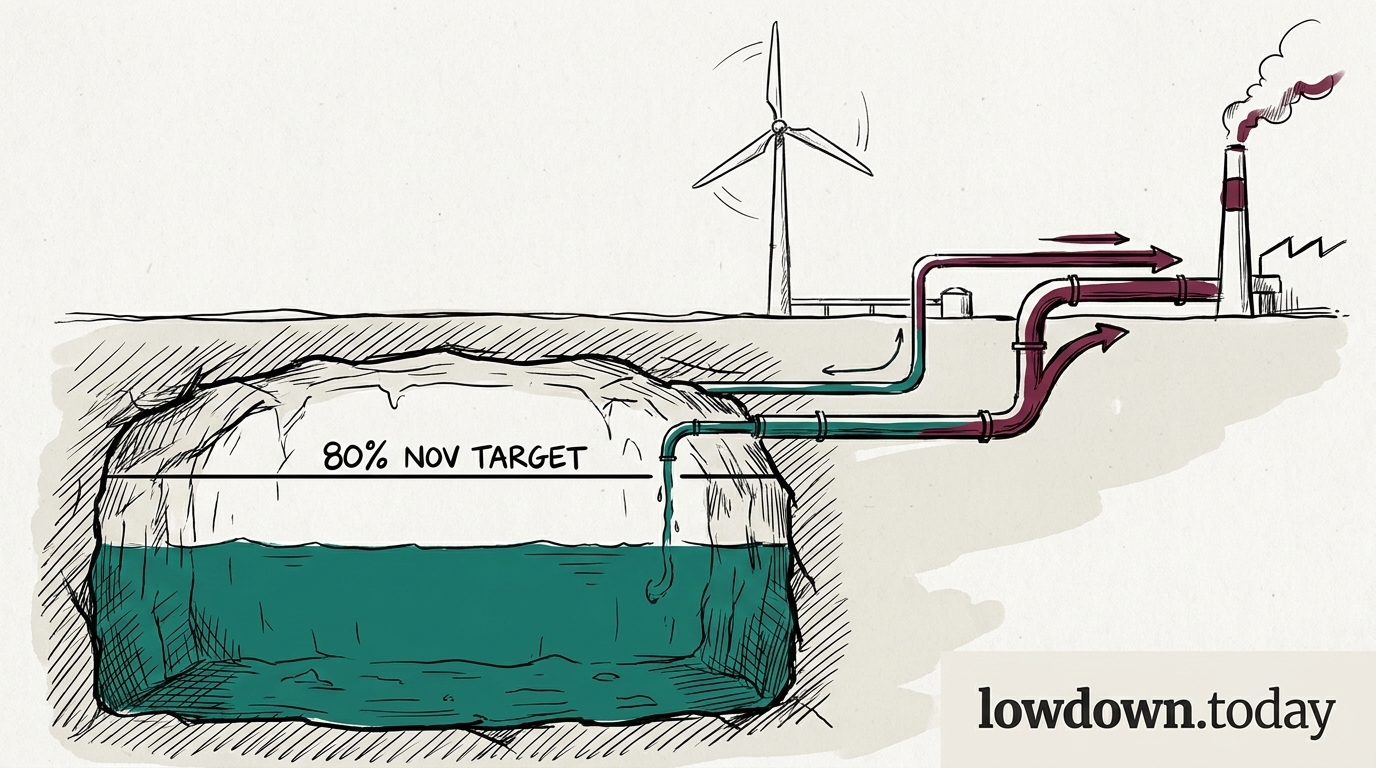
Spain's 9,145 GWh terminal inventory is the largest single stock in the EU LNG network, an option value that can reroute cargoes wherever the winter strip pays best rather than a cavern gas obligation tied to a fixed date. That flexibility matters more as Germany's cavern shortfall pushes more of the winter security question onto import infrastructure.
European Commission
European Commission
Brussels holds the bloc to 90% on a flexible window while Germany, holding roughly a quarter of EU storage capacity, tracks toward missing its own lower 80% figure by 21 points. A national shortfall this size in the anchor market matters more to bloc security than the flexible timetable alone can absorb.
French power exporters and CRE
French day-ahead rose in step with Germany but by less, reopening a EUR 7-17 premium that makes northward export flows commercially attractive again after the EUR 43.09 discount evaporated in days. CRE separately authorised RTE and Enedis to buy flexibility locally, betting the coming winter's binding constraint is grid congestion rather than a shortage of firm capacity.
TTF trading desk
TTF trading desk
A visible national shortfall like Germany's 21-point gap is a directional signal, not noise, for a desk holding the summer-winter spread. TTF's flat EUR 58-60 range through this week's German price swings says the market has not yet chosen to reprice refill risk into the front of the curve.
German cavern and CCGT operators
German caverns kept buying prompt gas at TTF near EUR 58-60 through the inversion; the wind collapse to 2.4 GW then flipped the spark spread to plus EUR 29 and put turbines back in the same queue. Every day turbines win that bid, injection at a third of the 877 GWh/day pace needed falls further behind.
Slovakia
Slovakia
Slovakia says it dropped its hold-out on the 21st sanctions package only after Ursula von der Leyen personally signed written gas-price and supply guarantees. The Council of the European Union's own 17,238-character release on the package names neither Slovakia nor any guarantee, leaving Bratislava's account unconfirmed by the institutional record.



