Skip to content
You can now search across every topic, entity and event.What's new
European Energy Markets
31JUL

Two US carriers stay, blockade runs on

3 min read
09:44UTC

The USS Abraham Lincoln and the USS George H.W. Bush remained on station in the Gulf as of 18 June, the blockade still redirecting vessels, despite the memorandum's clause that it be removed immediately.

EconomicDeveloping
Key takeaway

Two carriers on station are the proof the order to lift the blockade never reached the fleet.

Two US carrier strike groups, built around the USS Abraham Lincoln and the USS George H.W. Bush, remained on station in the Gulf region as of 17-18 June 1. CENTCOM (US Central Command), the US military command for the Middle East, has issued no drawdown order, and the naval blockade continues to redirect vessels, despite the Islamabad Memorandum of Understanding (MoU) clause that the blockade be "removed immediately."

The blockade is the apparatus that has throttled Iranian seaborne trade through the war, turning the strait into a corridor ships transit only on US sufferance. Trump signed the MOU and ordered the blockade lifted on 16 June , but CENTCOM kept it running pending a signed instrument it has not received. The carriers on station are the physical evidence that the order has not reached the water.

The shipping industry reads operations, not press releases. Insurers, mine-clearance crews and tanker owners need an on-water change before commercial transits resume; a memorandum does not move a hull. Hormuz logged zero new tanker transits the day after Trump signed . The Geneva signing ceremony was scrapped, and Baghaei confirmed the text was finalised electronically, the presidents' signatures applied digitally rather than at any podium.


Deep Analysis

In plain English

Think of the naval blockade as a lock on a gate that is run by one department and the key as a different document held by another department. When the US President signed the Islamabad MOU, he was handing over a promise to unlock the gate. But the military commanders operating the lock need a separate written order from the Defence Department before they can actually turn the key. As of 18 June, that order had not arrived. So both aircraft carriers, the Abraham Lincoln and the George H.W. Bush, stayed in position, redirecting ships just as before. The gate remained locked. Separately, the sea still has live floating mines in it. Even if the lock were opened, no commercial ship would sail through a minefield without a guarantee that the mines had been removed.

Deep Analysis
Root Causes

The blockade-stays problem has a structural cause independent of politics: the CENTCOM enforcement mechanism runs on a separate chain of command from the diplomatic track that produced the MOU. Trump signed the MOU as the US executive; the blockade is operationalised by CENTCOM via the Secretary of Defense chain. Without a National Security Council decision memo, a SecDef order, and a CENTCOM operational directive, the blockade runs by default.

Mine-clearance progress also blocks the blockade lift. Hormuz was still seeded with active mines on 18 June. BIMCO and the International Chamber of Shipping have stated publicly that commercial vessels will not transit an uncleared minefield regardless of what a ceasefire agreement says. The operational prerequisite for the blockade lift, cleared lanes, does not yet exist.

What could happen next?
  • Risk

    An incident between an on-station carrier and an IRGC vessel, as happened on 15 June with the 'last warning' radio transmission, could escalate to an exchange of fire that voids the MOU before the 19 June ceremony.

    Immediate · Reported
  • Consequence

    The carrier stay gives Iran a public talking point: the US blockade continues despite the signed MOU, symmetrically matching Iran's own non-compliance on Lebanon.

    Short term · Assessed
  • Precedent

    If the blockade does not begin to lift within seven days of signing, insurers will treat the MOU as a rhetorical instrument rather than an operational change, maintaining war-risk exclusions and keeping effective transit near zero.

    Short term · Assessed
First Reported In

Update #131 · Iran deal's first death tests the text

Al Jazeera· 18 Jun 2026
Read original
Different Perspectives
Spain's LNG terminal operators
Spain's 9,145 GWh terminal inventory is the largest single stock in the EU LNG network, an option value that can reroute cargoes wherever the winter strip pays best rather than a cavern gas obligation tied to a fixed date. That flexibility matters more as Germany's cavern shortfall pushes more of the winter security question onto import infrastructure.
European Commission
European Commission
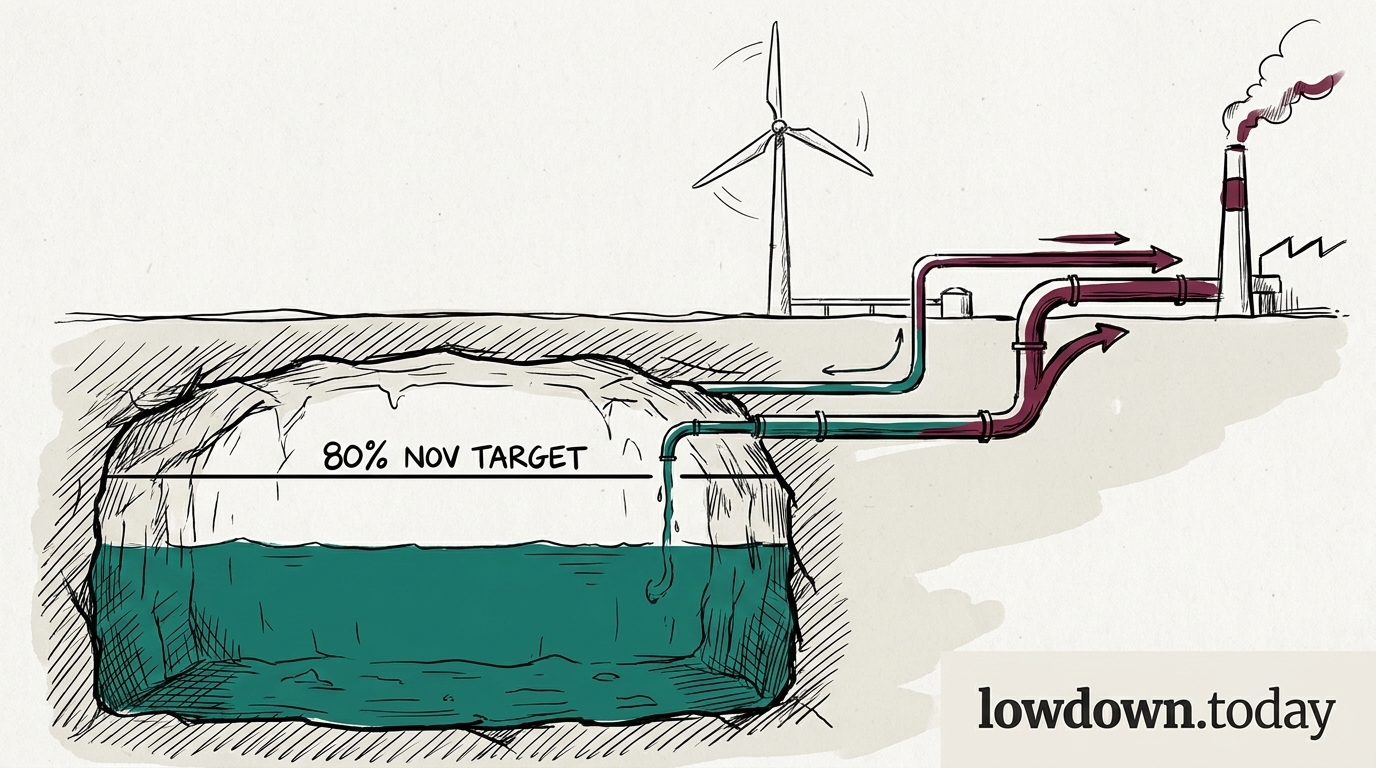
Brussels holds the bloc to 90% on a flexible window while Germany, holding roughly a quarter of EU storage capacity, tracks toward missing its own lower 80% figure by 21 points. A national shortfall this size in the anchor market matters more to bloc security than the flexible timetable alone can absorb.
French power exporters and CRE
French day-ahead rose in step with Germany but by less, reopening a EUR 7-17 premium that makes northward export flows commercially attractive again after the EUR 43.09 discount evaporated in days. CRE separately authorised RTE and Enedis to buy flexibility locally, betting the coming winter's binding constraint is grid congestion rather than a shortage of firm capacity.
TTF trading desk
TTF trading desk
A visible national shortfall like Germany's 21-point gap is a directional signal, not noise, for a desk holding the summer-winter spread. TTF's flat EUR 58-60 range through this week's German price swings says the market has not yet chosen to reprice refill risk into the front of the curve.
German cavern and CCGT operators
German caverns kept buying prompt gas at TTF near EUR 58-60 through the inversion; the wind collapse to 2.4 GW then flipped the spark spread to plus EUR 29 and put turbines back in the same queue. Every day turbines win that bid, injection at a third of the 877 GWh/day pace needed falls further behind.
Slovakia
Slovakia
Slovakia says it dropped its hold-out on the 21st sanctions package only after Ursula von der Leyen personally signed written gas-price and supply guarantees. The Council of the European Union's own 17,238-character release on the package names neither Slovakia nor any guarantee, leaving Bratislava's account unconfirmed by the institutional record.



