Skip to content
You can now search across every topic, entity and event.What's new
European Energy Markets
31JUL

Trading desks stretch to 21-hour days

2 min read
09:44UTC

European energy trading hours have more than doubled from 10 to 21 hours as volatility forces round-the-clock coverage.

EconomicDeveloping
Key takeaway

Trading hours doubled to 21 per day; bank forecasts diverge by EUR 30/MWh on Hormuz timing.

European gas and power trading hours are extending from 10 to 21 hours per day, according to Bloomberg, a structural adaptation to sustained market volatility. The extension reflects the reality that price-moving events (Hormuz threats, ceasefire announcements, force majeure declarations) arrive outside traditional European trading hours, and desks that are not staffed miss the move.

Standard Chartered forecast TTF could breach the EUR eighty mark if the conflict remains unresolved at summer injection start. Goldman Sachs forecast Q2 TTF at EUR 50/MWh, but that assumes Hormuz normalisation by mid-April, an assumption already overtaken by events. That forecast gap captures the market's fundamental uncertainty: whether the strait reopens in weeks or months is the single variable that separates a manageable injection season from another winter of extreme price spikes.


Deep Analysis

In plain English

European gas and electricity traders are now working much longer days. The markets that allow energy companies, utilities, and industrials to buy and sell gas and power have extended their operating hours from 10 to 21 hours per day. This is because prices are moving so sharply, driven by news about the Hormuz disruption, that participants need more time to respond and manage their risk positions. Standard Chartered bank thinks prices could reach EUR 80/MWh if the disruption continues into summer. Goldman Sachs predicted EUR 50/MWh, but its forecast assumed Hormuz would normalise by mid-April, which has not happened.

Deep Analysis
Root Causes

The shift from 10 to 21 hours of trading reflects a practical response to a structural change in the volatility regime: when geopolitical events can move prices by EUR 5-10/MWh in a single session, and those events arrive on Middle Eastern time zones (which are 2-4 hours ahead of European market open), market participants face unhedgeable overnight gap risk under a 10-hour trading window.

Extended hours reduce the overnight gap risk by allowing participants to react to news as it emerges, but they also require 24-hour desk coverage for energy trading operations, increasing operational costs for smaller trading firms and potentially concentrating market activity among larger participants with the infrastructure to maintain extended desks.

What could happen next?
  • Risk

    Goldman Sachs's EUR 50/MWh Q2 forecast was conditioned on Hormuz normalisation by mid-April. With that deadline passed, a Goldman forecast revision upward would signal that consensus market expectations are moving toward the Standard Chartered EUR 80+/MWh scenario.

  • Consequence

    Extended trading hours concentrate market-making capacity among larger institutions, potentially reducing liquidity during off-peak trading windows and widening bid-ask spreads for smaller energy buyers.

First Reported In

Update #1 · Europe's thinnest gas cushion since 2018

Bloomberg· 13 Apr 2026
Read original
Causes and effects
This Event
Trading desks stretch to 21-hour days
The operational shift from 10 to 21-hour trading days is a structural adaptation that increases staffing costs and operational risk across every European energy trading desk.
Different Perspectives
Spain's LNG terminal operators
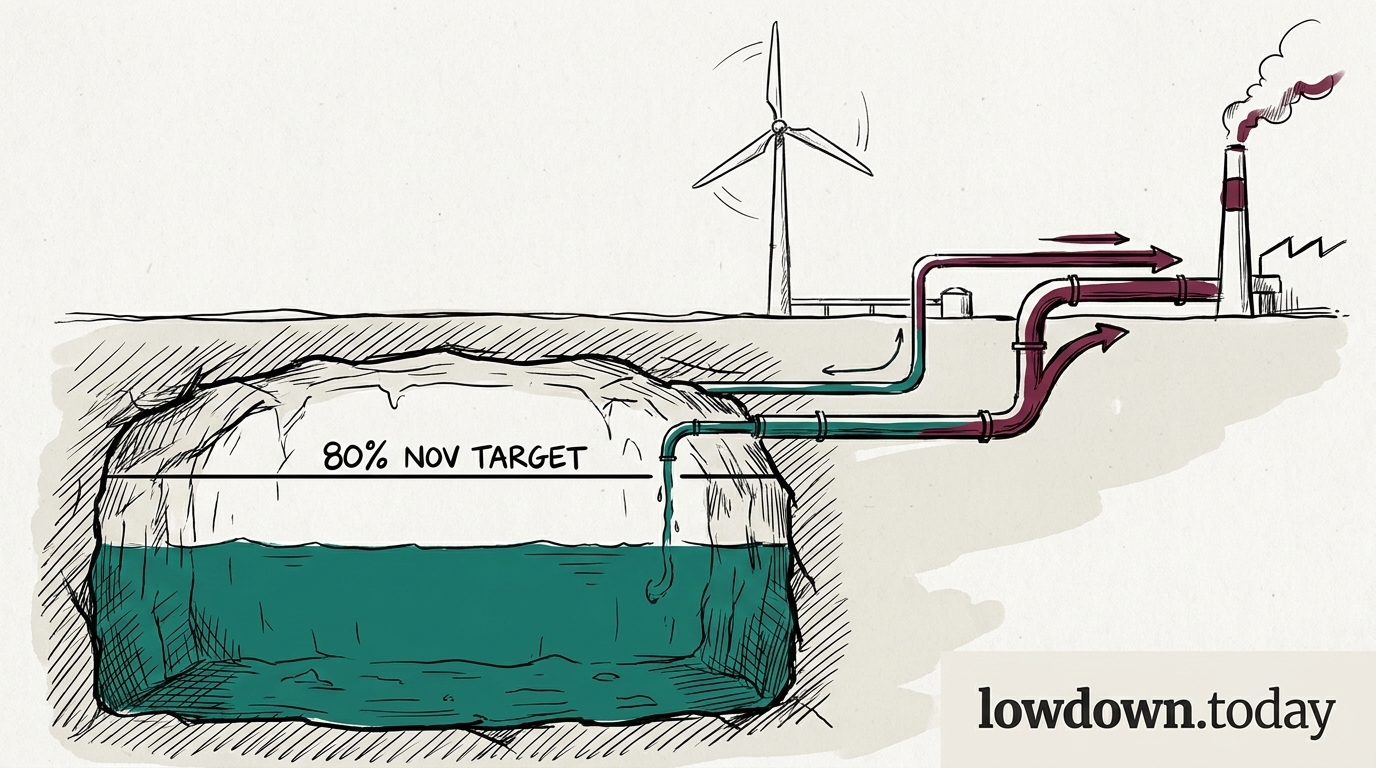
Spain's 9,145 GWh terminal inventory is the largest single stock in the EU LNG network, an option value that can reroute cargoes wherever the winter strip pays best rather than a cavern gas obligation tied to a fixed date. That flexibility matters more as Germany's cavern shortfall pushes more of the winter security question onto import infrastructure.
European Commission
European Commission
Brussels holds the bloc to 90% on a flexible window while Germany, holding roughly a quarter of EU storage capacity, tracks toward missing its own lower 80% figure by 21 points. A national shortfall this size in the anchor market matters more to bloc security than the flexible timetable alone can absorb.
French power exporters and CRE
French day-ahead rose in step with Germany but by less, reopening a EUR 7-17 premium that makes northward export flows commercially attractive again after the EUR 43.09 discount evaporated in days. CRE separately authorised RTE and Enedis to buy flexibility locally, betting the coming winter's binding constraint is grid congestion rather than a shortage of firm capacity.
TTF trading desk
TTF trading desk
A visible national shortfall like Germany's 21-point gap is a directional signal, not noise, for a desk holding the summer-winter spread. TTF's flat EUR 58-60 range through this week's German price swings says the market has not yet chosen to reprice refill risk into the front of the curve.
German cavern and CCGT operators
German caverns kept buying prompt gas at TTF near EUR 58-60 through the inversion; the wind collapse to 2.4 GW then flipped the spark spread to plus EUR 29 and put turbines back in the same queue. Every day turbines win that bid, injection at a third of the 877 GWh/day pace needed falls further behind.
Slovakia
Slovakia
Slovakia says it dropped its hold-out on the 21st sanctions package only after Ursula von der Leyen personally signed written gas-price and supply guarantees. The Council of the European Union's own 17,238-character release on the package names neither Slovakia nor any guarantee, leaving Bratislava's account unconfirmed by the institutional record.



