Skip to content
You can now search across every topic, entity and event.What's new
European Energy Markets
31JUL

Three ceasefires collapsed with zero instruments signed

3 min read
09:44UTC

Between 6 and 11 May, Ukraine, Russia, and Trump each declared a ceasefire; all three collapsed, with Ukraine logging 1,820 Russian violations by 10am on 6 May alone.

EconomicDeveloping
Key takeaway

Three ceasefires in eight days collapsed; Ukraine's long-range restraint was the only part that held.

Donald Trump announced a three-day ceasefire covering 9-11 May 2026 on 8 May, with a 1,000-for-1,000 prisoner exchange attached 1. Ukraine had declared a unilateral halt from midnight on 6 May; Russia declared one for 8-9 May. All three collapsed without a signed instrument 2.

The numbers on the Ukrainian unilateral halt are precise: 1,820 Russian violations logged by 10am on 6 May alone, as Russia launched 108 drones and 3 missiles over that period 3. For the Trump window, the only durable component was Volodymyr Zelenskyy's confirmation that Ukraine refrained from long-range retaliatory strikes during 9-11 May 4. Russia maintained drone and artillery exchanges throughout.

This is the third data point in a series that began with Putin's Orthodox Easter ceasefire in April . That template expired with 10,721 Ukrainian-logged Russian violations , then a 324-drone overnight barrage followed within hours. The Victory Day version repeats the same architecture: decree, partial compliance on long-range, unbroken front-line fire, accusation exchange, full resumption. The one variable that shifted between April and May is Trump's personal attachment to the framing; the operational outcome is identical.

Ukraine's demonstrated long-range restraint is now a documented bargaining chip; Russia has seen it deployed and can calibrate its next demand against it. Putin proposed the Victory Day ceasefire in a 29 April call to Trump ; Zelenskyy had pre-emptively called the concept theatrical on 30 April . Three templates produced Western wire coverage of diplomatic activity but no front-line halt.


Deep Analysis

In plain English

Between 6 and 11 May, three separate attempts were made to stop the fighting. Ukraine said it would stop shooting. Then Russia said it would stop shooting. Then Donald Trump announced a three-day pause. All three failed within hours. Each was an announcement, not an agreement. For a ceasefire to hold, both sides need to sign the same document, and a neutral observer needs authority to say who broke it. None of that was in place. Ukraine recorded nearly 2,000 Russian attacks in the first few hours of its own ceasefire. It is a bit like two drivers in a car park both announcing they are going to stop, but neither actually slowing down.

Deep Analysis
Root Causes

Two structural deficits caused the collapse of all three templates. First, no mutually recognised third-party verification authority exists between Russia and Ukraine. The UN Security Council cannot fill this role because Russia holds a permanent veto. The OSCE Special Monitoring Mission was expelled from Russian-controlled territory in 2022.

Second, Russia's Peskov-confirmed minimum condition, namely Ukrainian cession of Donetsk, Luhansk, Zaporizhzhia, and Kherson oblasts in their entirety, is irreconcilable with Ukraine's internationally recognised borders position. No ceasefire framework that does not address this gap can produce a durable halt; it can only produce a pause that each side uses to improve its military position.

Escalation

The triple-collapse pattern now constitutes a datable series: Easter in April, Victory Day window in May, Trump window in May. Each successive failure has been followed by a larger barrage. Any future ceasefire announcement should be treated as a precursor to escalation rather than a de-escalatory signal until a verification mechanism is in place.

What could happen next?
  • Consequence

    The absence of signed instruments across three templates makes it harder for Western governments to argue that diplomatic engagement with Russia produces outputs, weakening the political case for continued negotiation-first approaches.

    Short term · 0.8
  • Risk

    Trump's public commitment to the 9-11 May window without a corresponding Russian signature creates a credibility cost for future US mediation; the next ceasefire proposal from Washington will face a higher scepticism threshold from Kyiv and European capitals.

    Medium term · 0.72
  • Precedent

    The 1,820-violation tally within hours of the 6 May Ukrainian ceasefire establishes a documentation methodology that Kyiv can deploy to delegitimise future unilateral Russian ceasefire proposals before they expire.

    Immediate · 0.85
First Reported In

Update #16 · 800 drones, three ceasefires, one cliff

Al Jazeera· 13 May 2026
Read original
Different Perspectives
Spain's LNG terminal operators
Spain's 9,145 GWh terminal inventory is the largest single stock in the EU LNG network, an option value that can reroute cargoes wherever the winter strip pays best rather than a cavern gas obligation tied to a fixed date. That flexibility matters more as Germany's cavern shortfall pushes more of the winter security question onto import infrastructure.
European Commission
European Commission
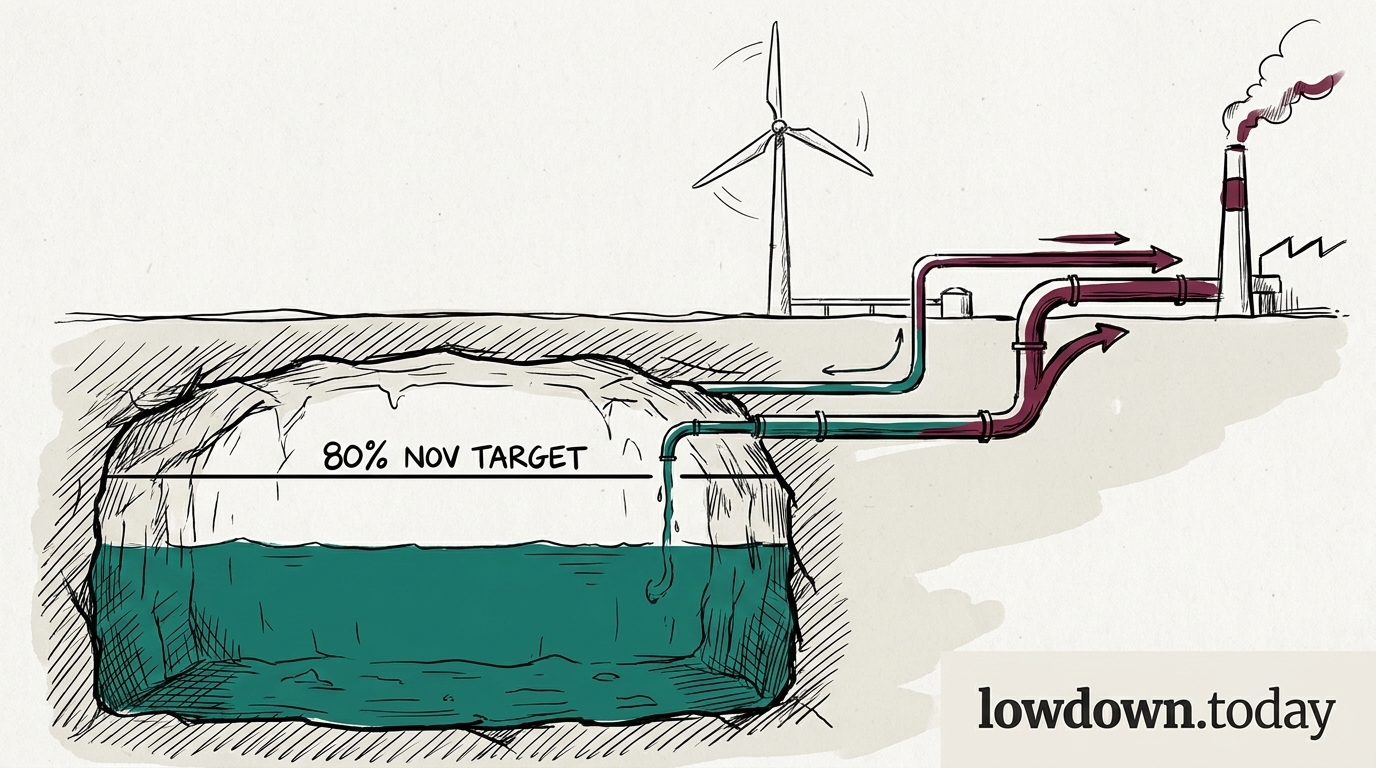
Brussels holds the bloc to 90% on a flexible window while Germany, holding roughly a quarter of EU storage capacity, tracks toward missing its own lower 80% figure by 21 points. A national shortfall this size in the anchor market matters more to bloc security than the flexible timetable alone can absorb.
French power exporters and CRE
French day-ahead rose in step with Germany but by less, reopening a EUR 7-17 premium that makes northward export flows commercially attractive again after the EUR 43.09 discount evaporated in days. CRE separately authorised RTE and Enedis to buy flexibility locally, betting the coming winter's binding constraint is grid congestion rather than a shortage of firm capacity.
TTF trading desk
TTF trading desk
A visible national shortfall like Germany's 21-point gap is a directional signal, not noise, for a desk holding the summer-winter spread. TTF's flat EUR 58-60 range through this week's German price swings says the market has not yet chosen to reprice refill risk into the front of the curve.
German cavern and CCGT operators
German caverns kept buying prompt gas at TTF near EUR 58-60 through the inversion; the wind collapse to 2.4 GW then flipped the spark spread to plus EUR 29 and put turbines back in the same queue. Every day turbines win that bid, injection at a third of the 877 GWh/day pace needed falls further behind.
Slovakia
Slovakia
Slovakia says it dropped its hold-out on the 21st sanctions package only after Ursula von der Leyen personally signed written gas-price and supply guarantees. The Council of the European Union's own 17,238-character release on the package names neither Slovakia nor any guarantee, leaving Bratislava's account unconfirmed by the institutional record.



