Skip to content
You can now search across every topic, entity and event.What's new
European Energy Markets
31JUL

Ten Hezbollah sites hit after clash

2 min read
09:44UTC

Israeli jets hit around ten Hezbollah sites across four south Lebanon villages on 2 July, hours after a Hezbollah gunman severely wounded an Israeli reservist at Bint Jbeil.

EconomicDeveloping
Key takeaway

Iran cannot reach nuclear talks without calming a border whose trigger sits with Hezbollah, not Tehran.

The Israel Defense Forces (IDF) struck around ten Hezbollah sites across Bint Jbeil, Beit Yahoun, Kounine and Baraashit on 2 July, hours after a Hezbollah gunman severely wounded a reservist from the 679th Yiftah Armoured Brigade at Bint Jbeil 1. Hezbollah, the Lebanese Shia armed movement, has fought Israel along the southern border since the war began in February. Israeli tank fire hit the building the gunman had fired from first, and the air strikes followed.

Iran named this border its precondition for nuclear talks, yet Tehran staged a week of national unity in the capital while the front it says must quieten stayed hot. Hezbollah has answered every framework put to it, rejecting the US-Israel-Lebanon disarmament text within hours on 27 June , and it has not stopped firing. The mourning in Tehran and the shooting in Bint Jbeil ran on the same days.

Iran ties any resumption of nuclear talks to calm on this border, yet the trigger sits with Hezbollah's own command, not with Tehran's negotiators. A single reservist wounded at Bint Jbeil drew ten sites of Israeli fire the same day, and neither Doha nor Tehran ordered the shot that started it. Each clash here resets the precondition Iran set for itself.


Deep Analysis

In plain English

Hezbollah is an armed and political group in Lebanon, backed by Iran, that has been fighting a border war with Israel. The Israel Defence Forces, or IDF, is Israel's military. On 2 July, a Hezbollah gunman badly wounded an Israeli army reservist in the town of Bint Jbeil in south Lebanon. Israel responded within hours by hitting around ten Hezbollah locations across four nearby villages with jets and tank fire. This matters because it shows the ceasefire lines from earlier this year have not stopped the fighting. One wounded soldier was enough to trigger strikes across multiple towns, the kind of quick, outsized response that keeps the war simmering even while diplomats discuss peace elsewhere.

Deep Analysis
Root Causes

The clash at Bint Jbeil happened inside a zone the IDF still physically occupies. The US, Israel and Lebanon signed a trilateral framework on 27 June tying withdrawal to Hezbollah's disarmament rather than a fixed Litani River line , but Hezbollah's secretary-general Naim Qassem rejected it within hours as a 'surrender of sovereignty'.

With no agreed line and no Hezbollah commitment, troops and fighters keep operating in overlapping territory, so any tactical contact carries a built-in risk of triggering a strike wave.

The 2 July toll also fits an established pattern. Israel struck roughly 80 Hezbollah sites on 19 June, the deadliest single day on the Lebanon front since the Islamabad MOU . A single Israeli casualty has repeatedly produced a double-digit strike count, suggesting the ratio itself has become the operating rule of engagement, whatever the trigger.

First Reported In

Update #145 · Iran's heir skips the funeral built for him

Times of Israel· 4 Jul 2026
Read original
Causes and effects
Different Perspectives
Spain's LNG terminal operators
Spain's 9,145 GWh terminal inventory is the largest single stock in the EU LNG network, an option value that can reroute cargoes wherever the winter strip pays best rather than a cavern gas obligation tied to a fixed date. That flexibility matters more as Germany's cavern shortfall pushes more of the winter security question onto import infrastructure.
European Commission
European Commission
Brussels holds the bloc to 90% on a flexible window while Germany, holding roughly a quarter of EU storage capacity, tracks toward missing its own lower 80% figure by 21 points. A national shortfall this size in the anchor market matters more to bloc security than the flexible timetable alone can absorb.
French power exporters and CRE
French day-ahead rose in step with Germany but by less, reopening a EUR 7-17 premium that makes northward export flows commercially attractive again after the EUR 43.09 discount evaporated in days. CRE separately authorised RTE and Enedis to buy flexibility locally, betting the coming winter's binding constraint is grid congestion rather than a shortage of firm capacity.
TTF trading desk
TTF trading desk
A visible national shortfall like Germany's 21-point gap is a directional signal, not noise, for a desk holding the summer-winter spread. TTF's flat EUR 58-60 range through this week's German price swings says the market has not yet chosen to reprice refill risk into the front of the curve.
German cavern and CCGT operators
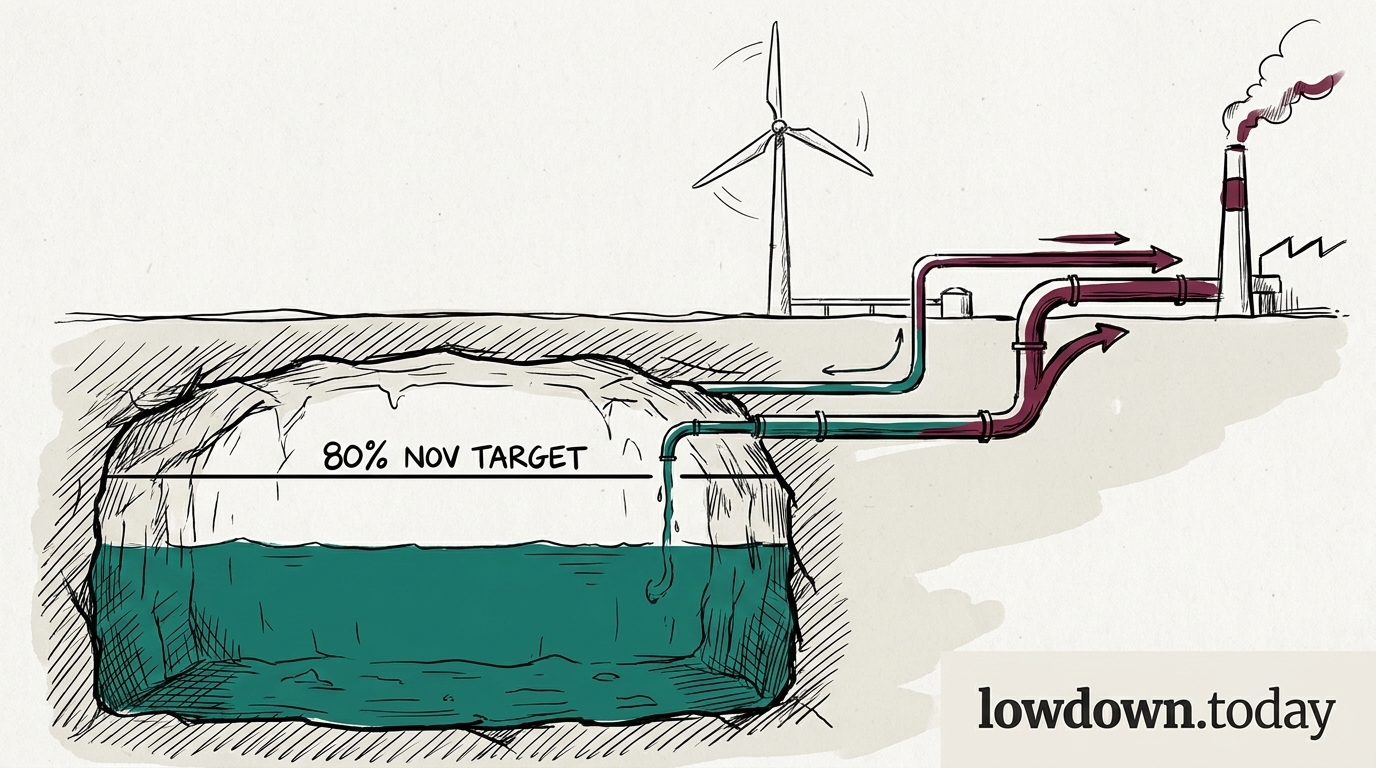
German caverns kept buying prompt gas at TTF near EUR 58-60 through the inversion; the wind collapse to 2.4 GW then flipped the spark spread to plus EUR 29 and put turbines back in the same queue. Every day turbines win that bid, injection at a third of the 877 GWh/day pace needed falls further behind.
Slovakia
Slovakia
Slovakia says it dropped its hold-out on the 21st sanctions package only after Ursula von der Leyen personally signed written gas-price and supply guarantees. The Council of the European Union's own 17,238-character release on the package names neither Slovakia nor any guarantee, leaving Bratislava's account unconfirmed by the institutional record.



