Skip to content
You can now search across every topic, entity and event.What's new
European Energy Markets
31JUL

ORG brands UK tech dependency a risk

4 min read
09:44UTC

The Open Rights Group published 'Tech Giants and Giant Slayers' on 15 April, branding Britain's decade of US-tech dependency a national security vulnerability. It cites a CMA estimate that the UK wastes £500m a year on cloud lock-in alone.

EconomicDeveloping
Key takeaway

The CMA figure means the entire Sovereign AI Fund is being burned every year on cloud lock-in alone.

The Open Rights Group published "Tech Giants and Giant Slayers" on 15 April 2026, arguing Britain's decade of US-tech dependency is a national security vulnerability 1. The report cites a Competition and Markets Authority (CMA) estimate that the UK wastes £500m a year on cloud services due to lock-in, switching barriers and project overruns 1. It flags the US CLOUD Act, the US federal law requiring disclosure of overseas data held by US-headquartered companies, as a mechanism that can compel UK data disclosure without UK consent, and points to Microsoft's documented shutdown of email services for individuals hit by ICC-related sanctions as concrete precedent 1. Palantir contracts, the report adds, are expanding rather than shrinking 1.

The CMA figure sits awkwardly next to the Sovereign AI Fund . In budget terms, the annual cloud waste matches the entire fund spent every year on lock-in alone, yet DSIT has not matched it with a single cloud-layer instrument. The CMA cloud investigation closed in July 2025 without DMA-equivalent enforcement powers, leaving the exposure untouched. Britain is solving the model layer at the margin while the cloud layer still bleeds at scale.

The CLOUD Act flag shifts the framing from commercial efficiency to legal exposure. ICC-sanctioned individuals losing Microsoft email access is not a hypothetical: it is precedent that a US statute can reach UK users through the infrastructure they already use, regardless of where the data sits. The report treats this as an analogue of the EU-level Draghi Report's 11.2% implementation rate after one year : stated ambition without the matching legal instrument. Britain is building a national champion upstairs and leaving the front door open downstairs.


Deep Analysis

In plain English

The Open Rights Group is a British digital rights organisation. In April 2026 it published a report arguing that Britain's dependence on American technology companies carries national security consequences beyond commercial inefficiency. The core of the argument: a US law called the CLOUD Act means American companies can be ordered by US courts to hand over data they hold on behalf of British customers, including government data, without UK courts being involved. The ORG cites Microsoft shutting down email accounts for people sanctioned by the International Criminal Court as a real-world example where US law reached into British infrastructure and cut off services. The Competition and Markets Authority (the UK's competition regulator) estimates that Britain wastes £500m a year on cloud services purely because of the difficulty of switching providers. The report argues that building a domestic AI sector while leaving this dependency unaddressed is building on a compromised foundation.

First Reported In

Update #2 · Brussels buys, Britain backs, Google unlocks

The Register / Open Rights Group· 19 Apr 2026
Read original
Causes and effects
This Event
ORG brands UK tech dependency a risk
The report puts a number on the cloud-layer gap the UK's sovereign AI strategy leaves untouched, and flags the US CLOUD Act as a legal mechanism that can compel UK data disclosure without UK consent.
Different Perspectives
Spain's LNG terminal operators
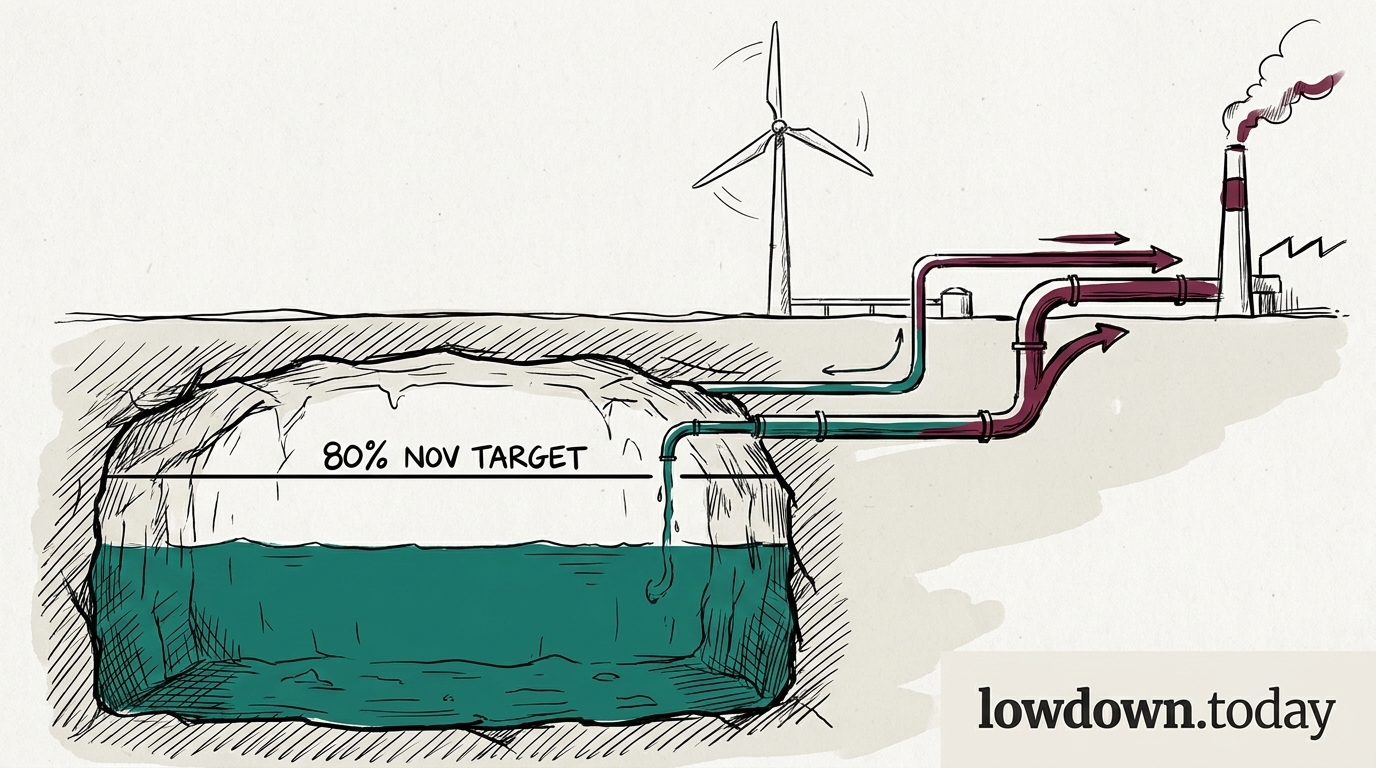
Spain's 9,145 GWh terminal inventory is the largest single stock in the EU LNG network, an option value that can reroute cargoes wherever the winter strip pays best rather than a cavern gas obligation tied to a fixed date. That flexibility matters more as Germany's cavern shortfall pushes more of the winter security question onto import infrastructure.
European Commission
European Commission
Brussels holds the bloc to 90% on a flexible window while Germany, holding roughly a quarter of EU storage capacity, tracks toward missing its own lower 80% figure by 21 points. A national shortfall this size in the anchor market matters more to bloc security than the flexible timetable alone can absorb.
French power exporters and CRE
French day-ahead rose in step with Germany but by less, reopening a EUR 7-17 premium that makes northward export flows commercially attractive again after the EUR 43.09 discount evaporated in days. CRE separately authorised RTE and Enedis to buy flexibility locally, betting the coming winter's binding constraint is grid congestion rather than a shortage of firm capacity.
TTF trading desk
TTF trading desk
A visible national shortfall like Germany's 21-point gap is a directional signal, not noise, for a desk holding the summer-winter spread. TTF's flat EUR 58-60 range through this week's German price swings says the market has not yet chosen to reprice refill risk into the front of the curve.
German cavern and CCGT operators
German caverns kept buying prompt gas at TTF near EUR 58-60 through the inversion; the wind collapse to 2.4 GW then flipped the spark spread to plus EUR 29 and put turbines back in the same queue. Every day turbines win that bid, injection at a third of the 877 GWh/day pace needed falls further behind.
Slovakia
Slovakia
Slovakia says it dropped its hold-out on the 21st sanctions package only after Ursula von der Leyen personally signed written gas-price and supply guarantees. The Council of the European Union's own 17,238-character release on the package names neither Slovakia nor any guarantee, leaving Bratislava's account unconfirmed by the institutional record.



