Skip to content
You can now search across every topic, entity and event.What's new
European Energy Markets
31JUL

OpenAI takes first permanent London base

3 min read
09:44UTC

OpenAI confirmed on 13 April it was moving to its first permanent London base, with room to more than double local headcount. The announcement landed days before Britain launched domestic alternatives designed to reduce dependence on its models.

EconomicDeveloping
Key takeaway

Britain is funding domestic alternatives to OpenAI while clearing visas that help OpenAI scale in the same city.

OpenAI confirmed on 13 April 2026 that it was moving to its first permanent London office, with capacity to more than double local headcount 1. The move landed days before the UK Sovereign AI Fund named Cosine and five other domestic firms as its first investees, a portfolio explicitly framed around reducing British dependence on frontier US AI models.

DSIT is writing equity cheques and allocating Isambard-AI GPU hours to firms whose pitch decks cite independence from American frontier models. The Home Office and Treasury are clearing same-day visas and real estate approvals that help OpenAI scale from its King's Cross base. Both tracks recruit from the same global AI talent pool, and neither department has publicly addressed the contradiction.

Cosine's positioning, that Britain should be building its own AI rather than renting it, sits awkwardly alongside OpenAI's London expansion on any reading. The UK version of that choice is currently to welcome both and bet that domestic talent density will rise faster than OpenAI can hire it away.


Deep Analysis

In plain English

OpenAI is the American company that makes ChatGPT. In April 2026 it moved into its first permanent London office, at a site large enough to employ at least double its current British headcount. London matters geopolitically because Britain is not part of the European Union's regulatory framework. British-based employees are not covered by the EU's AI Act and its forthcoming enforcement regime. Britain is also simultaneously spending £500m trying to build domestic AI companies that would reduce dependence on OpenAI. The irony is that both things are happening at the same time: the government is backing domestic AI firms to compete with OpenAI while also providing the visa approvals and infrastructure access that allow OpenAI to scale in the same city.

What could happen next?
  • Risk

    OpenAI's permanent London presence allows it to recruit from the same UK AI talent pool that DSIT is trying to retain for sovereign AI investees, potentially accelerating the talent drain the Sovereign AI Fund was designed to arrest.

  • Consequence

    A well-staffed London operation allows OpenAI to engage with UK government procurement pipelines and bid for public AI contracts that DSIT's fund aims to reserve for domestic alternatives, absent explicit procurement restrictions.

First Reported In

Update #2 · Brussels buys, Britain backs, Google unlocks

Tech.eu· 19 Apr 2026
Read original
Different Perspectives
Spain's LNG terminal operators
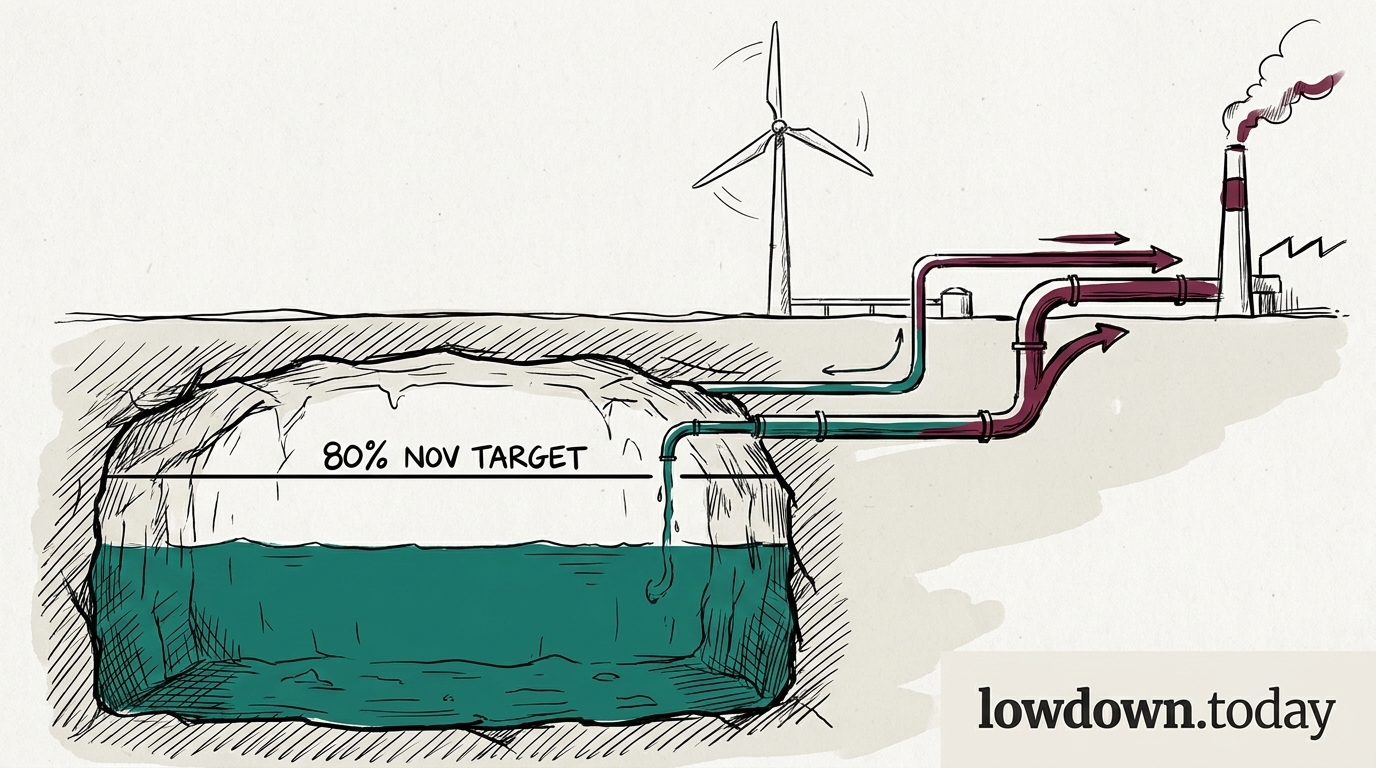
Spain's 9,145 GWh terminal inventory is the largest single stock in the EU LNG network, an option value that can reroute cargoes wherever the winter strip pays best rather than a cavern gas obligation tied to a fixed date. That flexibility matters more as Germany's cavern shortfall pushes more of the winter security question onto import infrastructure.
European Commission
European Commission
Brussels holds the bloc to 90% on a flexible window while Germany, holding roughly a quarter of EU storage capacity, tracks toward missing its own lower 80% figure by 21 points. A national shortfall this size in the anchor market matters more to bloc security than the flexible timetable alone can absorb.
French power exporters and CRE
French day-ahead rose in step with Germany but by less, reopening a EUR 7-17 premium that makes northward export flows commercially attractive again after the EUR 43.09 discount evaporated in days. CRE separately authorised RTE and Enedis to buy flexibility locally, betting the coming winter's binding constraint is grid congestion rather than a shortage of firm capacity.
TTF trading desk
TTF trading desk
A visible national shortfall like Germany's 21-point gap is a directional signal, not noise, for a desk holding the summer-winter spread. TTF's flat EUR 58-60 range through this week's German price swings says the market has not yet chosen to reprice refill risk into the front of the curve.
German cavern and CCGT operators
German caverns kept buying prompt gas at TTF near EUR 58-60 through the inversion; the wind collapse to 2.4 GW then flipped the spark spread to plus EUR 29 and put turbines back in the same queue. Every day turbines win that bid, injection at a third of the 877 GWh/day pace needed falls further behind.
Slovakia
Slovakia
Slovakia says it dropped its hold-out on the 21st sanctions package only after Ursula von der Leyen personally signed written gas-price and supply guarantees. The Council of the European Union's own 17,238-character release on the package names neither Slovakia nor any guarantee, leaving Bratislava's account unconfirmed by the institutional record.



